
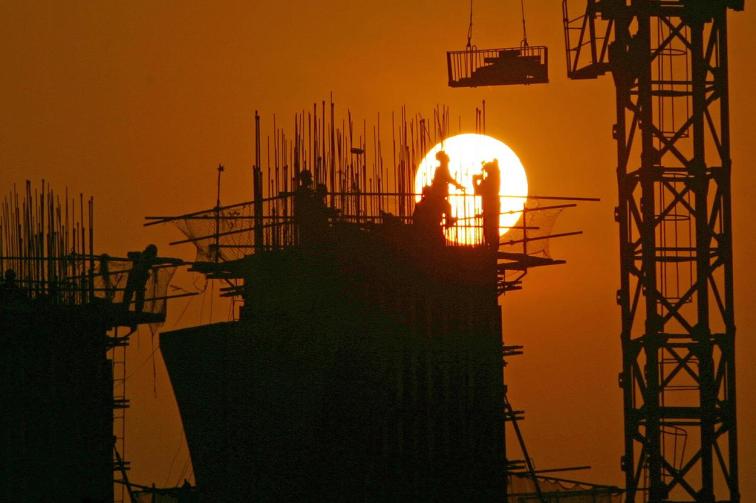
Illustration: China's economy continues to decline. (Photo by China Photos/Getty Images)
[People News] On September 15, 2026, the National Bureau of Statistics released the economic performance report for August: the added value of industrial enterprises above designated size increased by 5.2% year-on-year, accelerating by 0.7 percentage points from the previous month, and was 'higher than market expectations'; the total value of goods imports and exports rose by 19.8% year-on-year; high-tech manufacturing grew by 16.7%, and equipment manufacturing increased by 12.1%; the Consumer Price Index (CPI) rose by 0.8%, while the Producer Price Index (PPI) increased by 3.8%.
Spokesperson Fu Linghui opened with the phrase 'three stabilizations and two accelerations': stable production, stable employment, stable prices, rapid growth in emerging industries, and rapid growth in imports and exports. However, the tone quickly shifted, noting that the adverse effects of the external environment have deepened, the contradiction between strong supply and weak demand domestically is prominent, and some enterprises are facing operational difficulties, indicating that the foundation still needs to be consolidated.
The spokesperson of the National Bureau of Statistics resembled a poor merchant on Pinduoduo, who, when shipping goods, first layers the good fruits on top, hiding the bad ones underneath. This was followed by the classic statement: the world economy faces downward pressure on growth, and many countries are making difficult choices in promoting growth, controlling inflation, and stabilizing markets. China's fixed asset investment has declined, and international energy fluctuations have impacted the economy; these issues and challenges are 'mostly temporary and phase-specific, and can be overcome with effort.'
In areas where the data appears unfavorable, the blame is first shifted to the international environment. While industry and exports remain resilient, consumption and investment have deteriorated to the point where it is challenging to present them positively, necessitating an urgent 'alignment with international standards,' as many countries are also facing difficult choices.
The consumer sector is experiencing a significant downturn. In August, the total retail sales of consumer goods rose by just 0.4% year-on-year, a decrease from July's 0.6% and below the market forecast of 0.8%. From January to August, the cumulative total retail sales of consumer goods increased by only 1.1% year-on-year, with retail sales of consumer goods and services growing by 2.5% year-on-year. Specifically, service retail grew by 4.9%, while goods retail only increased by 1.0%. Urban retail is nearly stagnant, and rural areas are similarly struggling.
The public is short on cash, hesitant to spend, and unwilling to part with their money, a situation that cannot be masked by the official narrative of 'seasonal' or 'policy effects emerging.' Despite prolonged stimulus measures such as trade-ins and equipment upgrades, goods retail remains in a poor state, indicating that domestic demand is exceptionally weak. The authorities have reluctantly turned to service retail as a façade; while sectors like telecommunications, tourism, and cultural and recreational services are experiencing rapid growth, this may sound appealing, but once the surface is stripped away, the underlying reality is revealed. Consumer goods consumption is the essential foundation for broader employment and industrial chains.
The investment landscape is even more troubling. From January to August, national fixed asset investment (excluding rural households) fell by 7.2% year-on-year, and even after excluding real estate development, it still declined by 4.2%. Investment in real estate development saw a drastic drop of 19.9%. Private investment decreased by 10.1%, although the purchase of equipment and tools showed some positive growth; construction and installation projects experienced a significant downturn. Investment in the Northeast region plummeted by 25.5%, with both the eastern and western central regions facing considerable pressure. The official explanation attributes this to extreme weather conditions, including high temperatures, typhoons, and floods affecting construction, with companies exercising caution in their investment decisions during the transition from old to new growth drivers.
The core issue is that the real estate sector, once a powerhouse of growth, has come to a complete halt. This has led to the collapse of land finance and related industrial chains that local governments heavily depend on, resulting in a significant reduction in infrastructure investment.
Employment and prices are also failing to show any improvement. In August, the urban survey unemployment rate climbed to 5.3%, marking a 0.1 percentage point increase from the previous month. The government quickly attributed this rise to the 'seasonal impact of new graduates entering the labor market' and highlighted that the unemployment rate for the key demographic aged 30-59 remained unchanged at 3.9%. Data on youth unemployment will not be released until later this month, and historically, when the figures are unfavorable, they tend to be delayed or adjusted. While the manufacturing sector is reported to be 'overall stable', with growth in the information software services and expansion in accommodation and catering, these claims often serve as mere cosmetic enhancements to the economic narrative. In reality, many young people prefer to deliver food, engage in live streaming, or adopt a 'lying flat' lifestyle rather than work in factories or find suitable jobs. The average weekly working hours stand at 48.2 hours, which sounds productive, but in truth, many are working overtime to secure their positions or juggling multiple jobs, and the authorities are hesitant to disclose the actual hourly wage.
Industrial data has become the only facade to cover the economic downturn. With a growth rate of 5.2%, high-tech industries growing at 16.7%, the electronics sector at 17.2%, and an astonishing 101.5% surge in integrated circuit manufacturing, these figures can be broken down: mining has seen a decline of 1.4%, and some traditional industries continue to contract, with total automobile production also falling. Domestic demand is not keeping pace, forcing production capacity to be exported. While the government claims that new growth drivers contribute over 50% or even 60%, they simultaneously acknowledge that supply is strong while demand is weak, indicating that the economy has deteriorated to the point of resorting to misleading rhetoric.
Fu Linghui's blame-shifting rhetoric centers on 'relativization' and 'externalization', framing the consumption fatigue, investment collapse, real estate crisis, youth employment challenges, and local debt pressures—stemming from the Chinese Communist Party's (CCP) policy errors and governmental incompetence—as merely 'part of a global common challenge'. Other nations are also grappling with growth and inflation issues; thus China's current state can be described as 'overall stable, progressing towards new and better outcomes'.
In recent years, the CCP has consistently highlighted concepts like 'internal circulation', 'expanding domestic demand', and 'common prosperity', yet these assertions have been repeatedly undermined by actual data. The imbalance of weak supply and strong demand is not a result of external factors; rather, it is a consequence of long-standing internal policy failures, distribution structures, expectation management, and institutional weaknesses. High savings rates, low income expectations, the fading wealth effect from real estate, lack of confidence in the private sector, and young people's uncertainty about the future are the core reasons hindering domestic demand growth. Blaming the international community is akin to a student who fails an exam yet shamelessly claims that the entire class is performing poorly.
The CCP always finds justifications; when the data is favorable, it touts 'China's contribution to the global growth engine' and 'institutional advantages'; conversely, when the data is unfavorable, it points to 'complex external environments', 'temporary difficulties', and 'similarities with other countries'. New phrases such as new momentum, high-quality development, and moving towards new and better outcomes are continually introduced, and they seem to take pleasure in this linguistic play.
Industry and exports can temporarily sustain themselves through subsidies, the integrity of the supply chain, and overseas demand, but consumption and investment are in continuous decline, showing no signs of recovery. The household sector's balance sheets are suffering, confidence is low, wealth distribution is skewed towards capital and specific industries, and social mobility is on the decline. While the National Bureau of Statistics can highlight impressive figures from high-tech sub-sectors to create a positive narrative, it cannot mask the stark reality of a persistent decline in overall investment, nearly stagnant retail growth, and a significant downturn in the real estate market.
The economic data for August is disappointing, further revealing the ongoing structural imbalances reflected in the statistics. The National Bureau of Statistics employs polished rhetoric, maintains consistent messaging, and adeptly shifts blame: 'Other countries are also facing difficulties,' implying that our challenges are not severe; the issues are temporary, so I see no institutional problems. This narrative, akin to celebrating a funeral, may maintain an appearance of stability, but it fails to address the deep-rooted issues and systemic failures.
The contradiction of strong supply and weak demand will not simply vanish with a statement that 'it can be overcome.' As consumption remains weak, investment continues to decline, youth employment pressures mount, and local finances become increasingly strained, blaming other countries may provide a temporary distraction, but it cannot conceal the grim reality of the economic landscape.
(First published by the People News)△







News magazine bootstrap themes!
I like this themes, fast loading and look profesional
Thank you Carlos!
You're welcome!
Please support me with give positive rating!
Yes Sure!