
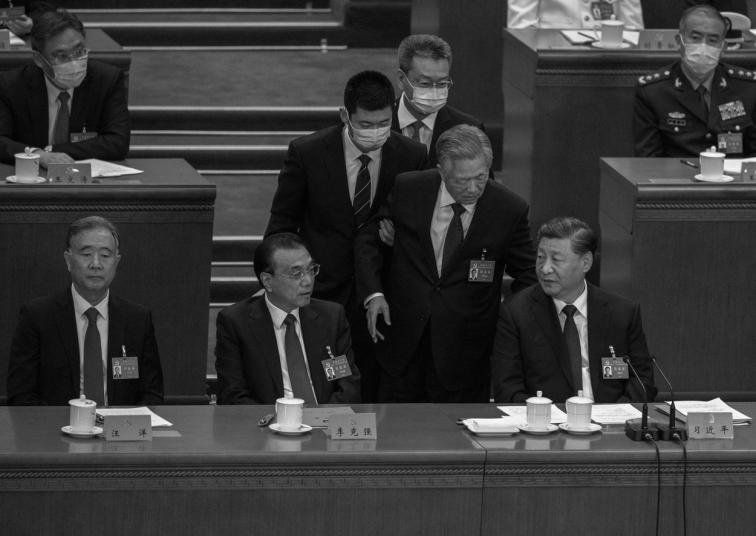
On October 22, 2022, during the closing ceremony of the 20th National Congress of the Communist Party of China, Xi Jinping ordered the removal of former President Hu Jintao from the venue. (Photo by Kevin Frayer/Getty Images)
[People News] On the evening of July 30, news circulated widely on the overseas internet that former Chinese Communist Party leader Hu Jintao, his wife Liu Yongqing, and their son Hu Haifeng had died from food poisoning. Numerous self-media outlets analyzed this information, including questioning the authenticity of a Weibo post by Qin Feng, the former director of Phoenix TV's Chinese channel, alleging that it was fabricated.
In my opinion, this news is highly likely to be false. For someone in a high position like Hu, the safety of the food they consume must be ensured. If the report were true, the poisoning could only have been intentional, with the instigator being someone in a high position. This would not only lead to accountability for many individuals but would also inevitably create significant turmoil within the Communist Party. Such consequences are something everyone must consider, especially given that the death of Li Keqiang was once disguised as a sudden heart attack to obscure the truth and silence criticism. If there were an intention to harm Hu Jintao, there would be no need to employ such clumsy tactics.
Following the spread of this news, it is reported that Qin Feng has clarified and denied the allegations to friends, emphasizing that his account was hacked. A question that the outside world needs to ponder is: why is such false information being released at this time, just before the Beidaihe meeting? Is it suggesting that Hu has already passed away, or is someone indicating that Hu and others are at risk? Or is it an attempt to confuse the external understanding of the Communist Party's dark politics?
In the history of the Communist Party, are there precedents of high officials being poisoned? Indeed, there are. Currently, the more notable cases include the poisoning incidents involving Wang Ming and Zhu De.
Wang Ming, an early leader of the Chinese Communist Party (CCP), previously served as the CCP's representative to the Comintern in Moscow. During the Yan'an Rectification Movement and following the establishment of the CCP's government, the party has consistently maintained a negative view of him, essentially depicting him as a cautionary example of dogmatism and opportunism. The CCP claims that he is widely seen as having committed serious 'leftist' adventurism errors between January 1931 and January 1935, which resulted in significant setbacks for the CCP's revolutionary efforts. Additionally, from 1937 to 1940, he was accused of making 'rightist capitulationism' errors towards the Kuomintang. In recent years, scholars have begun to reassess this perspective, prompting the question: how did Wang Ming himself understand these events?
In his later years, Wang Ming authored a book titled 'Fifty Years of the CCP,' in which he rejected the CCP's earlier claims. He shared his insights on Mao Zedong's actions during critical events, analyzed why the Rectification Movement served as a 'rehearsal' for the Cultural Revolution, and discussed Mao's 'lonely monk' fate. Notably, he also referenced instances where he felt he was deliberately harmed by Mao, a topic that is seldom addressed positively in the official party history.
According to Wang Ming, on October 4, 1941, he and Mao Zedong had an unusual disagreement after receiving a telegram from the Soviet Union. Wang Ming advocated for strengthening China's anti-Japanese efforts when Germany attacked the Soviet Union, arguing that this would prevent Japan from assisting Germany and thus support the Soviet Union; however, Mao opposed this view. During this period of contention, Wang Ming dined at Mao's residence almost daily. A few days later, he suffered from severe gastric hemorrhage, dizziness, and heart weakness. A doctor's diagnosis suggested he had been poisoned. By October 10, Wang Ming was too ill to get out of bed.
On October 14, Mao dispatched Li Fuchun, who was then the Central Secretary, and Fu Lianzhang, the Director of the Central Health Bureau, to take Wang Ming to the hospital, where Jin Maoyue was appointed as his attending physician.
In revelations from Wang Ming's book, he disclosed that during his hospitalization, Jin Maoyue gradually administered large doses of mercury-containing poison to harm him, which caused him to frequently lose consciousness. Wang Ming believed he was able to avoid death thanks to his wife, Meng Qingshu, who was caring for him in the hospital. After observing Wang Ming's unusual reactions to the medication, she stopped him from taking it and disposed of the drugs. Later, she grew suspicious and sought both traditional Chinese medicine and other Western medical opinions. It was during this period that Mao began the rectification movement in Yan'an and consolidated his power.
On August 13, 1942, Wang Ming was discharged from the hospital to recuperate at home, while Jin Maoyue continued to oversee his treatment. In January 1943, Wang Ming sent a telegram to Georgy Dimitrov of the Comintern through two Soviet journalists, reporting on the situation in Yan'an and Mao, and inquiring if he could be taken to Moscow for medical treatment. In early February, Wang Ming received a response agreeing to his trip to Moscow, which made Mao quite anxious.
On February 12, Jin Maoyue, acting on Mao's orders, delivered a large dose of mercuric chloride along with a mixture of sodium bicarbonate and magnesium sulfate for Wang Ming to take internally. On February 19, Jin Maoyue planned to administer an enema to Wang Ming. However, due to suspicions, Meng Qingshu consulted other doctors about the prescription, who confirmed that the medication was highly toxic and potentially lethal, and should not be taken at all. Consequently, Meng Qingshu formally accused Jin Maoyue of his wrongdoing to Mao and the Central Committee of the Communist Party. Faced with public outcry, Mao called in 12 doctors from various hospitals to conduct a joint examination of Wang Ming.
The doctors concluded, based on Jin Maoyue's prescription, the nurses' records, and their own assessments, that the dosages prescribed could indeed lead to poisoning or death. Eleven doctors signed the conclusion report. After the evaluation, Jin Maoyue rushed to Wang Ming's bedside, crying profusely, admitting that he was guilty and had poisoned Wang Ming, but claimed he was following the orders of Li Fuchun, asserting that as a new party member, he had to adhere to the party's directives. Before Wang Ming could respond, two soldiers burst in and took him away. Jin Maoyue was subsequently sentenced to five years in prison, but was later released by Mao and became his personal health doctor. After the founding of the People's Republic of China, he rose to a leadership position in the Ministry of Health.
In addition to the poisoning incident this time, Wang Ming also recounted that during the summers of 1948, 1953, and 1955, Mao Zedong repeatedly exploited Wang Ming's hospitalizations to poison him.
While there is no additional evidence to corroborate this account of Mao's poisoning of Wang Ming, Wang Ming's explanations, the evidence he provided, and Mao's notorious ruthlessness—including his later actions against other leaders of the Chinese Communist Party (CCP)—make it unsurprising that Mao would resort to such measures. Moreover, Jin Maoyue's subsequent denial lacks credibility as well. The only reason Mao sought to poison Wang Ming was to liberate himself from the constraints imposed by the Communist International, establish his own ideology of Mao Zedong Thought, and seize the highest authority within the CCP. On his ascent to power, Mao would eliminate any obstacles in his way, whether they were Wang Ming, Gao Gang, Liu Shaoqi, Peng Dehuai, Lin Biao, or others.
Now, let’s turn to another high-ranking CCP official suspected of being poisoned, Zhu De. In the annals of CCP history, the term 'Zhu Mao' refers to Zhu De, who is recognized as one of the principal architects and leaders of the CCP army and the CCP state. He was also one of the early leaders of the CCP, holding qualifications and prestige that surpassed those of Mao in the early military ranks of the CCP.
Following Zhou Enlai's death in January 1976, Zhu De's health further declined. Official records indicate that on June 21, he unexpectedly caught a cold. By July 1, his condition had deteriorated significantly. He suffered from a persistent high fever, pneumonia, gastroenteritis, kidney disease, heart failure, diabetes, and various other ailments, making it extremely difficult for him to speak. On the 6th, Zhu De passed away at the age of 90.
In the 7th issue of 'Together We Advance' published in 2012, an oral history interview by Zhou Haibin with Zhao Liping, the wife of Zhu De's only son Zhu Qi, who is over eighty years old, suggests that Zhu De may have been intentionally harmed due to delays in his medical treatment.
Zhao Liping recalls that after Zhu De and Kang Keqing returned to Beijing in 1970, they resided at 'New Six' on Wanshou Road and never returned to their home in Zhongnanhai. With all of Zhu De's secretaries dismissed or purged, the Communist Party assigned new staff to assist him.
During Zhao Liping and Zhu Qi's first visit to 'New Six', they brought several big-character posters to show. As they began to say, 'When you were in Guangdong, I heard that…' Kang Keqing quickly gestured for them to stop, pointed under the table, and whispered to Zhao Liping, 'Don't say anymore, it's not good to say too much.' It was then that Zhao Liping realized her concern about the house possibly being bugged. What exactly was the Communist Party trying to eavesdrop on?
On June 21, 1976, Zhu De was scheduled to meet with foreign guests. However, due to a delay in the meeting and no one informing him, he sat in the air-conditioned Great Hall for nearly an hour. Shortly after returning home, he began to feel unwell and caught a cold. The Central Committee of the Communist Party specifically formed a medical team for Zhu De. On one occasion, Kang Keqing overheard a member of the medical team, then Minister of Health Liu Xiangping, asking the supervising doctor, 'How much longer can we delay?' The doctor responded that they were currently in the process of resuscitation, and the situation was not looking good.
Zhao Liping's daughter is a doctor. She informed her grandmother, Kang Keqing, that the injection Zhu De was currently receiving might be detrimental and could worsen his condition. Kang Keqing then inquired with the doctor about the possibility of changing the medication, but they dismissed her concerns, stating it was the opinion of an expert group. Shortly thereafter, Zhu De passed away.
In a revelation by overseas scholar Chen Pokong in his book 'The Thick Black Theory of Zhongnanhai', it was reported that on the night of a meeting with foreign guests, Zhu De suddenly fell gravely ill and was rushed to receive medical attention. According to standard procedure, the attending physician was required to retrieve Zhu De's medical records from the Central Health Bureau; however, due to the urgency of the situation, they were unable to access the records. It was later discovered that two days prior, Zhu De's medical records had mysteriously disappeared.
Zhu De's health deteriorated day by day, and he ultimately succumbed after more than ten days of ineffective treatment. Following his death, the Zhu family sensed something suspicious and requested an investigation, only to find out that the attending physician who had treated Zhu De had also died unexpectedly. Zhu De's wife, Kang Keqing, later remarked to others: 'As long as Wang Dongxing remains silent, the truth will never come to light.' Wang Dongxing was a close confidant of Mao and served as the director of the Central Security Bureau at the time. The Zhu family suggested that Zhu De may have been murdered.
Additionally, the Hong Kong media's assertion of 'poisoning to silence' was even more shocking. Reports indicated that at Zhu De's memorial service, there was a strict rule prohibiting anyone from lifting the party flag that covered his body. At that time, everyone, including Zhu De's relatives and friends, adhered to this 'iron discipline', except for General Pi Dingjun, the commander of the Fuzhou Military Region, who violated the rule. Consequently, when Zhu De's body was revealed, it showed a charred face, and even his exposed hands were blackened, indicating classic signs of poisoning. The following day, Pi Dingjun died in a plane crash.
Was it possible for Wang Ming and Zhu De to be poisoned or delayed in receiving treatment at that time? The author believes there is a high likelihood, largely due to their connection with Mao. However, in the current context, where there is a lack of genuinely deterrent leaders within the Chinese Communist Party, the risk of a similar poisoning incident is significantly heightened. Even if such an event were to occur, it would likely be obscured by other illnesses, such as that of Li Keqiang. The real question that warrants investigation is why Hu Jintao and his family of three were 'poisoned.'
(First published in the People News) △



News magazine bootstrap themes!
I like this themes, fast loading and look profesional
Thank you Carlos!
You're welcome!
Please support me with give positive rating!
Yes Sure!