
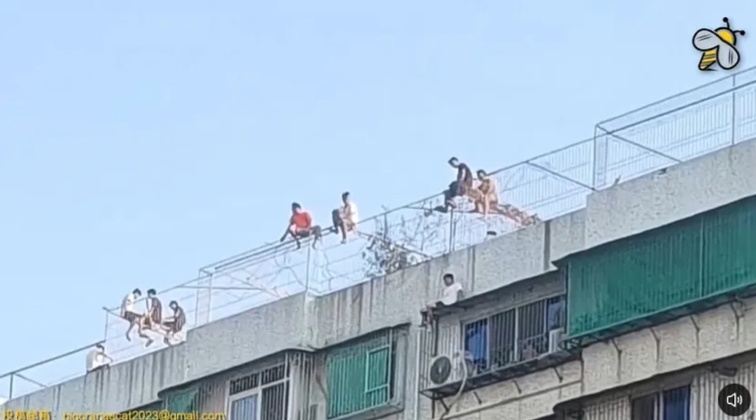
On October 21, nine construction workers in Shantou, Guangdong, climbed to the rooftop of a residential building to demand their unpaid wages. (Screenshot from "X" @YesterdayBigcat)
[People News] Are Chinese workers truly on the verge of rebellion? The latest report from the American organisation "Freedom House" reveals that in the third quarter of this year, the number of dissent and protest events across China increased compared to the previous quarter, with workers being the predominant group involved, followed by homeowners and farmers. Guangdong, the wealthiest province in China, witnessed the highest number of protest incidents.
As reported by Newtalk News Network, "Freedom House" released the 13th issue of the "China Dissent Monitor" (CDM) on the 2nd, indicating that from July to September 2026 (the third quarter), a total of 948 dissent and protest events were recorded nationwide, marking an increase from the previous quarter but a 33% decrease compared to the same period in 2025. The report attributes the year-on-year decline to increased censorship, suggesting it may not accurately reflect the actual situation.
The analysis in the report shows that protests led by workers constitute the highest proportion of dissent events, reaching 44%, followed by homeowners at 27% and rural residents at 9%. Guangdong province accounted for approximately 13% of the protests this quarter, followed by Henan, Shaanxi, Hebei, and Shandong. Since June 2022, the CDM has recorded a total of 16,845 dissent events.
The report highlights the issues of land expropriation and forced relocation, noting that since June 2022, there have been over 1,100 related protests. These protests involve rural and urban residents demanding the cancellation of land requisition, obstructing demolitions, or seeking resettlement compensation. Such protests have seen a significant increase in recent years, with an estimated fivefold rise from 2023 to 2025, occurring across 31 regions. This trend reflects ongoing conflicts driven by local governments' dependence on income from land transfers. Additionally, the issue of unpaid wages for workers is prominent, with construction sites accounting for 52.8% of worker protests, which is significantly higher than the construction industry's share of non-agricultural employment. The seasonal rise in wage protests seems to have emerged earlier, with labour protests in the third quarter comprising 45.2% of all offline incidents, surpassing the 38.2% recorded in the same period of 2025.
The report indicates that 'threatening to jump off a building' is one of the more provocative tactics used in worker protests, accounting for about 2.4% in the third quarter. However, analysis reveals that the frequency of this strategy has increased over the past three years at private construction sites, possibly reflecting the ongoing deterioration in relations between private developers and the real estate industry. State-owned construction companies have also become frequent targets of protests, with China State Construction Engineering Corporation facing the most protests this quarter. Factory protests are particularly notable in coastal provinces such as Zhejiang, Jiangsu, Guangdong, and Fujian.
Top site choice: Are you not optimistic about Li Sichuan? Hou Youyi unexpectedly demoted the deputy mayor to deputy secretary-general, leading to speculation. The New Taipei City government has responded.
The 'China Dissent Monitor' gathers data from various sources, including news reports, civil society organisations, and social media within China, employing machine learning to aid in the collection process. The report highlights that, despite heightened censorship efforts, the public continues to voice their dissatisfaction regarding issues such as land rights, wages, and resettlement through public demonstrations. △






News magazine bootstrap themes!
I like this themes, fast loading and look profesional
Thank you Carlos!
You're welcome!
Please support me with give positive rating!
Yes Sure!