

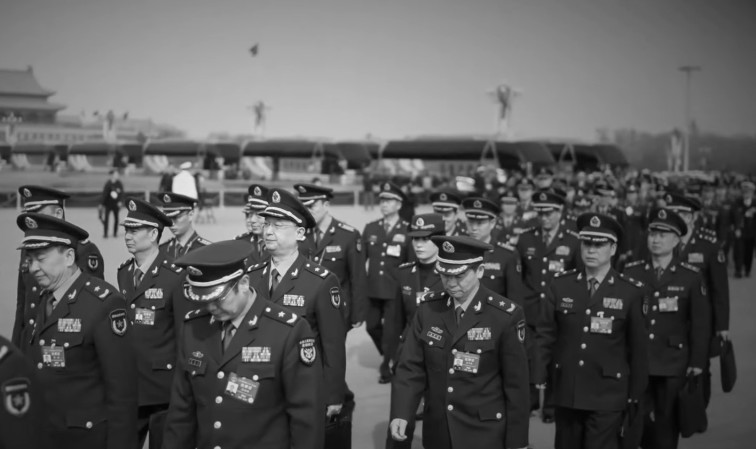
The Central Military Commission of the Communist Party of China originally consisted of 7 members, but now only Xi Jinping and Zhang Shengmin remain. (Video screenshot)
[People News] The Fifth Plenary Session of the Communist Party of China (CPC) concluded on October 29 in Beijing, with Zhang Shengmin being recognised as the biggest winner.
The official communiqué released after the meeting revealed that the plenary session approved a decision on 'comprehensively and strictly governing the Party' and elected Zhang Shengmin, Vice Chairman of the Central Military Commission, as a member of the Central Political Bureau.
Zhang Shengmin was appointed as Vice Chairman of the Central Military Commission on October 23, 2025, during the Fourth Plenary Session of the 20th CPC National Congress. However, he did not enter the Political Bureau at that time, in accordance with CPC conventions. After a full year, he has finally been promoted to a member of the Political Bureau, indicating that Xi Jinping is satisfied with Zhang's performance over the past year.
So, does Zhang Shengmin's entry into the Political Bureau guarantee his absolute safety, ensuring he won't meet the same fate as Zhang Youxia and He Weidong?
I believe we cannot conclude that he has achieved absolute safety based solely on this.
More accurately, this promotion suggests that Xi Jinping still trusts Zhang Shengmin and is willing to further elevate his political status. However, in the power structure dominated by Xi Jinping, receiving a promotion to the highest levels does not equate to obtaining permanent political protection.
What distinguishes Zhang Shengmin is that he is not only the Vice Chairman of the Military Commission but also remains at the core of power and has received further promotion after the recent troubles faced by high-ranking military officials such as Zhang Youxia, He Weidong, and Miao Hua. This sets him apart from other senior generals who have been promoted.
However, to determine whether he is truly safe, several issues need to be examined separately.
1. Why has Zhang Shengmin become the biggest winner of the Fifth Plenary Session?
I believe there are at least three reasons.
First, he played a significant role in the military purge.
Zhang Shengmin has been involved in political work within the military for a long time and has served as the Secretary of the Central Military Commission's Discipline Inspection Commission since 2017, while also acting as the Deputy Secretary of the Central Commission for Discipline Inspection. His experience has made him well-acquainted with the military's internal disciplinary oversight system.
During this round of military rectification, his position is particularly unique, as he is one of the military commission leaders responsible for conducting relevant investigations. Following the investigations of Zhang Youxia and Liu Zhenli, he became the only general among the military commission members to retain his position.
In other words, he is not only a survivor of the purge but also a key executor of the purge actions.
Second, he has demonstrated his political reliability to Xi Jinping.
A key difference between Zhang Shengmin and figures like Zhang Youxia, He Weidong, and Miao Hua is his background in political work and discipline inspection.
Zhang Youxia embodies the traditional military system of qualifications, achievements, and connections, while He Weidong and Miao Hua are significant figures promoted by Xi Jinping within the military. Zhang Shengmin's strength lies in the fact that his power base is rooted more in the disciplinary oversight system than in a vast network of military generals.
For Xi Jinping, in an environment where trust among senior military leaders is lacking, having a vice chairman of the military commission who can carry out rectification tasks without a clearly defined independent military faction is clearly of special value.
Third, Xi Jinping needs someone who can represent the military in the Politburo.
Before Zhang Youxia's downfall, there were Politburo members among the vice chairmen of the military commission, including He Weidong. With both of these individuals now out of the picture, there is a gap in military representation within the Politburo.
Zhang Shengmin's recent entry into the Political Bureau serves as both a political reward for him and a reorganisation of the military's top leadership.
2. Entering the Political Bureau: Why can't Zhang Shengmin ensure his safety?
There is a significant historical and contemporary contrast to consider:
The political position that Zhang Shengmin has now attained is exactly the same as that once held by Zhang Youxia and He Weidong.
Zhang Youxia, who is not only a member of the Political Bureau but also the Vice Chairman of the Central Military Commission, ranks among the highest leaders in the Chinese Communist Party. However, this status did not shield him from investigation and expulsion from the Party.
Similarly, He Weidong, also a member of the Political Bureau and Vice Chairman of the Military Commission, was not spared either.
Miao Hua, while not a member of the Political Bureau, serves as a member of the Central Military Commission and the Director of the Political Work Department. He is a senior general promoted by Xi Jinping, yet he too ultimately fell from favour.
This illustrates that within Xi Jinping's power structure, an official's rank, position, and even their previous trustworthiness do not provide a reliable guarantee of political safety. In fact, it can be argued that the more power an official wields and the more resources they control, the more likely they are to become a target of Xi Jinping's scrutiny.
Zhang Shengmin's entry into the Political Bureau signifies an elevation in his political status, but it also entails greater responsibilities.
If the military's reform yields positive results, Xi Jinping can credit Zhang's loyalty and execution; however, if issues arise post-reform, or if there are serious problems with the military's combat readiness, command structure, or equipment development, Zhang may find himself held accountable.
This encapsulates the dual nature of Zhang Shengmin's political future.
3. What are the potential sources of Zhang Shengmin's greatest risks in the future?
I believe there are three potential risks.
1. From Anti-Corruption Enforcer to Subject of Investigation
Zhang Shengmin, who previously held the position of Secretary of the Military Commission's Discipline Inspection Commission, was involved in internal disciplinary oversight and investigations within the military. His role likely exposed him to numerous political, economic, and personnel issues concerning senior generals. This background serves as both his political asset and a potential liability.
Should the military's anti-corruption campaign continue to intensify, investigations may extend to former investigators, enforcers, and related personnel arrangements.
At present, however, there is no evidence suggesting that Zhang Shengmin himself is involved in any disciplinary or legal violations.
2. Xi Jinping's Distrust of the Military Will Not Vanish with a Single Promotion
This is, in my view, the most significant factor.
Xi Jinping's campaign to reform the military ostensibly aims to combat corruption and reinforce the accountability of the Chairman of the Military Commission, but at a deeper level, it reflects a demand for absolute loyalty to the military.
The challenge lies in the fact that loyalty cannot be permanently established through a single political gesture.
Currently, Zhang Shengmin may be trusted because he has acted in accordance with Xi Jinping's directives; however, if he were to gain excessive control over military personnel and disciplinary inspections, thereby establishing his own influence, would Xi Jinping still feel secure?
This situation illustrates a fundamental paradox within a highly centralised authoritarian system: leaders require capable aides but are wary of those aides developing an independent power base.
3. The Burden of Military Purges May Ultimately Fall on Him
The scale of this latest military reform initiative has been quite remarkable.
According to the communiqué from the Fifth Plenary Session and related reports, the meeting confirmed disciplinary actions against 16 military personnel, including Zhang Youxia and Liu Zhenli. Prior to this, individuals such as He Weidong and Miao Hua had also faced disciplinary measures.
However, the removal of senior generals does not necessarily resolve the military's issues. If the purge results in prolonged vacancies in senior command positions, fosters a climate of fear within the military, and discourages officials from taking responsibility—potentially impacting combat readiness and operational capabilities—then Zhang Shengmin, who oversees military discipline, will find it challenging to completely detach himself from the situation.
In other words, he could emerge as a beneficiary of this purge, but he may also bear responsibility for its consequences in the future.
Fourth, the most pressing question is: Will Zhang Shengmin become the next Wang Qishan?
This question is quite intriguing.
Wang Qishan was once a key figure in Xi Jinping's anti-corruption campaign. After Xi Jinping assumed power in 2012, Wang Qishan took on the role of Secretary of the Central Commission for Discipline Inspection, leading a significant anti-corruption initiative that enabled Xi to eliminate many political rivals.
However, at the 19th National Congress in 2017, Wang Qishan stepped down from his position as Secretary of the Central Commission for Discipline Inspection. Although he later became Vice President of the State, he gradually receded from the inner circle of power.
While the circumstances of the two are not entirely comparable, there is one notable aspect to consider:
In Xi Jinping's power structure, the political value of the anti-corruption operator often hinges on their ability to continually fulfil Xi's political requirements.
When they can assist Xi Jinping in removing potential threats, they are seen as indispensable; however, once their mission is accomplished, or if their influence begins to raise concerns, their status may shift.
What Zhang Shengmin faces now is, to some extent, a reflection of this very issue.
However, I believe there is a significant difference between him and Wang Qishan: while Wang Qishan is primarily the architect of anti-corruption efforts within the party, Zhang Shengmin is directly embedded in the military power structure. Given that the military controls armed forces, Xi Jinping's trust in military leaders may be more sensitive than his trust in general party and government officials.
5. Four Signals to Monitor Zhang Shengmin's Future
I recommend focusing on the following key observations:
1. Whether the Military Commission will appoint new vice-chairmen and members. If Zhang Shengmin remains the only military commission leader to retain his position long-term aside from Xi Jinping, his power and responsibilities may become even more concentrated.
2. Whether Zhang Shengmin continues to wield influence over military discipline inspections and personnel matters. If he transitions from being an anti-corruption enforcer to a comprehensive military manager, his political standing may further solidify, but this concentration of power could also lead to increased suspicion.
3. Whether there are changes in his public engagements and political treatment, particularly regarding significant military meetings, personnel appointments and dismissals, and his role in Politburo meetings.
4. Whether military officials associated with him begin to face investigations. If the scope of purges gradually extends to his team, this would be a critical signal to watch closely.
In summary, I tend to believe that Zhang Shengmin's political security has significantly improved in the short term, but risks remain in the medium to long term.
This promotion at least suggests that Xi Jinping currently has no plans to purge him, but rather needs him to continue to play a role.
However, is Zhang Shengmin ultimately a stabiliser following Xi Jinping's military purge, or could he become a casualty in the next round of power struggles?
This will depend on how Xi Jinping perceives military power.
If Xi Jinping views Zhang Shengmin as a reliable aide capable of helping him control the military, then Zhang's position may continue to ascend.
Conversely, if Xi Jinping perceives that Zhang Shengmin is gradually establishing his own power base, or that someone must take responsibility for the repercussions of the military's purges, then the titles of Politburo member and Vice Chairman of the Central Military Commission may not offer him adequate protection.
I believe that Xi Jinping's recent appointment of Zhang Shengmin to the Politburo sends an important signal: he is trying to create a military leadership system that does not depend on traditional military power factions, but instead relies on personal loyalty and discipline.
However, this system has a fundamental flaw: everyone must demonstrate their loyalty to the supreme leader, yet the supreme leader cannot genuinely trust anyone's loyalty.
This could be the most significant uncertainty in Zhang Shengmin's political future.
From this angle, while Zhang Shengmin is the biggest winner of the Fifth Plenary Session, he may not be a winner who can feel completely secure.
△
△






News magazine bootstrap themes!
I like this themes, fast loading and look profesional
Thank you Carlos!
You're welcome!
Please support me with give positive rating!
Yes Sure!