
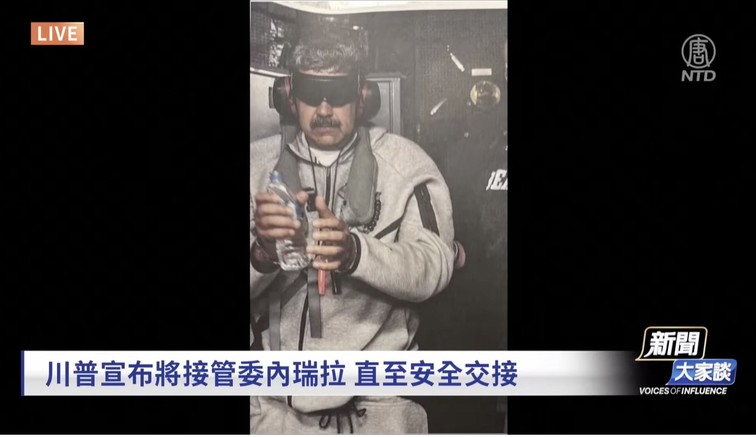
The image depicts Venezuelan President Maduro being apprehended by the U.S. military on January 3, 2026, and then transported to the amphibious assault ship USS Iwo Jima, en route to New York, USA. In the picture, Maduro is dressed in a grey tracksuit, his eyes are obscured by a black cloth strip, and he is holding a water bottle, while wearing what seems to be a large headset-like device on his ears. (Video screenshot)
[People News] In a surprise operation, the U.S. military raided Venezuela and captured President Maduro and his wife alive. Upon hearing the news, Venezuelan citizens excitedly flooded the streets, celebrating with songs and dances at the tyrant's downfall. Chinese netizens also expressed their joy, referring to this event as 'the first major happy news of 2026' and 'a turning point in history.'
Chinese Netizens: The First Major Happy News of 2026
According to Dajiyuan, many netizens took to the internet to express their astonishment, stating, 'It’s too sudden, too shocking, beyond imagination.'
One netizen shared, 'I just went out for a meal, and when I came back and opened my computer, I was shocked to see that Venezuelan President Maduro had been captured alive.'
Another netizen commented on their overall impression: 'It’s unbelievable. No movie could portray this. The U.S. acted so quickly; it’s truly shocking.'
Many netizens echoed that this is 'the first major happy news of 2026' and 'a turning point in history.'
Blogger Tian Rui analysed that the swift capture of Maduro by the U.S. indicates that the U.S. has a comprehensive understanding of Maduro's movements and acted with remarkable speed. The implications of this event for dictators worldwide are significant, particularly for the Chinese Communist Party (CCP) and Xi Jinping, who may feel a considerable impact. It is highly likely that the U.S. has gathered extensive information on these dictators.
Just hours before the U.S. military captured Maduro, he was still at the official residence, the Flower Palace, meeting with Qiu Xiaoqi, the CCP's special representative for Latin American and Caribbean affairs, and his delegation.
Many netizens from mainland China have humorously suggested that it was Xi Jinping of the Chinese Communist Party who assisted the United States in capturing Maduro—how could the U.S. have such precise knowledge of Maduro's location? Was it that the CCP delegation provided the information, or was it due to the meeting between the CCP's special representative Qiu Xiaoqi and Maduro, which allowed the U.S. military to obtain Maduro's whereabouts? In any case, the CCP appears to have played some role in this incident.
Netizens also resurfaced footage of Maduro proudly showcasing his Huawei phone, joking that the Huawei phone was instrumental, stating, "Without the Huawei phone's location tracking, they wouldn't have been able to catch you."
'Tianrui' opines that Maduro was captured immediately after his meeting with Qiu Xiaoqi. Will Qiu Xiaoqi remain in Venezuela? Regardless, Maduro's capture by the U.S. is a direct embarrassment for the CCP, which will likely heighten the fears of the CCP's leadership regarding Trump. The U.S.'s precision strikes, including decapitation and live capture, have left dictators, including Xi Jinping, restless.
Following this astonishing event, countless individuals in mainland China began to speculate and hope for U.S. action against the CCP.
On social media, a flood of comments from netizens emerged: "If the U.S. could take similar action against the CCP and Xi Jinping, that would be fantastic." "Today it's Venezuela, tomorrow it could be any country." "Today it's Maduro, tomorrow it could be Xi Jinping." "The U.S. has transitioned from being infiltrated and divided to dismantling the evil axis! This indicates that Trump is the chosen one." "This is a day worth celebrating!" "A perfect illustration of 'to catch the thief, first catch the king.'" "Anyone who associates with the CCP is bound to face misfortune." "Hollywood couldn't even produce such an exciting film."
International netizens have voiced their opinions, stating: 'The U.S. government is efficient, it speaks and acts decisively; setting goals and launching full-scale attacks, the axis of dictatorship should be worried!' 'Fantastic! As long as we capture the dictator, we can avoid bombing cities, prevent soldier casualties, and avert a world war', 'Baozi, hide well, you might be next', 'Trump is making America great again; the evil axis countries are merely paper tigers struggling for survival before their demise, eliminating one is a step forward', 'In just one hour, we can take anyone from anywhere in the world, so let's take Putin, Xi Jinping, Trump, and Kim Jong-un!', 'Xi Baozi is terrified.
Dictators are feeling anxious and criticising the U.S.
Following U.S. President Trump's announcement of Maduro's capture, he elaborated that the U.S. will 'run Venezuela' and temporarily take control of its oil infrastructure, asserting, 'We will manage this country until a safe, proper, and prudent transition can occur.'
He stressed that the U.S. will not permit 'someone who does not prioritise the interests of the Venezuelan people' to assume power.
Trump further stated that the U.S. will allow 'the largest American oil companies to enter Venezuela, investing billions of dollars to repair the severely damaged oil infrastructure and begin generating revenue for this country.'
He also warned that if necessary, the U.S. is ready to launch 'a second, larger strike.' The U.S. 'occupation will not cost America a dime,' with expenses covered by 'funds flowing from underground,' specifically the oil revenues of Venezuela.
Trump's statements have left dictators worldwide feeling profoundly uneasy.
Maduro has been captured alive, and the international community's response is sharply divided. The Chinese Communist Party, which has consistently supported Maduro, has condemned the United States for the second time. Venezuela's allies, including Russia, Cuba, and Iran, have criticised the attack as an 'infringement of sovereignty.' In contrast, Argentine President Javier Milei has praised Venezuela for achieving 'freedom,' while Brazilian President Lula has remarked that this action crosses 'an unacceptable red line.'
Experts suggest that the United States' actions against Venezuela will have a 'direct and negative' impact on the Chinese Communist Party's geopolitical interests in Latin America. Some experts further assert that dictators from Cuba to Beijing are certainly feeling more uneasy now than they did yesterday.'
According to a report by Newtalk, since China is the largest buyer of Venezuelan crude oil, and with U.S. President Donald Trump announcing that the U.S. will take control of Venezuela, experts believe that China will need to seek alternative sources for Venezuelan oil.
The South China Morning Post reported that Terry Haines, founder of the Washington consulting firm Pangaea Policy, indicated that according to the 'National Security Strategy' recently released by the Trump administration, the overall goal of the United States is to limit, contain, and weaken China's economic and geopolitical influence in Latin America, 'whether in Venezuela, Colombia, Panama, Argentina, or other regions in South America or Central America.'
Haines highlighted that the actions taken by the United States against Venezuela will have a "direct and negative" effect on China's geopolitical interests in Latin America. Additionally, the ousting of a head of state who was once an ally of China (referring to Maduro) is likely to elicit strong reactions from countries like Iran and Russia.
He further suggested that investors should prepare for the possibility that the competitive dynamics between the U.S. and China may intensify in the short term following Maduro's arrest. Should this happen, the U.S. might implement some form of economic countermeasures against China, while China could halt its purchases of U.S. soybeans, which may also impact rare earth supply issues.
The Times reported that Simon French, chief economist at investment bank Panmure Liberum, believes that China is the second-largest oil consumer globally, after the U.S., and is also the largest buyer of Venezuelan oil. In light of the U.S. actions against Venezuela, how will China secure its oil supply from the country? This will necessitate seeking alternative sources.
Jeremy Chan, a senior analyst at the Eurasia Group and a former official at the U.S. Consulate in Shenyang, opined that Beijing might exploit the panic among Latin American nations like Brazil to stir local discontent against Trump. At present, it is hard to envision any country uniting to oppose Beijing's approach.
Jeremy Chan remarked that, in general, "dictators from Havana (Cuba) to Beijing are undoubtedly feeling more anxious now than they did yesterday." △






News magazine bootstrap themes!
I like this themes, fast loading and look profesional
Thank you Carlos!
You're welcome!
Please support me with give positive rating!
Yes Sure!