
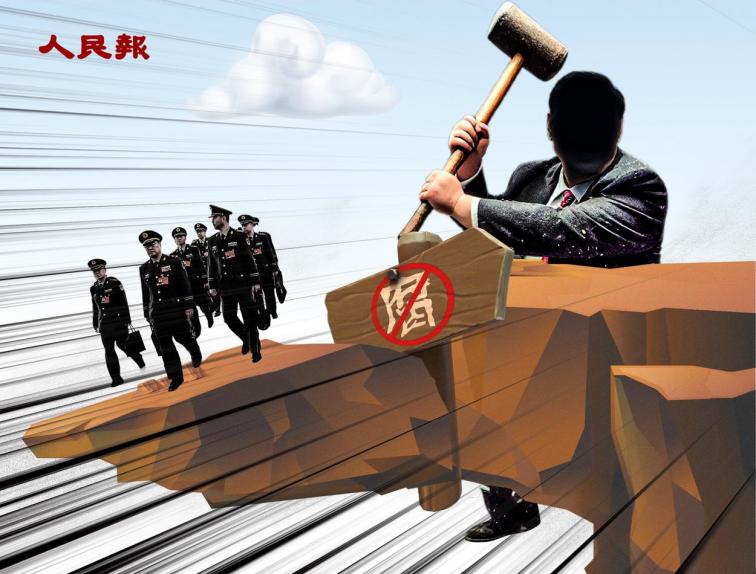
Xi Jinping’s Central Committee and the Military in Fierce Infighting (Graphic by People News)
[People News] The Political Bureau of the Central Committee of the Communist Party of China has announced that the Fifth Plenary Session of the 20th Central Committee will be held in October, focusing on the theme of 'comprehensively and strictly governing the Party.' This indicates that there will be an intensified campaign to strengthen the Party both before and after this meeting.
Xi Jinping's 'Digging Pits' and 'Shifting Blame'
The official statement from the Politburo meeting typically reflects the remarks made by Xi Jinping, who presides over the meeting. He begins by touting the 'great achievements' of 'comprehensively and strictly governing the Party,' and then notes that 'the international situation, national conditions, and Party conditions have undergone profound changes,' adding that 'we are also facing many new situations and new problems.' In essence, this is a political tactic to shift blame.
This comes in the wake of the 20th National Congress of the Communist Party, where many members of the Central Committee selected by Xi Jinping have faced significant setbacks. Approximately 70 members of the current Central Committee have encountered issues, representing nearly 20% of the total. This marks the most serious situation since the end of the Cultural Revolution in 1976.
Xi's defense is that, regarding governance, the majority of outcomes are 'great achievements,' while a small number of problems are due to objective reasons.
By the time of the Fifth Plenary Session in October, he will have to confront a moment of immense pressure.
According to the Party Constitution (often referred to as the 'rules of the gang'), the Central Politburo and its Standing Committee are 'elected' by the Central Committee and are accountable to it.
While Xi has established a dictatorship within the Politburo, he is still required to formally report to the entire Central Committee on behalf of the Politburo during the plenary session, providing necessary explanations.
The totalitarian political system of the Chinese Communist Party has been in operation for many years. High-ranking officials within the party-state face political coercion, and the intertwining of interests has established a rigid rule of 'unanimous approval' during Central Committee plenary session votes, rendering the entire meeting a mere formality. However, as circumstances evolve, although Xi Jinping's power has become more centralized, his authority has waned. When he addresses all Central Committee members to provide explanations, he likely feels internal pressure.
Xi Jinping's significant pressure stems from the fact that he has set a trap for himself.
On August 29, 2016, the General Office of the Central Committee of the Communist Party of China issued the 'Opinions on Preventing the Promotion of Officials with Illness,' which addressed accountability for 'promoting officials with illness.' The regulations stipulate that if the promotion of officials with illness leads to negative consequences, or if there are continuous or widespread instances of such promotions, the main leaders of the Party Committee (Party Group) must be held accountable. This Party Committee, at the highest level, certainly includes the Central Committee of the Communist Party of China, meaning Xi Jinping is among those who could be held responsible.
Although Xi Jinping stands above the party's disciplinary rules and national laws, under the pressure of the powerful Central Commission for Discipline Inspection, it is currently unlikely that Central Committee members will vote against the reports or resolutions presented by Xi, nor will they publicly call for accountability. However, dissatisfaction among officials towards Xi is building, and anger is rising, which Xi is likely aware of.
During the Fifth Plenary Session, when Xi reports to the Central Committee, his language will undoubtedly include phrases like 'profound changes in the international situation, national conditions, and party conditions,' and 'comprehensive strict governance of the party is also facing many new situations and new problems,' using these points to defend himself.
Is the Fifth Plenary Session hinting at the existence of anti-party factions?
Xi Jinping is seeking to distance himself from political responsibilities related to corruption in the officialdom and unclear personnel appointments, and he may impose severe penalties on Zhang Youxia, a prominent figure in the military elite. Prior to the Fifth Plenary Session, the authorities are expected to publicly announce the final characterization of the Zhang Youxia case to influence public opinion.
On January 24, Zhang Youxia, Vice Chairman of the Central Military Commission, and Liu Zhenli, a member of the Central Military Commission and Chief of the Joint Staff, were suddenly dismissed from their positions. Military reports criticized the two for 'seriously undermining the accountability system of the Chairman of the Military Commission' and 'endangering the Party's ruling foundation.' No further updates on their cases have been released.
Overseas commentator Cai Shenkun disclosed that Zhang Youxia has admitted to attempting to pressure Xi Jinping into relinquishing power, stating bluntly that 'rewriting history is just one step away.' Additionally, Zhang Youxia had garnered support from certain party elders.
There are also rumors that following Zhang Youxia's arrest, several elders and families of the second generation of red elites have come forward to advocate for him, making efforts on various fronts with a mix of soft and hard rhetoric.
Another commentator, Chen Pokong, recently told The Dajiyuan that the authorities may unveil shocking news during the Fifth Plenary Session, potentially labeling Zhang Youxia, Liu Zhenli, and others as a counter-revolutionary group. Xi Jinping seems to be signaling that he possesses compromising materials on everyone in the Politburo, including both current and former senior officials, and that he can take down anyone he chooses at any time.
If the term 'counter-revolutionary group' is indeed used at that time, it would be a significant development.
Of course, being labeled as counter-revolutionary means standing against the evil Chinese Communist Party, which is inherently a positive term; however, in the context of internal struggles within the CCP, it often has little to do with ideology and is simply a term used for targeting individuals.
Will Zhang Youxia be branded as an ambitious figure?
Throughout the history of the Chinese Communist Party, the term 'anti-party group' has often been associated with 'ambitious individuals.' For instance, in the 1970s, there were the Lin Biao and Chen Boda anti-party group (later labeled as the Lin Biao counter-revolutionary group) and the Jiang Qing counter-revolutionary group, known as the 'Gang of Four.' Lin Biao was denounced as a bourgeois, ambitious individual and conspirator, with official narratives accusing him of plotting to usurp the party and seize power. Following the downfall of Jiang Qing, Wang Hongwen, Zhang Chunqiao, and Yao Wenyuan from the 'Gang of Four' were similarly characterized as bourgeois ambitious individuals and conspirators attempting to overthrow the party.
The phrases 'ambitious individuals' and 'conspirators' have been used less frequently in public discourse since the Deng Xiaoping era, but they have resurfaced during Xi Jinping's leadership. Notable figures named include Zhou Yongkang, Bo Xilai, Guo Boxiong, Xu Caihou, Ling Jihua, and Sun Zhengcai, all accused of having 'inflated political ambitions and engaging in conspiratorial activities.' Among these, Zhou Yongkang, Bo Xilai, and Ling Jihua were rumored to have formed cross-faction alliances aimed at a coup against Xi Jinping, with Zhou Yongkang even allegedly plotting to assassinate him. Xu Caihou and Guo Boxiong attempted to block Xi Jinping's rise to power, while Sun Zhengcai reportedly set up a secret room to pay homage to the dragon robe, aspiring to be Xi's successor.
Previously, the authorities accused Zhang Youxia and Liu Zhenli of 'seriously undermining the responsibility system of the Chairman of the Military Commission' and 'threatening the party's ruling foundation.' Such strong language suggests that Zhang and Liu may have been involved in actions akin to a coup or power grab, while also seemingly paving the way for the forthcoming characterization of 'ambitious individuals.'
If the Xi administration genuinely seeks to label Zhang Youxia as an ambitious figure, the underlying reason may be Zhang's attempts to ally with retired elders and certain members of the 'red second generation' to thwart Xi's re-election at the upcoming 21st National Congress. In the current context of the Chinese Communist Party (CCP), the phrase 'endangering the party's governing foundation' essentially refers to jeopardizing Xi's own governing foundation and obstructing his lifelong rule.
Xi is concerned that stepping down could lead to repercussions, which is why he considers a smooth re-election at next year's 21st National Congress to be of utmost importance. His aggressive stance towards Zhang Youxia is intended to deter other potential dissenters and redirect the party's internal criticism regarding the corruption that has occurred during his tenure. Nevertheless, the CCP regime is deeply mired in crisis, with public discontent and official anger rising dramatically. Amid the turmoil of internal power struggles within the CCP's upper ranks, this faltering red boat is unlikely to navigate far.
(Dajiyuan)
△






News magazine bootstrap themes!
I like this themes, fast loading and look profesional
Thank you Carlos!
You're welcome!
Please support me with give positive rating!
Yes Sure!