

CCTV reporters had to secure themselves with safety ropes while reporting on Typhoon 'White Dolphin' along the coast of Zhejiang to prevent being swept away by the strong winds. (Video Screenshot)
[People News] After a long journey of 6,000 kilometers and over 15 days of development, this year's most unusual and longest-lasting typhoon, 'White Dolphin,' made landfall in Zhejiang with winds reaching level 14 on the evening of August 9! However, just before it made landfall, even the international metropolis of Shanghai, located hundreds of kilometers from the landing point, was once again inundated...
Setting records with a direct hit! Level 14 winds sweep through Zhejiang
According to official reports from the mainland, the center of Typhoon 'White Dolphin' made landfall around 5:30 PM on August 9 in Yuhuan, Taizhou, Zhejiang, with maximum winds of level 14 near the center at the time of landfall. It made another landfall around 6:40 PM the same day in Wengyang Street, Yueqing City, Wenzhou, Zhejiang, with maximum winds of level 13 near the center at that time.
Television footage shows the coastal areas of Zhejiang being battered by wind and rain, with massive waves! While reporting along the coast of Zhejiang, a CCTV reporter had to secure herself with a safety rope to avoid being blown away by the typhoon. Even with the rope, this female reporter struggled against the fierce winds, nearly unable to stand, as she shouted into the microphone, her voice continuously drowned out by the roar of the storm.
https://www.ganjingworld.com/video/1iojnguph7g740aulc6LvtuA91o01c
Meteorological experts have noted that 'White Dolphin' has set several historical records: it is the first ocean typhoon in history to form near the International Date Line and make landfall in China with a strength exceeding that of a tropical storm! 'White Dolphin' has three notable characteristics: first, it has a long-distance oceanic journey and an exceptionally long lifespan. It formed on the west side of the International Date Line on July 27, and its path before landfall will exceed 6,000 kilometers, with a lifespan of over 15 days, which is more than three times that of an average typhoon; second, it undergoes explosive intensification and maintains high intensity for an extended period. Within 48 hours of its formation, 'White Dolphin' rapidly intensified from tropical storm level to super typhoon level; third, it features a massive circulation and a wide-ranging impact of wind and rain. The radius of the typhoon's 7-level wind circle reaches between 420 and 450 kilometers, with a circulation diameter of 1,300 kilometers.
The 'White Dolphin' is quite large, with a circulation cloud system diameter exceeding 1,200 kilometers and a cloud system area surpassing 1 million square kilometers, enough to cover the entire East China region.
Experts warn that after making landfall, 'White Dolphin' will push inland and may even 'stall and rotate' at the junction of Jiangxi, Hubei, and Anhui, leading to sustained extreme heavy rainfall. More critically, coastal areas are facing a compounded risk of 'wind, rain, and tide'—the destructive force will be geometrically amplified when strong winds and heavy rain coincide with astronomical high tides!
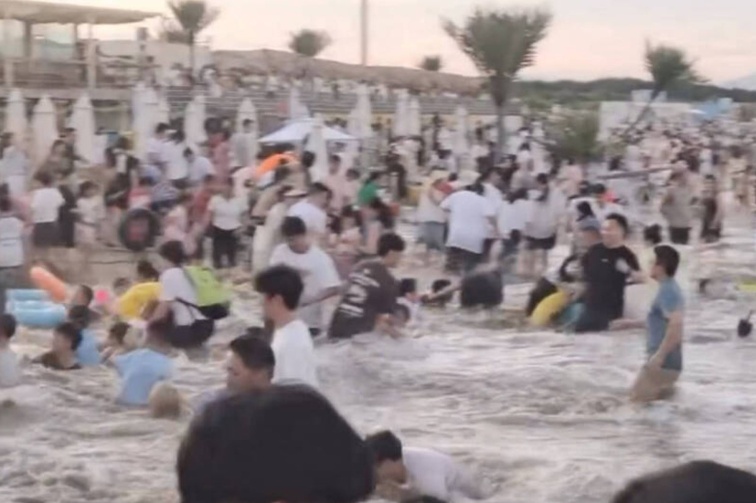
As Typhoon White Dolphin approaches, a large number of tourists enjoying the water at the Fujian coast were tragically swept away by massive waves. (Source: Weibo)
Tourists watching the waves at the Fujian coast were knocked down by giant waves.
According to a report by the Liberty Times, on August 8, a large crowd of tourists gathered at the seaside in Pingtan, Fujian, to watch the waves. Videos shared by netizens show massive waves crashing onto the shore one after another, knocking down people of all ages—men, women, and children alike. Some parents holding young children were even swept away by the powerful waves. The footage sparked widespread outrage on social media, with many users commenting, 'Don't go to the beach during a typhoon,' 'There’s no sense of danger at all; how can so many people be at the beach during a typhoon?' and 'Darwin has been busy these past few months.'
On the morning of the 7th, another incident occurred at the seaside in Pingtan. A couple in their twenties, seeking the perfect photo opportunity, took the risk of climbing over the protective fence of a guesthouse and entered an unprotected rocky area to capture the sunrise. Unfortunately, due to the influence of the typhoon's outer circulation, the sea was extremely rough and the rocks were slippery, causing both to lose their footing and fall off a cliff. The woman tragically died at the scene, while the man was injured and taken to the hospital for treatment.
Local guesthouse operators expressed their frustration, stating that the guesthouse had already installed a fence and provided safety reminders to all guests about typhoon precautions and staying away from the coastline. However, the couple climbed over the fence to access the dangerous area around 5 a.m., which ultimately led to the tragedy.
Shanghai's transformation into a 'flooded land' has sparked intense discussions.
What is surprising is that before the typhoon officially made landfall, China's largest city, Shanghai, had already 'fallen' first! On the 9th, Shanghai was hit by heavy rainfall, with over a hundred road sections in the city severely flooded, turning streets into rivers almost instantly. Not only was Shanghai Disneyland forced to close early, but all long-distance passenger transport was also completely suspended.
Numerous Chinese netizens have shared videos taken on the streets of Shanghai, showing that the water has risen to submerge half of a car wheel, with water flowing into supermarkets and subway stations. Shanghai Disneyland closed early, and the long-distance bus terminal halted operations. Many netizens commented, 'The typhoon hasn't even made landfall yet, and we're already flooded... leading by a wide margin.'
This marks the second instance of 'street boating' in Shanghai in less than two months.
During the World Artificial Intelligence Conference held in Shanghai in July, a sudden downpour transformed many roads into rivers, stranding numerous vehicles and flooding streets, supermarkets, campuses, and hospitals, creating a scene reminiscent of a vast ocean. The Jiangwan Stadium in Yangpu District experienced leaks akin to a burst water pipe. At that time, Chinese Communist Party leader Xi Jinping was attending the AI conference, and the stark contrast between the high-tech event and the flooded streets ignited intense discussions online, with many netizens seizing the opportunity to satirize the situation.
Following last month's heavy rainfall that caused urban flooding and building leaks in Shanghai, public and media scrutiny has arisen regarding the city's underground drainage system, high-speed rail stations, and the flood prevention capabilities of upscale shopping malls. In fact, as early as 2013, in response to Typhoon 'Fitow' and several extreme rainstorms that resulted in severe flooding, the public and media began to question the low standards of urban construction and the insufficient capacity of the underground drainage system to handle extreme weather. Yet, over a decade since Xi Jinping took office, Shanghai, which claims to be China's premier city, has still not managed to address even the issue of urban flooding.
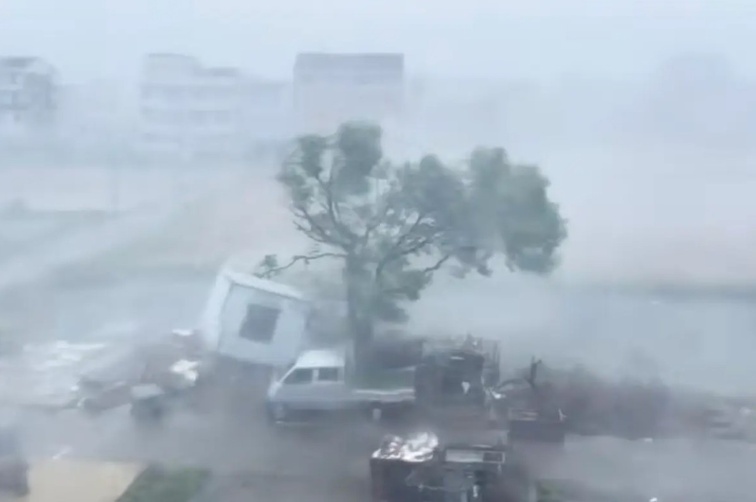
Typhoon 'Bai Dolphin' made landfall twice on the evening of August 9 in Yuhuan, Taizhou, Zhejiang, and Wengang Street, Yueqing City. This typhoon traveled an impressive distance of 6,000 kilometers, setting a record for oceanic typhoons making landfall in China. (Video screenshot)
Experts Warn of the Combined Risks of 'Three Convergences'
Typhoon Baidou made landfall in Yuhuan, Zhejiang around 5:30 PM on the 9th and is expected to gradually move inland. However, experts on the mainland have emphasized the need for heightened vigilance regarding the potential combined risks of 'three convergences' during the typhoon's impact period.
The term 'three convergences', also referred to as 'the convergence of wind, rain, and tide', describes an extreme situation where the strong winds, heavy rainfall, and astronomical tides brought by the typhoon occur simultaneously in the same coastal area.
Chen Si, deputy director and senior engineer at the Fujian Strait Meteorological Science Research Institute, noted that each of these three elements—wind, rain, and tide—possesses its own destructive power. When they 'converge', the resulting destructive force can increase geometrically, making it one of the most critical risks that coastal areas must be vigilant about during typhoon prevention efforts.
Experts indicate that the specific impacts of the 'three convergences' manifest in three main areas: first, the fierce winds that can cause significant destruction; second, the torrential rains that sharply elevate the risk of flooding; and third, the elevated tide levels that increase the risk of seawater backflow.
With Typhoon Baidou approaching with great intensity, the combined risks of the 'three convergences' should not be underestimated. Meteorological experts advise the public to stay alert and take necessary precautions against potential dangers.
△







News magazine bootstrap themes!
I like this themes, fast loading and look profesional
Thank you Carlos!
You're welcome!
Please support me with give positive rating!
Yes Sure!