
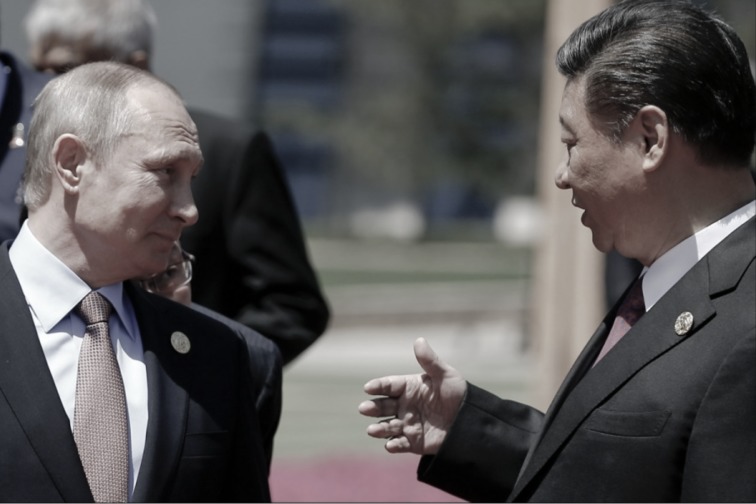
File Photo: Putin and Xi Jinping Posing for a Photograph
[People News] Just four days after U.S. President Trump departed from Beijing on May 15, Russian President Putin arrived in the city on May 19. Some commentators believe this timing reveals the Chinese Communist Party's (CCP) intentional effort to position Beijing as a hub for major power diplomacy, while also suggesting that Russia has become a pawn in the U.S.-China rivalry.
Shaping the Major Power Diplomacy Centre
According to recent reports from various international media, at the invitation of CCP leader Xi Jinping, Putin arrived in Beijing on May 19 for a two-day visit, during which he is scheduled to hold talks with Xi Jinping. This visit comes shortly after Trump's trip to Beijing and was marked by a high-profile reception, including a red carpet, military band, state banquet, and private tea gathering, all designed to showcase the stability of the relationship between the two nations. Observers widely regard this meeting as one with significant political symbolism.
Many analysts note that Putin's swift visit to China just days after Trump's departure sends a clear political message: while engaging with the U.S., the CCP also aims to convey that it will not alienate Russia. This move helps to reinforce the image of Beijing as a 'global power hub.' Additionally, it signals to both the U.S. and Russia that the CCP is capable of discussing cooperation while keeping its strategic options open. China (the CCP) can host the U.S. President and promptly welcome the Russian President, reaffirming that Beijing remains the centre of major power diplomacy.
In an article published in Euronews, diplomat and geopolitical scholar Gould-Davies suggests that Beijing may want to prevent the outside world from misinterpreting the situation as 'China and the U.S. rapidly drawing closer after the Trump-Xi meeting.' To achieve this, through Putin's visit to China, it reiterates that the Sino-Russian strategic relationship remains robust, thereby alleviating any doubts from Moscow and reminding Washington that China (the Communist Party) still possesses 'Russian leverage.'
A meeting of those with hidden agendas
Independent commentator Cai Shenkun shared on the X platform that Putin's current visit to Beijing marks his 25th trip to China since he came to power, and it is also Xi Jinping's 40th meeting with Putin. While it may seem like a peak handshake between the leaders of China and Russia, it is, in fact, a gathering of individuals with hidden agendas.
Cai Shenkun argues that the timing of Putin's visit is particularly sensitive, coming right after Trump has concluded his own visit to Beijing. This arrangement, where one leader departs just as the other arrives, indicates that Beijing is strategically balancing its relationships. For Xi Jinping, having just met with Trump a few days prior, embracing Putin immediately afterwards is a way to signal to Washington that he has the Russian card ready to play at any moment! Additionally, Putin's swift arrival serves not only to gauge the underlying dynamics of the China-U.S. interactions but also to assert his presence on the global stage, demonstrating that he has not been sidelined. This situation highlights that Russia has effectively become a pawn in the China-U.S. rivalry. While Putin enjoys the highest level of hospitality, he is using Russia's future as collateral to secure a place next to Xi Jinping.
Trump denies the notion of 'the East rising and the West declining.'
During the US-China summit, Xi Jinping suggested that the United States is a declining power. That evening, Trump responded on social media, emphasising the 'remarkable rise' of the US in both economic and military aspects.
Several media outlets have noted that while the Russia-Ukraine war was not a primary topic during the Xi-Trump meeting, Xi Jinping appeared to be trying to appease the US by telling Trump, 'Putin may regret invading Ukraine.'
While Trump was visiting Beijing, Russia launched an attack involving 1,560 drones on Ukraine's capital, Kyiv. In reaction, Ukrainian Foreign Minister Dmytro Kuleba remarked, 'The leaders of the US and China have enough leverage to persuade Putin to end the war.'
According to information released by both China and Russia, during Putin's visit to China, the two nations are expected to sign a high-level joint statement along with a series of bilateral agreements.
Analysts estimate that Putin will discuss Sino-Russian strategic cooperation, energy collaboration (including the 'Power of Siberia 2' gas pipeline), the situation in Iran, and matters related to the Russia-Ukraine war with Xi Jinping. The two sides may also sign a joint statement to reinforce their 'comprehensive strategic cooperative partnership.'
Some analysts from outside China believe that Beijing's ongoing receptions of leaders from the United States and Russia are, to a certain extent, a demonstration of its diplomatic influence. However, other observers note that following Western sanctions, Russia's economic and energy dependence on China has intensified, leading to a more unequal dynamic in Sino-Russian relations. At present, China and Russia are 'politically united, economically mutually beneficial, but with a highly unequal dependence.' If one were to ask who needs whom more, the answer would be that Russia needs China more, and this dependence is continuing to grow. Consequently, after Trump concluded his state visit to China, Putin quickly flew to Beijing. △






News magazine bootstrap themes!
I like this themes, fast loading and look profesional
Thank you Carlos!
You're welcome!
Please support me with give positive rating!
Yes Sure!