
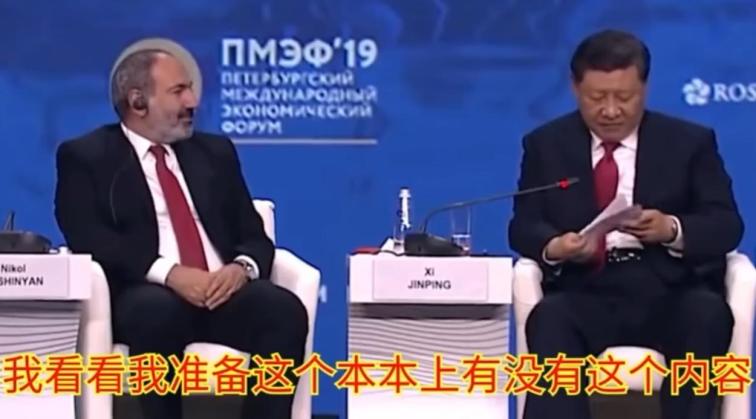
At the 2019 St. Petersburg International Economic Forum (SPIEF), during the plenary session, Xi Jinping, in response to a question from a Russian journalist, flipped through a small booklet in his hand, saying: "Let me see if this content is in my prepared notes..." His response prompted laughter from the audience. (Video screenshot)
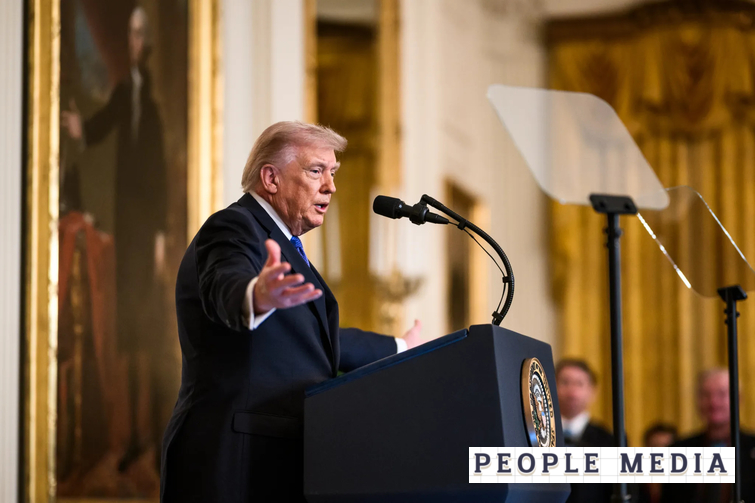
[People News] From May 13 to 15, U.S. President Donald Trump visited Beijing for talks with Chinese Communist Party leader Xi Jinping. During the brief one and a half days of his visit, the interactions between Trump and Xi were striking, generating numerous anecdotes and rumours about their meeting.
A video that circulated online shows that on the evening of the 14th, during a state banquet hosted by Xi Jinping for Trump, the U.S. President was seen flipping through a black-covered notebook with his left hand. Many speculated that this was Xi Jinping's 'notebook that never leaves his hand,' and the topic quickly went viral online. However, subsequent reports from media outlets like CNN revealed that upon zooming in on the video, the black cover was embossed with the presidential seal of the United States, suggesting that it was likely a notebook Trump had brought with him.
So why do so many people think that Trump was looking at Xi Jinping's notebook? The answer lies in the widespread curiosity about Xi's little notebook.
Why is Xi Jinping's prompt book referred to as the 'little notebook'? The origin of this term can be traced back to the St. Petersburg International Economic Forum (SPIEF) in June 2019. During the event, the Russian host asked Xi Jinping, 'In my opinion, the most significant economic news right now is the trade war between China and the United States. Chairman, my first question for you is, the world's two largest economies—China and the United States—are in confrontation, and the damage they are incurring is so substantial that it has a massive impact on the global economy. How should they protect their interests without destroying their own foundations? Trump is a negotiation expert and an exceptional businessman. He first tears up existing agreements, stops following these rules, and then forces negotiations to restart. The end result is that he secures an agreement that satisfies him, and this is the case in all situations... How do you plan to negotiate?'
This question appeared to catch Xi Jinping off guard and posed a challenge for him. Clearly unsure of how to respond, he fell silent for a few seconds before picking up several prepared cards. While flipping through them, he remarked, 'Let me see if this content (answer) is in my little notebook.' When this statement was translated into English and echoed throughout the venue, it elicited laughter from the audience.
This is how Xi Jinping's 'little notebook' came to be known. The video segment of this incident was completely censored by the Chinese Communist Party, and even the term 'little notebook' has become a sensitive phrase on Chinese social media.
Xi Jinping's dependence on his 'little notebook' has been a familiar experience for Trump. On October 30, 2025, Trump and Xi Jinping met in Busan, South Korea, for the first time in six years, attracting global attention. However, during the meeting, Xi Jinping focused entirely on reading from his notebook, seemingly avoiding eye contact with Trump on purpose. Notably, Trump showed a strong interest in Xi's oversized script, which even included pinyin annotations in some places, occasionally glancing at the notebook with a bemused expression.
Following the welcoming ceremony on the morning of May 14, the two leaders engaged in talks. Footage revealed that during his opening remarks, Xi Jinping struggled after just two sentences and had to resort to his 'little notebook.' In contrast, Trump closed his eyes, no longer attempting to make eye contact with Xi as he had during their previous meeting in Busan.
The 'little notebook' has become a common feature in Xi Jinping's discussions with global leaders. On October 31, 2025, during a break at the Asia-Pacific Economic Cooperation (APEC) summit, Xi Jinping held a roughly 30-minute conversation with Sanna Marin, where he again read from his notebook the entire time, while Marin responded quickly and effortlessly.
During Xi Jinping's visit to France, his conversation with Emmanuel Macron also involved him reading from his notebook throughout. Macron's expression was quite revealing; he appeared confused and impatient with Xi Jinping's scripted remarks, continuously looking at this 'leader' of the Chinese Communist Party, who was so close yet unable to communicate naturally.
Some netizens have remarked on the little notebook of the Chinese Communist Party (CCP) leader, stating, 'CCP leaders lack the ability to answer reporters' questions spontaneously and cannot deliver speeches off the cuff, making them ill-suited for a public election system; they can only engage in secretive court intrigues.'
In interactions with international leaders, the CCP leader's inability to speak without a script is seen as highly unusual. For others, it is quite abnormal for a national leader to be unable to communicate normally. Yet, within the CCP's system, this rigid reliance on a little notebook and reciting from a script is quite common. Furthermore, during Trump's visit to China, many aspects left Americans from free and democratic societies feeling bewildered.
For example, U.S. Secretary of State Marco Rubio, known for his hardline stance on China and condemnation of the CCP's repression of Uyghurs and the pro-democracy protests in Hong Kong, was placed on the CCP's sanctions list twice in 2020, barring him from entering China. However, during this visit, Rubio, in his role as U.S. Secretary of State, accompanied Trump to China, where the CCP leader shook hands with him in a gesture of welcome. The CCP then altered the name 'Rubio' on the table card to 'Lu Bi Ao' to sidestep the previous sanctions. To the CCP, it appears that simply changing the Chinese translation of the name equates to changing the person. This tactic of name-changing allows the CCP to 'extricate itself' and 'find a way out,' which not only undermines its credibility and image but also highlights the arbitrary nature of its policies.
On the morning of the 14th, the Chinese Communist Party held a formal welcome ceremony for President Trump in front of the Great Hall of the People. Dozens of children jumped up and down on command, chanting 'Welcome, welcome, warmly welcome!' Trump paused in front of this group, and typically, he would engage with the welcoming children, even shaking hands and hugging them. However, these children continued to jump as if they were robots that had not received a stop command. This North Korean-style welcome ceremony left leaders from free democratic countries feeling bewildered, as they were not encountering innocent and charming children, but rather tools manipulated by the Communist Party, jumping around on cue.
On May 13, Bayer, a reporter from American Fox News who arrived early, experienced the extensive surveillance cameras on the streets of Beijing while filming. He noted that at a street corner outside Haidian Station in Beijing, he counted at least 20 cameras. He remarked, 'Big Brother is watching you; there are cameras everywhere in Beijing.' He added, 'Our driver parked illegally for two minutes and received a text message on his phone, being fined about $40 because he was caught on camera.' This level of surveillance led American journalists to question the Communist Party's claims of 'ensuring people's safety.' His firsthand experience made him more inclined to believe that the Communist Party's true aim is tracking and monitoring.
Trump's brief visit to China has concluded, but Xi Jinping's 'little notebook,' the Communist Party's tricks of 'this Rubio is not that Rubio,' the jumping North Korean-style elementary school students, and the omnipresent surveillance cameras have all become part of the historical record.
△




News magazine bootstrap themes!
I like this themes, fast loading and look profesional
Thank you Carlos!
You're welcome!
Please support me with give positive rating!
Yes Sure!