
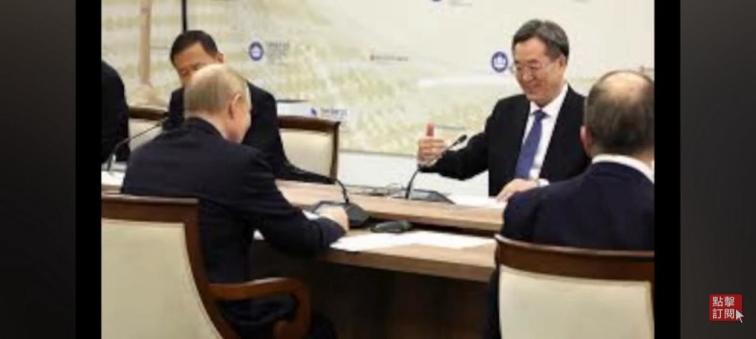
On June 20, Ding Xuexiang, a member of the Standing Committee of the CCP Politburo and Vice Premier of the State Council, met with Russian President Vladimir Putin in St. Petersburg. (Video screenshot)
[People News] Russian President Vladimir Putin is set to visit Beijing for a state visit from May 19 to 20, where he will meet with Xi Jinping, General Secretary of the Communist Party of China, and Li Qiang, Premier of the State Council of China. Just three days earlier, U.S. President Donald Trump had wrapped up his trip to Beijing and returned to Washington. Trump's visit can be characterised as highly successful, with the Chinese Communist Party committing to purchase at least $17 billion worth of U.S. agricultural products annually over the next three years, alongside pledges not to provide 'substantial military aid' to Iran and to work on North Korea's denuclearisation.
According to a report by Le Figaro, Putin is feeling uneasy about the 'ambiguous interactions' between China and the U.S., fearing that a G2 dynamic could marginalise Russia. The Kremlin is determined to defend its interests in relation to Beijing. The article notes that Putin's upcoming visit aims to demonstrate the resilience of the Russia-China partnership, emphasising the alliance established by Putin and Xi Jinping in 2022, which is focused on countering the West. This display underscores Russia's anxiety regarding the thawing of China-U.S. relations. Putin is concerned that Xi Jinping may devote more attention to his bilateral relationship with Trump, raising fears about the potential emergence of a 'G2' framework that could sideline Russia.
On May 18, the Kremlin expressed serious expectations for Putin's itinerary in Beijing, hoping to cultivate a 'special partnership' with China.
During his visit to Beijing, Trump brought up the G2 issue, expressing clear dissatisfaction with Russia's hardline stance on the peace agreement in Ukraine. Xi Jinping also introduced a new statement regarding the 'constructive strategic stability relationship between China and the United States' during the Xi-Trump meeting, which may be revisited in Washington in the future. Matthieu Dussault, a researcher at the Montaigne Institute in France, believes that Russia is anxious about any potential improvement in China-U.S. relations, which further deepens its suspicions and leads it to seek support from China.
Experts note that since the deterioration of Sino-Soviet relations, the deep-seated distrust between the two countries has never fully disappeared. Currently, Russia is deeply entrenched in the conflict in Ukraine and is increasingly economically dependent on the Chinese Communist Party. Shi Yinhong, an international relations scholar at Renmin University of China, remarked, 'This makes Putin even more uneasy.' Putin is particularly worried that the Chinese Communist Party, in prioritising its relationship with the United States to revive its struggling economy, may gradually distance itself from Russia.
According to a report by Reuters, Russian President Putin stated on Tuesday, prior to his arrival in Beijing, that Russia and China are willing to support each other on a range of issues, including national unity and sovereignty defence. In a departure from previous visits, this time, Putin delivered a video address before heading to Beijing for the first time. He emphasised that the relationship between Moscow and Beijing has reached unprecedented levels. 'We support each other on issues that involve the fundamental interests of both countries, including maintaining sovereignty and national unity.' 'The two countries are actively strengthening their economic, political, and defence relations... Close strategic cooperation plays a significant stabilising role on the international stage. At the same time, the friendship between Russia and China is not directed against third parties.'
Putin has made it almost clear that he hopes the Chinese Communist Party (CCP) will continue to support Russia in its conflict with Ukraine, while Russia, in turn, backs the CCP's position on Taiwan.
Notably, on the same day that Putin arrived in Beijing, the Russian Ministry of Defence announced that the Russian military would commence a three-day nuclear weapons exercise and training starting on the 19th, involving thousands of soldiers across the country.
Since the onset of the Russia-Ukraine war in 2022, the West has imposed sanctions on Russia, while the CCP and Russia have been increasingly strengthening their ties in energy, trade, and the export of civilian components, with their partnership described as 'limitless.' According to information released by both nations, Putin is expected to sign a high-level joint statement and a series of bilateral documents during his visit to Beijing. The two leaders will also jointly attend the opening ceremony of the 'China-Russia Education Year.'
On the 18th, Chinese Foreign Ministry spokesperson Guo Jiakun outlined the arrangements for Putin's visit and the expectations from the CCP during a regular press conference. He mentioned that during the visit, the two heads of state would exchange views on bilateral relations, cooperation in various fields, and international regional issues of mutual concern. Both sides will continue to advance their relationship to a deeper and higher level.
△






News magazine bootstrap themes!
I like this themes, fast loading and look profesional
Thank you Carlos!
You're welcome!
Please support me with give positive rating!
Yes Sure!