
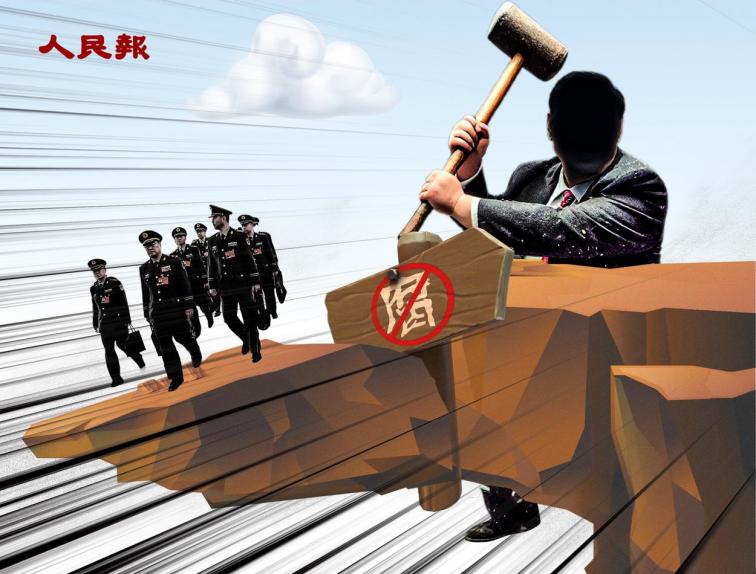
Xi Jinping’s Central Committee and the Military in Fierce Infighting (Graphic by People News)
[People News] Many believe that the term 'change of dynasty' is confined to thick history books. However, if you close the book and reflect on the events that have transpired in mainland China over the past two years, you will notice that the scenes reminiscent of a nation's impending collapse are now unfolding one by one. Xi Jinping is the last generation of leaders of the Communist Party.
Xi Jinping's 'Great Power, Diminished Authority' and the 'Two-Faced' Officials
Let’s first examine the officialdom. Over the past two years, a peculiar atmosphere has emerged in Beijing's political circles, which can be summarised in four words: 'Great Power, Diminished Authority.' The personnel and military power that Xi Jinping currently wields is indeed the most significant since Mao Zedong, yet paradoxically, his personal prestige has plummeted to an all-time low.
Consider the current officials; during meetings, they sit upright, taking notes more diligently than anyone else, with the word 'loyalty' seemingly etched on their foreheads. However, once the meeting concludes and they return home to close the door, they present an entirely different persona.
This is not mere conjecture. Anyone can review the reports from the discipline inspection commissions over the past two years, which are quite revealing. Previously, when corrupt officials were apprehended, the reasons cited were typically 'power-for-sex transactions and accepting large bribes.' However, a particularly notable new charge has emerged. For instance, Wang Xiaoguang, former member of the Guizhou Provincial Committee and former vice governor, and Chen Zehun, former member of the Changsha Municipal Committee and former executive vice mayor, along with dozens of other officials, are all explicitly reported: 'hoarding and reading publications with serious political issues.'
What is the identity of these individuals? They are the mentors who guide their subordinates in learning 'thought' on a daily basis, and they are the elites who have risen to the top within the system. What books are unavailable to them at home? Why do they risk losing their positions and being reassigned to secretly read overseas political analyses and those 'reactionary publications' that have been censored by the CCP?
The answer is simple: they no longer believe the narratives presented by the official media. They are more eager than the general public to know when this ship will sink and what the future holds. This ideological collapse is rotting from the ground up. The officials at the grassroots level are not naive; everyone is aware of the reality, and the flattery being offered is merely a form of 'political performance.'
Behind this performance lies profound fear and insecurity. Insiders have disclosed that all grassroots civil servants have had their passports confiscated, and even retired senior officials are not exempt. What does this approach of treating millions of officials as 'prisoners' yield? It leads to a culture of collective 'false loyalty' and 'double-faced individuals.'
Currently, a trend of 'political inertia' is prevalent in the officialdom: if no directives come from above, subordinates will not take action; if directives are issued, subordinates will execute them mechanically, and if something goes awry, the blame falls entirely on those above. Everyone is playing a role, waiting for that 'final moment' to arrive.
What keeps Zhongnanhai awake at night is a profound and ingrained hatred. Over the past few years, Xi Jinping has consolidated his power through anti-corruption campaigns, arresting millions. Each of these individuals has a family, influence, and descendants. An independent commentator, Du Zheng, was told by a friend that the son of a high-ranking official, who lost everything after being purged, has been secretly plotting for years with a singular aim: to 'stab Xi'.
This situation transcends mere political disagreement; it has evolved into a deep-seated blood feud. Xi Jinping is now arresting even his most trusted aides, whom he personally promoted, as seen in the recent uproar over the military purge. This 'turning the knife inward' strategy has left him surrounded by adversaries.
This exemplifies a classic 'last dynasty atmosphere': the more power the leader centralises, the more it resembles a taut rubber band—seemingly resilient, yet ready to snap at any moment. The entire court, both civil and military, is filled with actors, and his trusted aides have turned into traitors. Such a scenario, where one cannot win the 'hearts of officials', typically arises only on the eve of a regime change in history.
Officials are waiting for a shift in power; the helmsman of this ship has effectively been rendered powerless. He believes he controls everything, but in reality, he only manages a vast 'political troupe' that is poised to disband at any moment.
The bureaucracy is rotten to the core; where does the funding for this performance come from?
The economy is ensnared in a deadlock, and the financial situation is 'oil dry and lamp exhausted'.
Currently, the financial condition in mainland China can be succinctly described by an old saying: 'oil dry and lamp exhausted.'
When people watch the news, they may perceive that the real estate sector is in decline and that young people are struggling to find jobs, which they consider the biggest crisis. However, the real issue that has plunged Zhongnanhai into crisis is the banking system that has been severely depleted.
Let’s look at some concrete figures. Currently, China’s total debt has surpassed three times its GDP. Who is responsible for this debt? Primarily local governments. In the past, when land prices were high, selling a plot of land could easily cover debts, and everyone benefited. Now, with the real estate market completely stalled, land sales have come to a standstill, and local governments have become the largest “deadbeats.”
So what happens when the government lacks the funds to repay the banks? Xi Jinping’s approach is straightforward: treat banks as “ATMs.” Banks are compelled to purchase government bonds that are unlikely to be repaid, and they must also provide financial support to state-owned enterprises that are unable to pay their employees. What is the outcome? The interest margin for banks has now fallen below the critical survival threshold of 1.3%. In simpler terms, every transaction banks engage in is currently a loss, relying solely on the deposits of ordinary citizens to stay afloat.
Just a few days ago, on May 1st, the Chinese Communist Party announced a rather absurd, even “shameless,” new regulation.
The Supreme Court issued a judicial interpretation that raised the prosecution threshold for the crime of “unknown sources of huge property” from the original 300,000 to an astonishing 3 million.
Currently, banks are in a severe cash crunch, and the general public is reluctant to take out loans. Consequently, the government has turned its attention to those 'small corrupt officials.' This new policy effectively sends a public message: 'Department heads and section chiefs, quickly bring out the black money you've hidden under your beds or stuffed in your ceilings and deposit it in the bank! As long as it doesn't exceed 3 million, we won't inquire about its source or arrest you, and this money will be considered laundered.'
This situation illustrates just how depleted the finances have become. How is this different from the late Ming Dynasty, when Emperor Chongzhen pleaded with officials to donate money to save the nation? This approach is akin to drinking poison to quench thirst, relying on laundering illicit funds to provide a lifeline to a faltering banking system. However, there will inevitably come a day when the dirty money runs out, and the remaining debts will continue to accumulate interest without end.
Adding to the woes is the external 'deadlock.' The conflict between the U.S. and Iran is intensifying, oil routes in the Middle East are being disrupted, and oil prices are soaring. As the world's largest importer of crude oil, China is directly passing these costs onto its citizens. Simultaneously, the U.S. is poised to impose hefty tariffs. If a 60% comprehensive tariff is implemented as anticipated, China's last remaining ability to sustain itself through exports will be completely cut off.
When a country faces empty banks, a government that is evasive, and a halt in foreign trade, it enters a vicious cycle. In the past, the Chinese Communist Party relied on 'economic growth' to legitimise its rule, implying that as long as people had enough to eat, they wouldn't concern themselves with governance. Now, with the prospect of losing that security, will people still heed your words?
The lack of funds for wages means that the stability maintenance apparatus will come to a halt; without financial support for grassroots levels, government directives will become entirely ineffective. This is why Xi Jinping is referred to as the 'last generation,' as he has squandered the savings accumulated by the Communist Party over decades in this high-stakes gamble.
From despair to a surge in 'loyalty' incidents
Currently, the prevailing sentiment in mainland society can be encapsulated in two words: 'tense.' Have you noticed that in recent years, the frequency of chilling 'random violence' incidents has reached an unsettling level?
From drivers colliding with elementary school students after school to the 'invincible individuals' randomly attacking people in shopping malls, the public has coined a historically resonant term for this phenomenon - 'loyalty incidents.'
Why are these individuals seeking revenge on society? A closer look at their backgrounds reveals a striking similarity: economic ruin, lack of avenues for grievances, single and unemployed, and a complete loss of hope for the future. This is not merely a public safety issue; it signifies the complete breakdown of the social contract. Previously, people believed that as long as they followed the law and worked hard, life would continue. Now, millions of highly educated young people are discovering that the culmination of a lifetime of effort leads to delivering takeout or returning home to 'live off their parents.'
When it comes to young people, the statistics tell a compelling story. In the 2026 national examination, there were 38,000 positions available, yet over 3.7 million individuals registered and passed the review. What kind of despair lies behind this staggering 100 to 1 competition?
What does this signify? It signifies that, in the eyes of young people in China, aside from securing a meagre share within the system, the outside world appears to be a barren wasteland devoid of any opportunities. When the elites of a nation are all vying to become mere cogs in the stability maintenance machine, the country's creativity has effectively perished.
Even more absurd developments are on the horizon. On May 1st of this year, Beijing enacted the strictest drone ban in history. The entire city is prohibited from flying or selling drones, and even possessing more than three at home is deemed illegal. Why would a regime that controls the data of 1.4 billion people, with countless surveillance satellites overhead and hundreds of millions of cameras underground, be so intimidated by small machines worth just a few thousand yuan?
It is because it fears 'decapitation'; it fears low-cost retaliation. This reflects an intense 'security anxiety' deeply rooted within Zhongnanhai. The security measures for leaders during their outings have escalated to the extent of 'clearing airspace, closing roads, and requiring everyone to turn their backs'. This reveals a painful reality: Xi Jinping trusts no one anymore. He does not trust the populace, nor the officials he has appointed, and may even distrust the guards surrounding him. When a ruler feels the need to transform the capital into an electronic quarantine zone to feel secure, he has, in fact, become the loneliest prisoner in that city.
A popular saying among the public today is: 'We are the last generation.' This sentiment goes beyond merely choosing not to have children; it represents a 'spiritual reckoning' against this system. Lacking the support of both the populace and officials, even technological advancements have turned into a nightmare for the rulers. This state of mutual constraint between the upper and lower classes, along with the opposition between officials and the people, epitomises the typical condition of 'the end of a dynasty' in history.
When everyone has lost hope for the future, and the despair at the bottom of society has turned into a powder keg ready to explode, this ship cannot be salvaged by mere repairs.
Internal issues have reached a critical juncture, while external threats loom large. Xi Jinping initially aimed for a 'rise of the East and decline of the West,' but instead, he has faced a 'solid wall of containment' from the global community.
The international 'iron wall'—when the accelerator collides with the southern wall of civilisation.
When Xi Jinping assumed power, he was dealt a favourable hand: decades of globalisation benefits, the world's second-largest economy, and a Western world eager to engage in business with China.
However, by 2026, what will have become of this hand? It’s not just the United States; even Europe, which previously preferred a conciliatory approach, and neighbouring Southeast Asia, are now uniting to construct a technological and trade barrier against China.
The most talked-about issue recently is the US-Iran war. Zhongnanhai initially believed that chaos in the Middle East would force the US to divert its attention from Asia, allowing China to seize the opportunity. However, this calculation was misguided. Once the war erupted, the oil supply from the Middle East became perilous, posing a 'strangulation' risk for China's manufacturing sector, which heavily relies on imported energy.
Even more distressing is that the US-Iran conflict has exposed the reality of Chinese weaponry. Iran's air defence systems, which claim to intercept everything, are largely based on Chinese technology and were thoroughly penetrated in actual combat. This has made the global democratic alliance aware of a crucial fact: Xi Jinping's years of prioritising a 'military-first policy' have funnelled the people's life savings into the military-industrial sector, resulting in 'paper tigers.' This has unexpectedly bolstered the confidence of neighbouring countries that were previously wary of communism.
Meanwhile, a new wave of tariffs has been raised. Xi Jinping's current initiative of 'dual circulation' essentially aims to lead China towards a state akin to North Korea. However, the issue is that the people under Kim Jong-un have endured hardship and can tolerate it; in contrast, the Chinese have thrived through globalisation and have experienced the world. Now, you want everyone to shut themselves in and live on limited resources while diverting them to military buildup for confrontation. This is not a rescue for the Communist Party; it is a self-imposed isolation from the civilised world.
Is Xi Jinping the 'last leader'?
Why do we say Xi Jinping is the 'last leader'? Because we are facing a 'deadlock'. He has dismantled the succession mechanism and taken all the pressure upon himself, indicating that this system has lost its 'flexibility'. If he can no longer sustain himself physically, or if the banking crisis erupts completely, the entire structure will collapse in an instant, leaving no buffer.
As noted by an insider, those 'two-faced individuals' within the bureaucracy are actually waiting. They are anticipating that 'final moment' to arrive, and when it does, in a bid for self-preservation, they will take it upon themselves to settle accounts with this corrupt and decaying Communist Party that has long been in debt.
Xi Jinping's consolidation of power has reached its zenith, but he has also depleted all trust. He has personally closed the door on reform and opening up, and has dismantled the last supporting wall of the empire. History will not offer a second chance. The officialdom, economy, and society behind him have become so parched that a single spark could ignite a catastrophic situation.
From the 'two-faced individuals' in the political arena, the 'dirty money propping up the economy', the 'outburst of hostility' in society, to the 'iron curtain of the Cold War' in international relations, each of these four issues, when viewed through the lens of history, signals a potential regime change. This is especially significant as these four forces converge at the same moment. Our generation may indeed witness the final act of this decades-long drama unfold under his direction. After Xi Jinping, there will be no successors in the Chinese Communist Party (CCP).
We will all serve as the most genuine witnesses to this historical moment. Many people wonder what ordinary citizens should do if all of this comes to pass. The answer is simple: 'Stay alert.' Recognise the frailty behind those grand narratives, safeguard your finances, and protect your loved ones.
As represented by the undercurrents associated with the son of that high-ranking official, everyone aboard this ship is essentially searching for a lifeboat. When the final act concludes, it may not be an individual in Zhongnanhai who determines China's future, but rather each of us ordinary people who refuse to be complicit with evil. A wise person avoids standing under a crumbling wall; steering clear of malevolence is the prudent course of action.
(First published in People News)
△





News magazine bootstrap themes!
I like this themes, fast loading and look profesional
Thank you Carlos!
You're welcome!
Please support me with give positive rating!
Yes Sure!