
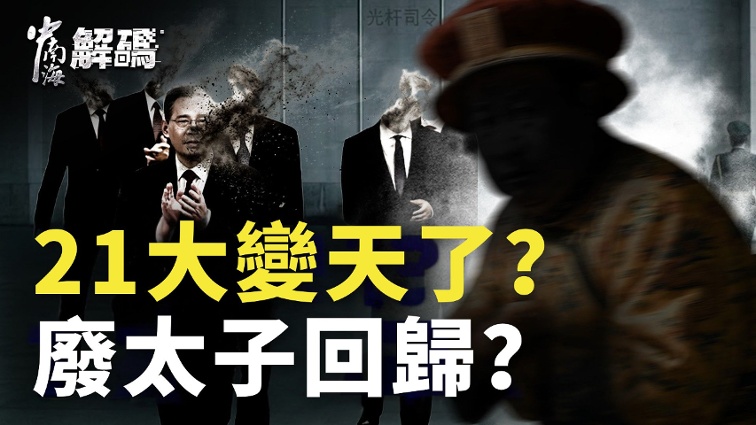
Will the 21st Party Congress bring a dramatic change? Is the ‘deposed crown prince’ making a comeback? (People News)
[People News] According to the political cycle of the Chinese Communist Party (CCP), the '21st National Congress' is set to take place in the autumn of 2027. Traditionally, this would have been a straightforward 'cake-sharing' meeting: determining who will succeed, who will join the Standing Committee, and who will step back into a secondary role. Under the established norms of 'seven up, eight down' and 'intergenerational designation', the outside world could usually predict the outcomes with considerable accuracy.
However, there has been an unprecedented surge of intense debate in political commentary circles, both at home and abroad, regarding the personnel arrangements for the 21st National Congress. Why is this happening? Because all previous 'rules' have been broken. The 'seven up, eight down' principle is no longer in play, 'intergenerational succession' has vanished, and even the identity of the 'number two figure' has become ambiguous. Meanwhile, China is grappling with numerous economic challenges, including rampant unemployment, supply chain disruptions, and a mass exodus of individuals. Yet, within the confines of the Party, this power struggle has transformed into a life-and-death contest.
What kind of structure will emerge at the upcoming 21st National Congress? Based on the latest developments and policy documents, there are four major versions of the personnel layout for the '21st National Congress'. This issue extends beyond mere personnel changes; it raises questions about how much longer the CCP, often likened to a sinking ship, can remain afloat.
The Re-election Faction—Xi Jinping's Familiar Politics
Let’s examine the first version, which is also the one that Xi Jinping is most eager to achieve: re-election after all.
Independent commentator Du Zheng highlighted a key detail regarding Xi Jinping's personnel choices: he adheres to a strict principle of 'only using familiar faces.' Regardless of one's capabilities, if an individual has not previously collaborated with him or assisted him with personal matters, he does not place his trust in them. Du Zheng predicts that the list of Standing Committee members from the 21st National Congress will reflect a significant 'ageing' trend.
With the recent downfall of Zhang Youxia, who was rumoured to be conspiring with the elders to block Xi's re-election, it seems unlikely that Xi will step down from any of his roles within the party, government, or military. Xi Jinping is set to retain his positions as General Secretary, President, and Chairman of the Central Military Commission. To secure his hold on power, he will rely on a cadre of 'old ministers' to support him.
Li Qiang, born in 1959: Despite the current economic situation, he is expected to remain as Premier. In Xi Jinping's view, he is not an economic expert but rather a compliant 'steward.' Xi needs him to continue serving as a protective shield on the front lines.
Cai Qi, born in 1955: He is anticipated to be appointed as Chairman of the National Committee of the Chinese People's Political Consultative Conference. The reason for this is that Xi Jinping now regards 'unifying Taiwan' as the sole legitimate basis for his re-election. Having spent time in Zhejiang, Cai Qi is well-versed in the strategies of united front work and internal disintegration, making him the most trusted choice for infiltration efforts.
Ding Xuexiang, born in 1962: As the youngest member of the Standing Committee, he is likely to be appointed as Chairman of the National People's Congress, effectively managing this 'voting machine' for Xi Jinping.
Wang Huning, born in 1955, is likely to be appointed as the Vice President of China, but not in a nominal role like Han Zheng. Instead, he is expected to serve as a powerful 'behind-the-scenes strategist,' continuing to manage the unrestricted warfare against the United States and the united front efforts regarding Taiwan.
Li Xi and Zhao Leji: Zhao Leji is reportedly in poor health, while Li Xi is entangled in cases involving Ma Xingrui and others. Both are anticipated to retire safely.
This means that during the upcoming reshuffle of the Standing Committee of the Communist Party of China's Political Bureau, there may only be three available positions: the First Secretary of the Central Secretariat, the Executive Vice Premier, and the Secretary of the Central Commission for Discipline Inspection. So, who will fill these vacancies?
Li Shulei, currently the Minister of the Propaganda Department and a Secretary of the Central Secretariat, is the most likely candidate to succeed Cai Qi as the First Secretary of the Secretariat, thereby entering the Standing Committee and overseeing party building, propaganda, and related areas.
Among the current Vice Premiers, Zhang Guoqing, who oversees industry, and Liu Guozhong, who oversees agriculture, are both strong contenders to join the Standing Committee, potentially replacing Ding Xuexiang as Executive Vice Premier. Given the ongoing military-industrial anti-corruption campaign, Zhang Guoqing is at a disadvantage, while Liu Guozhong, who previously governed Shaanxi, is expected to have the upper hand.
Regarding the Secretary of the Central Commission for Discipline Inspection, Xi Jinping still has competitive 'familiar faces' in local politics. One is Zhao Yide from the Zhejiang faction, currently the Secretary of the Shaanxi Provincial Committee, and the other is Xu Lin from the new Shanghai faction, who serves as the Secretary of the Guizhou Provincial Committee. One of these two may also compete for the position of Secretary of the Central Commission for Discipline Inspection, with Zhao Yide having a higher likelihood.
Additionally, Chen Min'er, the former successor and Secretary of the Tianjin Municipal Committee, has left behind numerous unfinished projects in Guizhou, and the corruption case involving big data in Guizhou is still unfolding. It is unlikely that he will enter the Standing Committee, and he may only retire to the National People's Congress or similar roles.
Perhaps the most unexpected development is the exclusion of Chen Jining, the Shanghai Municipal Party Secretary, who was once considered a strong contender for the Politburo Standing Committee. Xi Jinping perceives him as 'not familiar' enough or lacking in loyalty, which disqualifies him from the Standing Committee. Similarly, candidates like Yuan Jiajun from Chongqing and Yin Li from Beijing have also missed their opportunities to join.
In summary, the list for the 21st Central Committee of the Communist Party of China Politburo Standing Committee, along with the appointments expected at next year's 'Two Sessions', is approximately as follows:
Xi Jinping will continue as General Secretary of the Communist Party, President of the State, and Chairman of the Central Military Commission; Li Qiang will remain as Premier of the State Council; Cai Qi will be reassigned as Chairman of the National Committee of the Chinese People's Political Consultative Conference; Ding Xuexiang will take on the role of Chairman of the Standing Committee of the National People's Congress; the Executive Vice Premier will be either Zhang Guoqing or Liu Guozhong; Li Shulei will be promoted to First Secretary of the Central Secretariat; and Zhao Yide or Xu Lin will be elevated to Secretary of the Central Commission for Discipline Inspection.
The underlying rationale for this version is a focus on 'stability'. Xi Jinping prefers a mediocre but compliant old associate over a new figure with strong opinions. This is why someone like Chen Jining, who possesses an international outlook, is viewed as a potential threat from Xi Jinping's perspective.
The Transitional Faction: Ding Xuexiang and the 'Ruthless Regent' Cai Qi
If the first scenario depicts Xi Jinping's 'determined effort to the end', then the central figure in the second scenario is Ding Xuexiang.
Many people perceive Ding Xuexiang as 'Xi Jinping's big secret', always trailing behind Xi with a briefcase in hand. However, it is important not to underestimate him; he was the only member born in the 1960s to join the Politburo Standing Committee during the 20th National Congress, which sends a strong signal in itself.
Why did Xi Jinping select Ding Xuexiang?
Ding Xuexiang possesses a unique ability known as 'understanding without being told'. When Xi Jinping assigns a task, he often only provides the initial direction, and Ding Xuexiang is able to manage all the details effectively, all while maintaining a low profile and never overshadowing others. As he puts it, this is about 'being in the position of a soldier while strategising like a general'. This readiness to remain in the background is what makes Xi Jinping feel most secure.
If Ding Xuexiang were to succeed Xi, the narrative for the 21st National Congress would unfold as follows:
Xi Jinping would nominally transfer the roles of 'General Secretary' or 'President' to Ding Xuexiang, but he would firmly retain the position of Chairman of the Central Military Commission. This mirrors the strategy used by Putin when he allowed Medvedev to assume the presidency while he returned to the role of prime minister to maintain real power.
This arrangement offers three significant advantages for Xi Jinping: it silences the elders, provides a protective cover, and most crucially, ensures that power does not diminish.
Ding Xuexiang lacks his own faction within the party and does not command his own forces; his sole support in Zhongnanhai is Xi Jinping. His rise to the position of General Secretary effectively serves to help Xi Jinping safeguard his position, while Xi Jinping 'listens to the government from behind the curtain', and with just a single word, he can replace Ding at any moment.
Ding Xuexiang is currently adopting a very low-profile demeanour, which is actually a lesson from Xi Jinping. He is waiting to see if there will be an opportunity to become the nominal 'Number One' in 2027.
However, it is important to recognise a key truth: Ding Xuexiang's potential succession does not signify the end of Xi Jinping's political line; instead, it indicates a 'refinement' of that line. Xi Jinping is likely to use Ding Xuexiang's mild exterior to conceal his more hardline core principles.
Nonetheless, this scenario has a significant variable: Cai Qi. Cai Qi controls the Central Guard Bureau; will he simply allow Ding Xuexiang, his junior, to surpass him?
Another possible succession scenario is that Cai Qi effectively takes power, becoming the true 'regent.'
Currently, foreign media are suggesting that Cai Qi is the 'Number Two figure,' but in reality, he may already be 'One and a Half.'
To begin with, Cai Qi holds three key positions: Director of the General Office, First Secretary of the Secretariat, and, most importantly, the Director of the Central Guard Bureau. In simple terms, Cai Qi oversees what Xi Jinping eats daily, who he meets, and his security arrangements. Some analyses even suggest that following the Zhang Youxia incident, Xi Jinping, driven by a profound fear of a coup, has been compelled to rely heavily on Cai Qi to the extent of being 'marginalised.'
Secondly, there is Cai Qi's mentality of self-preservation. He is acutely aware that he has no allies within the party, only adversaries. If Xi Jinping were to resign or face an unexpected incident, Cai Qi would be the first to face retribution from the entire party. Thus, his only path to survival is to firmly hold onto power before the 21st National Congress. He aims to use Xi Jinping's authority to eliminate all opposition and transform Zhongnanhai into his personal secret agency.
Cai Qi embodies the archetype of a cruel official from ancient times. Xi Jinping employs him to manage the tumultuous era, but the primary issue with such officials is that once they amass power, they pose the greatest threat to the emperor himself.
While Cai Qi has managed to stabilise the situation for Xi Jinping, he also possesses all of Xi Jinping's hidden secrets. The two are now in a 'back-to-back' relationship of shared fate, unable to separate from one another, yet neither can rest easy.
However, is there truly no one in Zhongnanhai willing to resist? The sidelined elders, along with figures like Hu Chunhua, who have been marginalised yet are still biding their time as 'former crown princes,' are they really content to wait for their demise? The fourth scenario involves Hu Chunhua's final counteroffensive alongside the elder faction.
Counterattack Faction - Hu Chunhua and the Elders' Final Showdown
Many may find it puzzling that Hu Chunhua was removed from the Politburo during the 20th National Congress and sent to the Chinese People's Political Consultative Conference to 'drink tea.' How has he suddenly become a hot topic again?
Over the past year, Hu Chunhua has made frequent high-profile visits, with an unusually high level of protocol, accompanied by many officials who were former subordinates of Li Keqiang and Hu Jintao. These individuals now share a singular thought: Xi Jinping's policies have devastated the economy and strained international relations. If this continues, the Communist Party's ship is bound to sink.
In this 'counterattack' scenario, the events of the 21st National Congress may unfold as follows:
The elder faction, including figures like Zeng Qinghong and Wen Jiabao, is currently waiting for an opportunity. What kind of opportunity? A complete economic collapse or significant social unrest. If the public faces starvation or the unemployment rate skyrockets, they will unite to apply pressure on the eve of the 21st National Congress, demanding a personnel change under the banner of 'saving the Party.' Their argument is compelling: if we don’t change leadership now, we will all face disaster together.
Hu Chunhua is the card they are holding. He has a solid understanding of the economy and local governance experience. Most importantly, he embodies the 'reform and opening up' legacy of Deng Xiaoping. The elders aim to elevate him to signal to the outside world: China is returning to normalcy, so everyone should come back and invest. This represents a collective backlash from the Party's bureaucratic system against the 'Cultural Revolution-style governance.'
Despite Zhang Youxia being unexpectedly ousted by Cai Qi, there remains significant dissent within the military. Many are deeply resentful of this 'secret police governance.' If the elder faction can secure the tacit approval of these dissenters, the 21st National Congress will not merely be a meeting, but rather a confrontation.
Hu Chunhua's current low profile is essentially a strategy to buy time, waiting for Xi Jinping to make a mistake and for the economy to collapse completely.
However, this approach has a critical flaw, stemming from the calculations of Zeng Qinghong and his associates. While they are discontent with Xi Jinping, they are even more fearful of the Communist Party's potential collapse. As a result, they are ambivalent about Hu Chunhua, concerned that he might advocate for 'liberalisation' if he comes to power, which could jeopardise the Communist Party's existence. This conflicting mindset complicates Hu Chunhua's path to a comeback, framing it as a life-and-death struggle between 'preserving the Party' and 'preserving Xi.'
The Final Struggle of Zhongnanhai
From these four scenarios, it is evident that Zhongnanhai is in its final struggle.
Whether Xi Jinping continues his leadership, Ding Xuexiang steps in, Cai Qi assumes a regent role, or Hu Chunhua returns, none of these options can address the most fundamental issue: the system is outdated and cannot adapt to the current era.
Xi Jinping hopes to extend his tenure by relying on 'familiar faces' and 'harsh officials,' but he finds that those around him are 'lying flat.' The elders aim to save the Party through 'changing personnel,' yet they discover that power has long been seized by the secret police apparatus. The 21st National Congress, while ostensibly a personnel power exchange, is in reality the CCP's last struggle for survival.
(Source: Zhongnanhai Decoded) △






News magazine bootstrap themes!
I like this themes, fast loading and look profesional
Thank you Carlos!
You're welcome!
Please support me with give positive rating!
Yes Sure!