
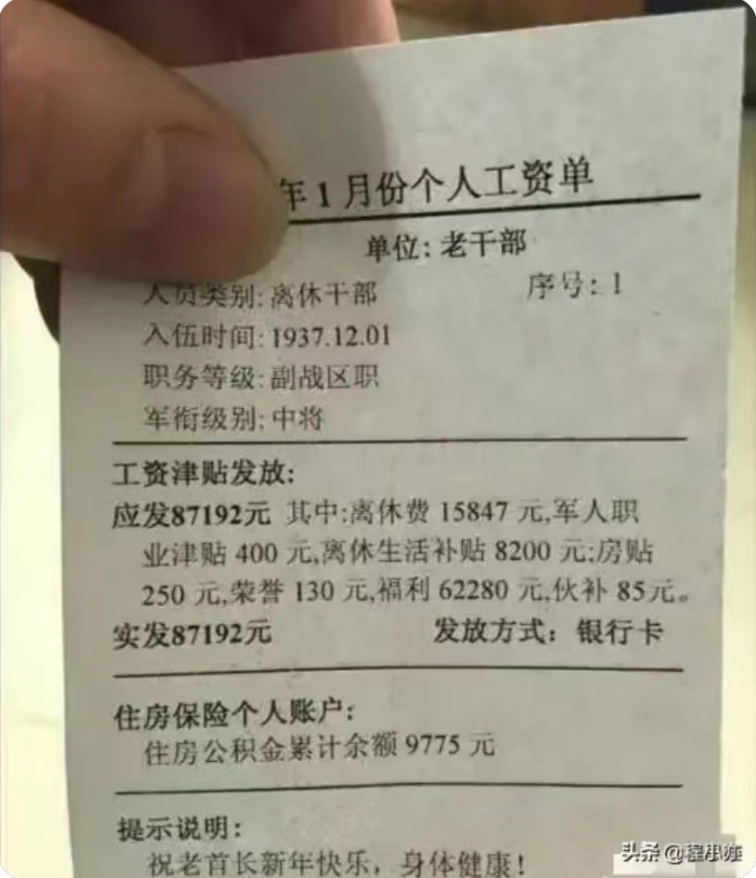
A netizen has publicly shared a salary slip from a retired military official for one month, revealing that the official received a total of 87,192 yuan in January of a certain year, which includes base salary and various high allowances. (Screenshot from X platform)
[People News] In recent years, the Beijing authorities have claimed to be actively promoting policies related to 'common prosperity' in an effort to address income and wealth inequality in China. On February 25, 2021, General Secretary of the Communist Party Xi Jinping announced the successful achievement of 'comprehensive poverty alleviation,' yet the actual economic conditions in China have raised significant scepticism within the international community.
In reality, the idea of 'common prosperity' was introduced by the Communist Party in 1992, but after more than 30 years, it remains unfulfilled; instead, the wealth gap has widened even further.
The Communist Party's pension policy is highly inequitable, with a stark contrast between the benefits received by officials and those of ordinary citizens. Recent data indicate that in six provinces, farmers' pensions are less than 120 yuan per month, while some public officials receive pensions exceeding five digits, leading to public outcry.
According to the latest data, among the 31 provinces in China, six provinces have farmers' pensions below 120 yuan per month, with Heilongjiang at 108 yuan; Hubei, Jilin, Gansu, and Anhui ranging from 113 to 118 yuan; and Yunnan at a mere 103 yuan.
In stark contrast, retired personnel from Communist Party agencies and institutions receive pensions exceeding 6,000 yuan per month, which is 30 times that of farmers.
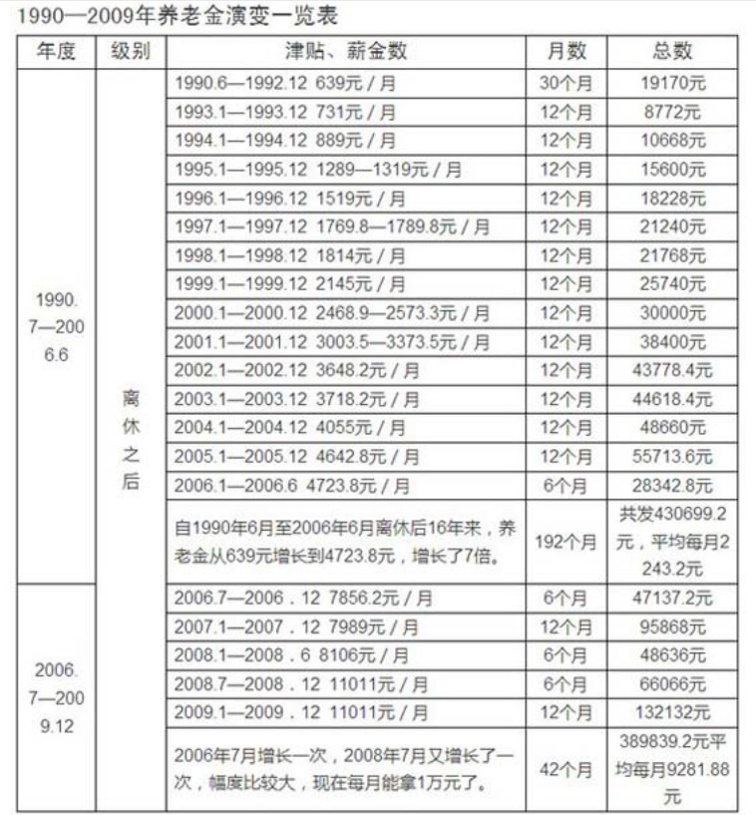
A table detailing the evolution of the retirement pension for retired Major General Wang Keqing from 1990 to 2009 reveals that his monthly pension amounts to 10,000 yuan. (Image from the internet)
In December 2021, a netizen on platform X, known as 'Xie Wanjun', shared a salary slip of a retired military officer, which showed that the officer earned a total of 87,192 yuan in January of a certain year, including salary and various substantial allowances.
In April 2023, another netizen on platform X, 'Zhengjing Lu Shezhang', released a salary slip for a retired official at the ministerial level named Zheng, indicating that this official received a total of 49,249 yuan in salary and allowances in January of a certain year.
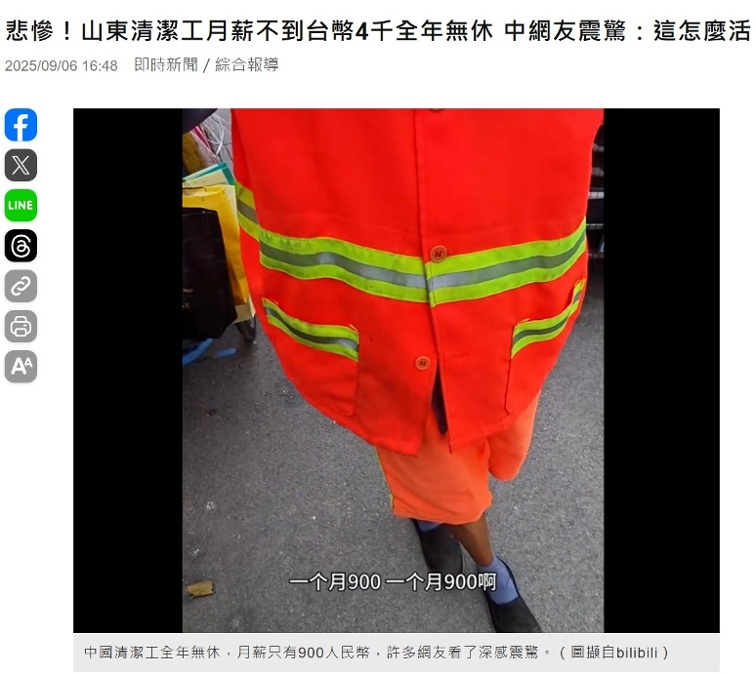
In Shandong, the monthly salary for a cleaner is just 900 yuan.
According to a report by Liberty Times on September 6, 2025, a video circulating on the Chinese video platform Bilibili features an interview with a 74-year-old cleaner (sanitation worker) in a small county in Shandong. It was revealed that this worker has no days off throughout the year, working from 6:30 AM to 11:30 AM, then after a lunch break, from 2 PM to 6:30 PM. With a monthly salary of only 900 yuan and no retirement pension, many Chinese netizens expressed their shock, questioning how one can survive under such conditions.
The reality starkly contrasts with the statements made by the leader of the Communist Party of China, revealing a significant disparity. Recently, a Chinese economist published a report asserting that there are 'structural problems' with the policies related to 'common prosperity'. He believes that the wealth gap in Chinese society is continuously widening and has urged the authorities to implement 'structural reforms' to address the current economic challenges facing China.
According to a report by the Hong Kong South China Morning Post, Li Shi, the director of the Institute for Common Prosperity and Development at Zhejiang University, recently released a research report indicating that the Gini coefficient, which measures wealth disparity, has surged from 0.45 in 1995 to 0.7 in 2023. He suggests that the actual economic conditions in China may significantly diverge from the optimistic figures released by the government. Li Shi noted that household income growth is currently slowing, and household consumption capacity is on the decline, emphasising that the authorities must push for 'structural reforms' to tackle the ever-widening wealth gap.
Li Shi remarked, 'The slowdown in economic growth, weak consumer demand, declining investment momentum, and employment pressures have constrained the development of the economic environment.' Meanwhile, income inequality in China continues to deteriorate, with the wealth gap among the populace expanding, contrary to the government's claims of a gradual reduction. 'We believe this data indicates that China is in 'urgent need' of policies aimed at rebalancing income.'
Additionally, the article "The Issue of Wealth Disparity in Mainland China," authored by Assistant Professor Xu Zhijia of Ming Chuan University, highlights that the concentration of wealth among a small elite is becoming increasingly apparent. Media reports reveal that there are currently 5 million individuals in mainland China who are millionaires with assets exceeding 10 million RMB, including 20,000 individuals whose net worth reaches 100 million RMB. In stark contrast, around 30 million people in rural areas live in absolute poverty, with an annual per capita income below 637 RMB. When considering those who are precariously above the poverty line with an annual income of 800 RMB, the total number of rural poor in mainland China rises to 100 million. Furthermore, when urban poverty is taken into account, official statistics indicate that 56 million people live in poverty in mainland China, while the World Bank estimates that the number is as high as 200 million.
The article suggests that social inequality poses a potential threat to the stability of the Chinese Communist Party's regime. The widening wealth gap has led to various societal issues, with the most pressing being social inequality. A new class of wealthy individuals and a class of impoverished people have emerged, with party officials and private entrepreneurs forming the "new wealthy class," while the large impoverished population has developed a "hatred of the rich" mentality. This growing sentiment of inequality and opposition within society could jeopardise social stability at any moment.
Secondly, the poor are increasingly turning to crime as a means of survival, which poses a significant threat to public security in mainland society and often acts as a ticking time bomb for social stability. The main source of this impoverished population consists of unemployed workers who have been laid off from urban jobs. Many of these laid-off workers frequently organise demonstrations and protests to advocate for their rights, striving to avoid falling into desperate situations.
Xu Zhijia points out that the widespread dissatisfaction among the large impoverished class not only affects public security but may also lead to discontent directed at the Communist Party officials and the government. If this imbalance of emotions is not managed, it could evolve into a significant force challenging the mainland regime. The authorities in mainland China must confront the risks to social stability posed by the growing wealth gap.
Many experts believe that the widening wealth gap is fundamentally a result of systemic design rather than simply a failure of the market. Particularly under the dictatorship of the Communist Party, there is a lack of an independent judiciary and civil society, resulting in unchecked power. This system exacerbates the elite's plundering of wealth, rendering the wealth gap a structural issue within society that cannot be resolved through political propaganda alone. △







News magazine bootstrap themes!
I like this themes, fast loading and look profesional
Thank you Carlos!
You're welcome!
Please support me with give positive rating!
Yes Sure!