

Zhang Xuefeng (Made by ChatGPT)
[People News] Zhang Xuefeng, a grassroots internet celebrity who rose from a poor county in Heilongjiang, became known for exposing the information gap in education. Yet at the peak of his career, he pressed the stop button on his own life. While he was immersed in the illusion of being a “hero breaking information barriers,” he was struck down by his own lack of health awareness just before the triumphal arch of his career. His “workaholic” story spread among those from humble backgrounds, but his death reflects the layered and brutal “killing lines” within the CCP system.
First Killing Line: Overwork Death at the Bottom and the Consumable Nature of Life
According to China Youth Daily, as early as 2013, the number of deaths from overwork in China reached 600,000 per year—China has surpassed Japan to become the country with the most “karoshi” (death from overwork). On average, more than 1,600 people die every day from illnesses caused by overwork.
China’s “996” work model is a systemic engine driving overwork deaths. A joint study by the World Health Organization and the International Labour Organization found that compared to working 35–40 hours per week, working more than 55 hours increases the risk of stroke by 35% and heart disease by 17%. Many Chinese workers labor more than 12 hours a day.
A study published in the journal Chinese Journal of Emergency Medicine analyzing 5,516 autopsy cases found that sudden cardiac death is the leading cause of sudden death. About 550,000 people die of sudden cardiac death each year in China, with ages 30–63 being the high-incidence group. Among young and middle-aged people, long-term high-intensity work and mental stress are major risk factors.
Amid today’s economic downturn and systemic anxiety, companies exploit employees under a “wolf culture.” Systematic overwork is glorified as competitiveness and packaged by CCP narratives as the pulse of the times. Xi Jinping has encouraged young people to “seek hardship,” while workplace burnout or “lying flat” is stigmatized as laziness. Chinese workers do the hardest work for the lowest pay. For example, U.S. manufacturing workers earn over $20 per hour (about 150 RMB), while Chinese workers earn about 30 RMB per hour. The CCP loudly calls for “great craftsmen” but never focuses on raising wages.
In this system, ordinary people’s lives are merely replaceable consumables. The faster you run, the sooner you die—because the track has already been set as a one-way path.
Second Killing Line: Educational Involution and the Trap of Class Solidification
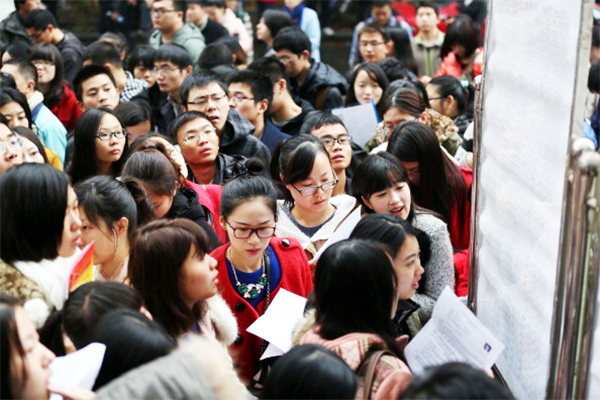
Under the CCP system, university expansion has created a diploma bubble without corresponding industrial upgrades or institutional reform. The more higher education expands, the more severe the structural imbalance in employment becomes. With over 12 million graduates each year, many cannot find jobs. The belief that education changes destiny has been disproven by class solidification and internal competition.
The urban-rural divide and the gap between those inside and outside the system force those from poor backgrounds to rely on extreme calculation to succeed. Society falls into an anxiety-driven competition. Zhang Xuefeng’s “realist” college entrance advice became popular because the system refuses to provide real fairness, equal resources, and mobility, instead shifting responsibility to individuals for making the “wrong choices.”
Although Zhang openly pointed out that the education system is no longer a fair ladder but a tool of selection and diversion, he could only teach parents how to navigate within the system’s limits, unable and unwilling to overturn its rules. Under CCP control, education does not truly impart knowledge and skills, but trains individuals to obey the system and become standardized “consumables” of the state.
Third Killing Line: Traffic Economy and Personal Brands Cannot Compete with State Power
Zhang Xuefeng transformed from lecturer to entrepreneur, with his company valued at hundreds of millions, relying on platform dividends and emotional monetization. On the surface, the CCP system tolerates or even encourages such market operations. But the ability of grassroots influencers to rise depends on the Party’s permission. Once a personal brand becomes too influential or crosses boundaries, platform restrictions, online censorship, and official warnings can occur instantly.
Zhang’s education-related remarks were repeatedly criticized by state media as “misleading” and “selling anxiety.” The traffic economy appears free but turns individuals into consumable tools. In front of the CCP’s propaganda machine, individuals are extremely small.
Fourth Killing Line: Instrumentalized Nationalism and Excessive Patriotic Expression
After the CCP’s 2025 military parade, Zhang publicly stated that if war broke out in the Taiwan Strait, he would personally donate 50 million RMB and his company 100 million RMB. This sparked controversy and drew a swift official response. His account was restricted, and he was warned about his influence.
His patriotic display gained attention, but while extreme statements can be used by the CCP to mobilize nationalism, overstepping limits or appearing to pressure the government crosses unspoken taboos. The CCP encourages slogans—but not commands. By speaking out this way, Zhang appeared to pressure the CCP toward military action, which brought serious consequences.
Fifth Killing Line: Disorder Under Totalitarian Social Control
Zhang devoted his life to breaking information gaps in education but exposed a fatal blind spot in managing his own health. What appears to be an individual tragedy is actually systemic damage.
After his sudden death, rumors about personal scandals and restrictions quickly spread. As a figure shaped by both traffic economy and authoritarian control, his rise reflects the complexity and disorder of the era. The CCP claims “people first,” yet reduces people to endlessly turning gears. It promotes “common prosperity,” yet allows anxiety and exhaustion to dominate ordinary life.
The controversies surrounding Zhang’s case signal a deeper crisis of trust and the potential disintegration of the system itself.
In CCP society, the limit of individual effort often defines the system’s true boundary. Zhang Xuefeng proved this with his life. For ordinary people, truly changing their fate is impossible without the collapse of the CCP.
(First published by People News) △




News magazine bootstrap themes!
I like this themes, fast loading and look profesional
Thank you Carlos!
You're welcome!
Please support me with give positive rating!
Yes Sure!