
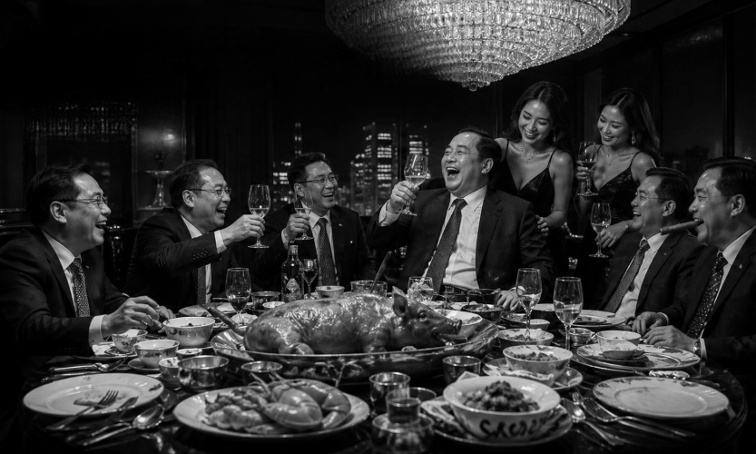
Every working day of a Chinese Communist Party (CCP) official is steeped in extravagance and indulgence. (People News/AI-generated image)
[People News] Since Xi Jinping took office, a so-called 'anti-corruption' campaign has been vigorously promoted. In the first decade of this campaign (from 2012 to just before the 20th National Congress of the CCP in 2022), nearly 5 million party members and officials at all levels were reported to have been investigated. In the subsequent years, the intensity of the anti-corruption efforts continued, with the total number of individuals punished exceeding 7 million in recent years.
According to statistics from the 20th National Congress of the CCP, 553 central management officials (those managed by the central government, primarily senior officials at the provincial and ministerial levels) have been placed under investigation, including several high-ranking national officials. The number of investigations has continued to rise each year (for instance, 45 central officials were dismissed in 2023, and 60 in 2024, etc.).
This year, according to annual statistics released by official sources and the Central Commission for Discipline Inspection (CCDI), the number of cases filed and punishments imposed by disciplinary inspection and supervision agencies remains high. For example, in 2025, over 1 million cases were filed nationwide, with 983,000 individuals punished.
It is clear that while the central government publicly champions anti-corruption, various forms of corruption within the CCP's officialdom are becoming increasingly severe, as corruption has deeply entrenched itself. Every working day, these officials, both high-ranking and low-ranking, are immersed in a ridiculous state of indulgence and extravagance.
On September 27, a user on platform X, "Jalen-USA," shared a true story that revealed that the head of a district government department in a provincial capital city under the Chinese Communist Party is a county-level cadre who only works about three hours in the afternoon each day, leaving him largely untraceable for the rest of the time.
The author expressed disbelief when he first learned about this situation. "It wasn't until I truly stepped in and gained a clear understanding that I realized reality is far more absurd than I had imagined."
The following details the daily life of this official as recorded in the post:
The director arrives at the office around 2 PM. Once there, he either holds meetings or signs documents. The office is deliberately decorated in a gloomy style to create an atmosphere of authority and seriousness.
Subordinates come in one after another to report on their work. However, he may not fully grasp the content of these reports. Typically, after listening, he simply responds with a casual, "Okay, got it."
After about an hour, business owners begin to reach out to him to arrange evening activities. He selects a restaurant based on the day's schedule and the hotel situation.
Around 5 PM, he leaves the office punctually and heads straight to the event venue.
The first event usually involves playing cards or mahjong for one to two hours, and he must win every time, which naturally boosts his mood.
Next, he moves on to the second event—at a high-end hotel. This typically takes place in a very private room, sometimes with a separate entrance. The accompanying personnel arranged by the business owners are already waiting there, and they must be young and attractive women, often more than one.
Upon his arrival, the dishes are served one after another, and the Maotai is opened. Toasts are exchanged, and the meal often lasts for about two hours.
After enjoying a lavish meal and drinks, the night is far from over. High-end KTVs, spas, foot baths, massages... a variety of entertainment activities continue.
Naturally, these venues are not easily accessible to the average person and are often shrouded in secrecy.
After reveling until one or two in the morning, late-night snacks are arranged to help ease the hangover and restore some energy.
The business owner then arranges for luxury cars to transport officials and accompanying women to an exclusive villa area, a secluded enclave of luxury homes. The owner heads home while the women stay behind, keeping one that catches his eye, and all those he is interested in remain.
Once the owner has dropped everyone off, he departs, leaving the remaining arrangements to those inside.
The next day, the festivities resume until around eleven or twelve in the morning. The owner has been waiting at the entrance early on. After the guests emerge, they are taken to a high-end restaurant for a meal to recharge and take a brief rest.
By two or three in the afternoon, they return to their offices. A new day begins, and the cycle continues.
According to the post, many of these district government officials at the department level are often the 'top leaders' of their units, typically aged between 35 and 45, which is when they are most energetic.
As for family matters, they need not worry at all. A cadre of followers, subordinates, and so-called 'insiders' will naturally handle everything efficiently.
Thus, a government department 'top leader' who appears to work only three hours a day actually leads a completely different lifestyle: spending the day in the office as a leader, navigating various banquets and entertainment venues at night, entering another realm of life in the early hours, and returning to the office the following afternoon, only to repeat the cycle.
The author describes this as a genuine representation of official life during the Xi Jinping era. The most absurd aspect is not the ridiculousness of an individual, but rather that a 'number one' in a government department can maintain such behavior for a long time without anyone being able to truly hold him accountable.

Users on platform X are hesitant to comment, noting that corruption is a widespread issue within the Chinese Communist Party's officialdom. (Screenshot from X webpage)
Netizens: A 'realistic portrayal' of grassroots officials
Many overseas netizens familiar with China's local officialdom (including those with institutional backgrounds or entrepreneurs who have interacted with the government) have remarked that the situation depicted in the post is very accurate, even to the extent of being a 'realistic portrayal.' In numerous prefecture-level cities or counties, officials at the department level (such as directors or street office heads) who possess approval and project allocation authority are the main targets of flattery and courting by various business owners. This narrative is 'not an isolated incident, but rather a common occurrence at the grassroots level.' The combination of 'winning at cards, high-end private rooms, Moutai liquor, KTV/bathing, late-night snacks, luxury villas, and arranging for beautiful women' represents the 'standard SOP' for the local business community in China to curry favor with officials. The economic costs incurred by business owners are ultimately recouped through government projects, resource allocation, or irregular approvals.
One user on X commented: 'This kind of work culture began around 2000, not just after the 18th National Congress. Don’t ask me how I know; I was once one of the section chiefs described in the text.'
Another user remarked: "As a side note, around the year 2000, one of my senior colleagues held a moderately significant official position in Mentougou. He mentioned that in Beijing, he generally wouldn't have to pay for anything. However, that's not the main point; the key issue is that the district chief he worked under in Mentougou hosted dinner parties every night, fully booked, and any dinner costing less than 150,000 yuan wouldn't even get past the secretary's approval. This was around the year 2000, mind you."
Others added: "I've witnessed this as well. Officials in China with a bit of power generally behave like this," and "If the system doesn't change, simply swapping leaders will still lead to corruption. Once they enter a closed loop of corruption, amassing over 200 million yuan, they might only receive a 15-year sentence; if they aren't exposed by the media, they can continue their corrupt practices."
In reality, based on media reports and disclosures from grassroots netizens who have managed to escape the system (such as ordinary clerks and staff members), it is evident that in the grassroots government departments of the Chinese Communist Party (CCP), those who genuinely work hard, stay late to prepare materials, and handle various forms of formalism checks and political studies are the ordinary civil servants or temporary workers at the lower levels. In contrast, those with real power, the "top leaders," are completely detached from daily operations, only needing to sign documents and listen to reports. It's no surprise that netizens say, "The grassroots cadres suffer, while the department heads enjoy themselves."
Some netizens also drew comparisons between this phenomenon and the current economic pressures faced by ordinary citizens in China, the youth unemployment rate, and the extension of retirement age, lamenting this bureaucratic lifestyle of "the rich and powerful living in luxury," which highlights the stark differences between those inside and outside the system.
Despite the authorities' loud proclamations about anti-corruption efforts, Xi Jinping's administration primarily targets officials perceived as politically disloyal in its large-scale arrests. The actual anti-corruption campaign is marked by 'loud thunder but little rain.' Furthermore, it fails to tackle the fundamental issue of insufficient oversight of power, leading to a shift in corrupt practices from 'open ostentation' to 'extreme secrecy.' This has resulted in the development of dedicated channels, private clubs, and standalone villas, as mentioned in the text, all designed to evade the eight-point regulations and create an 'underground networking chain.'
It is crucial to understand that at the grassroots or district-level departments, the 'top leader' wields nearly absolute power within their defined 'small kingdom.' The oversight from peer disciplinary inspection departments is ineffective, supervision from higher authorities is distant, and public oversight channels are obstructed. This has allowed the absurd situation of 'working three hours a day and partying every night' to persist over time.
(First published by People News) △





News magazine bootstrap themes!
I like this themes, fast loading and look profesional
Thank you Carlos!
You're welcome!
Please support me with give positive rating!
Yes Sure!