

Dong Guangping (second from left), who recently arrived in Canada, attended a Shen Yun performance in Toronto on June 27. (Photo sourced from X user Sheng Xue)
[People News] Chinese dissident Dong Guangping escaped to South Korea last month by navigating a rubber boat. In an interview with the New York Times today (June 28), he revealed that he has now flown to Canada and attended the world-renowned Shen Yun performance in Toronto on June 27.
At 68 years old, Dong Guangping was formerly a police officer in Zhengzhou, Henan. In 1999, he publicly signed a petition commemorating the 1989 Tiananmen Square incident, which crossed the Chinese Communist Party's most sensitive political boundaries. For years, he has been a target of the Beijing government and has faced imprisonment multiple times.
Dong Guangping has endured numerous challenges over the years. In 2015, he and Jiang Yafei were granted United Nations refugee status in Thailand, and the Canadian government had agreed to accept them. However, the Chinese authorities brazenly enforced cross-border law, collaborating with Thai police to forcibly abduct him back to China in Bangkok, where he was sentenced. This type of 'long-arm jurisdiction' and transnational capture has instilled fear among all Chinese dissidents fleeing to Southeast Asia, leading to widespread panic.
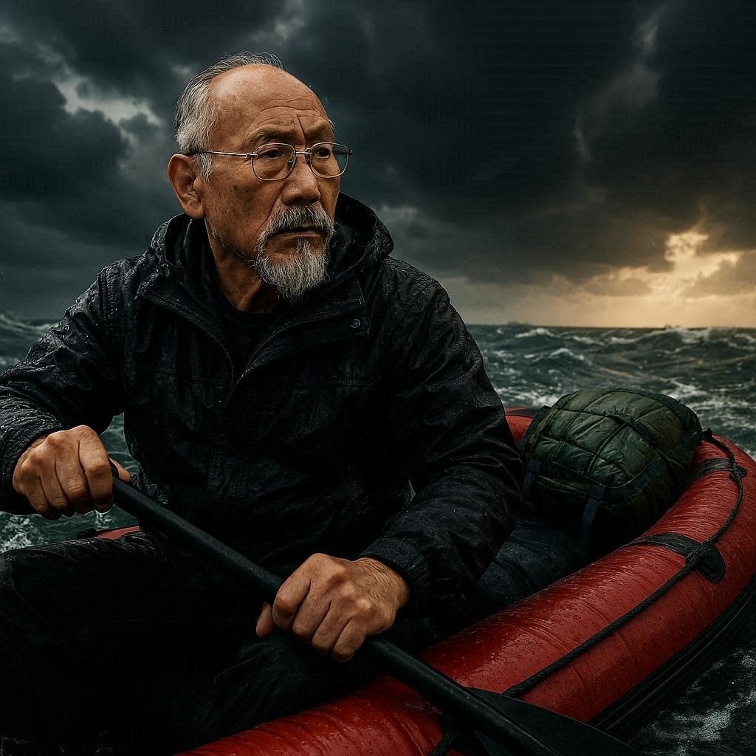
On May 25, Chinese dissident Dong Guangping bravely crossed the Yellow Sea in a rubber boat to reach South Korea. (Image generated by People News AI)
Dong Guangping's recent escape to Canada has been hailed by international human rights organizations as a 'delayed but significant victory for the global human rights camp against the CCP's transnational persecution.' This incident demonstrates that despite the extensive infiltration network of the CCP abroad, the collaborative rescue efforts of the international community and the free world—particularly the Canadian government and human rights organizations—can still penetrate the iron curtain of totalitarianism at crucial moments.
Once considered a key target by the CCP, Dong Guangping received a visa from the Canadian government, which defied political pressure and long-arm jurisdiction from Beijing to allow his entry. Geopolitical scholars interpret this as a clear signal of Ottawa's increasingly assertive stance towards China.
Canada's actions have revitalized its image as a 'sanctuary for freedom and human rights,' refusing to yield to Beijing's cross-border persecution for economic gain.
In the current climate, the CCP employs 'big data totalitarianism' to manage Chinese society like a 'high-tech prison.' In contrast, Dong Guangping managed to escape by sea using a rudimentary and perilous rubber boat. This highlights the remarkable resilience of Chinese dissidents, who, in the face of systemic regression and mutual harm among officials (including military purges, high-ranking officials committing suicide, and transnational tax pursuits), continue to risk their lives in the pursuit of freedom.
A dissident, closely monitored by authorities, managed to breach the so-called 'impregnable' maritime defense network of the Red Dynasty using a rubber boat, successfully reaching South Korea and eventually flying to Canada. This incident, similar to the small plane that crashed into the CITIC Tower in Beijing on June 26, once again shattered the myth of the Chinese Communist Party's 'comprehensive and all-encompassing surveillance.' It served as a significant morale boost for those in mainland China who yearn for freedom and feel hopeless about the system, while also causing officials in Zhongnanhai responsible for maintaining stability to break into a sweat once more.
(First published by People News)
△







News magazine bootstrap themes!
I like this themes, fast loading and look profesional
Thank you Carlos!
You're welcome!
Please support me with give positive rating!
Yes Sure!