
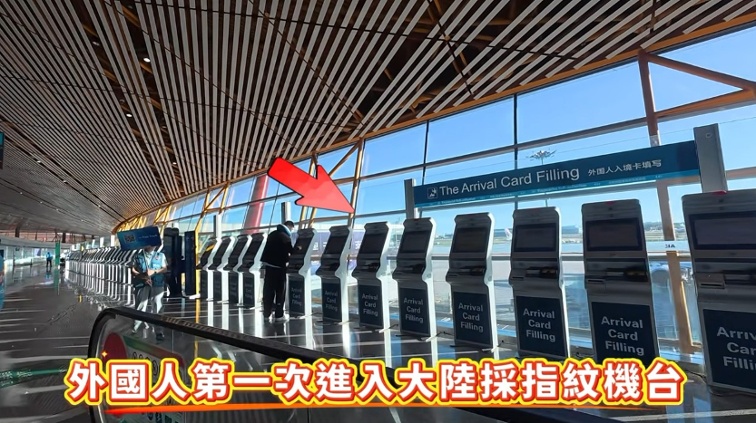
After foreign flights arrive at Beijing International Airport, numerous fingerprint scanning machines are present at the immigration office. (Video screenshot)
[People News] For expatriates and individuals from Hong Kong and Taiwan who have lived and worked in China for an extended period, the notion that 'one could be monitored at any time' is no longer a secret. However, if one day you accidentally click on a link online and find your passport photo, phone number, and even records of your supermarket visits or how many times you passed a certain intersection, how would you feel?
Earlier this year, this unsettling experience occurred to a former journalist who had been stationed in China.
Due to an extraordinarily bizarre security flaw in a police system, the Chinese Communist Party's 'Dynamic Control Platform for Foreign Personnel,' which had been operating in secrecy for many years, was unexpectedly revealed to the public. The circumstances surrounding the incident are quite dramatic.
Mark Hoogwerf, a Dutch cybersecurity expert and former journalist, stumbled upon a local police system named the 'Dynamic Control Platform for Foreign Personnel' while researching China's internet infrastructure online.
To his astonishment, the login page of this system had already been pre-filled with a username and password, as if the door had been left unlocked, allowing any internet user to gain direct access.
Upon entering, Huo Fei was shocked to find that he had stumbled upon an internal database that recorded over 700 foreign residents in Zhangjiakou City, Hebei Province, containing as many as 12,000 pieces of sensitive personal data. The categories included foreign journalists, corporate executives, international students, and individuals from Hong Kong and Taiwan.
While browsing through the system, Huo Fei was startled when a face he recognized all too well appeared on the screen—his own. Next to the photo, his passport number and the mobile phone number he had used in China were clearly displayed.
The omnipresent digital surveillance
Huo Fei discovered that this system was not just a simple registry; it was a “real-time tracking net” created using AI facial recognition and big data integration technology. The breadth of data it accessed was astonishing.
Basic personal privacy: Information such as birth date, marital status, detailed address, occupation, and even personal medical and healthcare records were retrieved.
Tracking physical footprints: The system captures real-time surveillance footage at traffic intersections, shopping malls, and supermarket entrances. For instance, a foreign journalist was recorded by cameras 78 times at a specific intersection, with each instance's time and location meticulously logged.
Details of travel and spending: Your specific seat number on high-speed trains or flights, as well as your transaction records at gas stations, were all integrated into personal profiles.
Even more alarmingly, this system was also performing AI relationship network analysis. Whenever two or more foreign individuals appeared together in front of the camera or took a photo, the system would automatically generate a “social graph,” marking them as “related personnel.”
Precision in target classification and labeling.
This control platform has accurately labeled all tracked individuals with political tags.
"Five Eyes Alliance": Citizens from the United States, Canada, the United Kingdom, Australia, and New Zealand are directly tagged as part of the "Five Eyes Alliance".
"Key Countries": This category includes citizens from Middle Eastern and African nations such as Iran, Israel, Egypt, and Pakistan.
"Taiwan and Hong Kong Individuals" and "Key Personnel": Hong Kong residents who participated in the anti-extradition movement and visitors from Taiwan are classified separately; dissenters and human rights activists are designated as "Key Personnel" and subjected to the highest level of surveillance.
Sophia Yan, a senior reporter for The Daily Telegraph who spent 10 years in China, also discovered her profile in the database. On the far right of her profile, there is a special column labeled: "Trackable". Clicking on it reveals numerous moments captured by cameras at various intersections and subway stations across China.
The ambition of social intelligence integration and "AI judicialization"
This leaked database highlights a significant fact: police surveillance data has infiltrated every aspect of society.
The database not only includes the police's own surveillance but also contains lists and photos from ski towns, the frequency of international students being photographed at school entrances, and even the administrative penalty record of a foreign resident fined 1,000 yuan for "failing to register a change of address on time".
As highlighted in the report by the Australian Strategic Policy Institute (ASPI), the Chinese Communist Party (CCP) is not only building an extensive surveillance network but is also attempting to 'judicialize' and 'automate' AI surveillance. This involves using AI to assist judicial processes, enabling the preemptive suppression of dissent.
Mark Hoffer began backing up data after discovering the platform in January, continuing until the website was shut down in May. Records from this system in Zhangjiakou indicate that it was still being updated as recently as April this year, with some fields left blank, suggesting that this deeply concerning system was merely a 'work in progress' at that time.
The unexpected findings by Mark Hoffer and Yan Qianjun have undoubtedly provided a glimpse into the true nature of the CCP's surveillance apparatus for the outside world.
For the CCP authorities, this incident may be viewed as a significant technical error and data leak; however, for all foreigners living in China and compatriots from Hong Kong and Taiwan, it underscores a grim reality: under the fusion of 'digital state capitalism' and 'power surveillance,' there is no privacy or freedom to be found. Every action you take, every glance you make, and every journey you embark on has already been quietly recorded in the databases of this totalitarian regime's algorithms.
The platform in Zhangjiakou is certainly not an isolated case; it is likely just the tip of the iceberg of a vast surveillance system that spans across China.
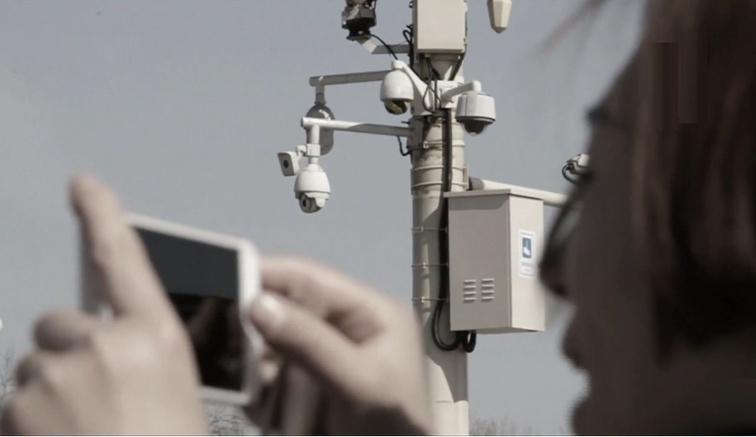
With as many as 1.15 million surveillance cameras on the streets of Beijing, netizens have mockingly referred to the city as the 'City of the Heavenly Eye.' (Video screenshot)
So, how does the CCP monitor foreigners within its borders?
According to investigation reports from international human rights organizations, diplomatic security guidelines from various governments, authoritative international media investigations, and the laws and regulations of relevant countries, it is clear that Western nations have long recognized that the Chinese Communist Party (CCP) has established a comprehensive, high-intensity surveillance and control system for foreigners in China, integrating both online and offline methods. From the moment foreigners enter Chinese territory, their clothing, food, housing, and transportation are all closely monitored by the CCP. The fundamental premise of this system is to regard foreigners as potential 'security threats' or intelligence targets, with surveillance methods primarily categorized into the following areas:
1. Comprehensive tracking of movement and accommodation (offline control)
Mandatory accommodation registration system: Foreigners are required to register for 'temporary accommodation' with local public security authorities within 24 hours of their arrival in China (48 hours in rural areas). When checking into a star-rated hotel, the front desk will automatically transmit passport information to the public security bureau system. If staying in a private residence or an Airbnb-style accommodation, they must report in person to the local police station, accompanied by the landlord, or risk facing fines or detention.
Omnipresent 'Sky Net' facial recognition: High-definition surveillance cameras (part of the Sky Net Project and Brightness Project) are installed throughout streets, airports, high-speed train stations, and subway entrances across China. These cameras utilize facial recognition and gait recognition technologies to enable real-time tracking and comparison of specific foreigners' movements.
High-Speed Rail and Public Transport Real-Name System: To purchase high-speed rail tickets, domestic flight tickets, and even some long-distance bus tickets, individuals must use their passports for real-name registration. The travel information of foreigners is instantly synchronized with border control and national security databases.
2. Digital Footprints and Communication Surveillance (Online Monitoring)
Mandatory Binding and Software Monitoring (WeChat and Alipay): In China, it is nearly impossible to function without WeChat (Weixin) and Alipay for payments, transportation, and QR code scanning. WeChat, however, serves as a central tool for the Chinese Communist Party's internet surveillance. All text messages, voice messages, photos, and payment records sent via WeChat are subject to automated keyword screening and manual review.
The Great Firewall (GFW) and VPN Interception: Foreigners using local SIM cards or broadband internet must navigate through the 'Great Firewall.' During particularly sensitive times (such as entering Xinjiang, Tibet, or during significant political meetings), customs or security personnel may forcibly inspect foreigners' mobile phones, potentially installing data extraction software known as 'Feng Ying' (Feng采/BXAQ) to gather contact lists, text messages, and social media records.
SIM Card Real-Name System and Base Station Positioning: To obtain a Chinese mobile number, individuals must take an on-site photo and scan their passport. By analyzing signals from mobile phones connecting to base stations, security agencies can accurately map the daily activity range of foreign individuals.
3. Target Classification and Implementation of Different Levels of Monitoring
The Chinese Communist Party categorizes foreigners within the country into various risk levels and applies different degrees of surveillance accordingly.
The Chinese Communist Party (CCP) primarily utilizes 'automated systems' such as big data, facial recognition, accommodation registration, and algorithmic monitoring to oversee ordinary tourists and international students.
Foreign journalists and diplomats, due to the highly sensitive political environment, often find themselves under physical surveillance by CCP security personnel (undercover national security agents), who closely follow them in vehicles and on foot. Their residences and offices are frequently bugged with listening devices, and their reporting activities are often directly obstructed or harassed.
Foreign human rights activists and personnel from sensitive 'non-governmental organizations' (NGOs) face intense personal surveillance within China, with restricted movement and the risk of being barred from leaving the country without prior public announcement (known as Exit Banning).
4. Community Grid Workers and the 'Mass Prevention and Control' Intelligence Network
In addition to high-tech methods, traditional 'Chaoyang masses' (a digital-age, larger-scale upgraded version of the 'Little Foot Investigation Team') and grassroots control networks remain active.
Community grid workers, security personnel, front desk staff, and neighborhood committees are assigned the task of monitoring foreigners within their communities. If a foreigner is seen frequently entering or exiting a particular residence, property management typically reports this to the local police station.
Foreign teachers and international students at universities are usually paired with Chinese 'teaching assistants' or 'senior students,' whose implicit duty includes monitoring the speech and ideological trends of foreign personnel. Additionally, the party branch within foreign enterprises serves as an internal oversight mechanism for foreign executives.
5. Legal Instrumentalization and the 'Anti-Espionage Law'
In recent years, the Chinese Communist Party (CCP) has significantly broadened the scope of surveillance and investigation through the enhancement of the Anti-Espionage Law, the National Security Law, and the Data Security Law.
The ambiguous definition of 'espionage' means that activities such as collecting publicly available economic data, industry reports, or investigating supply chain conditions can be classified as 'endangering national security.'
Exit Bans: The CCP can directly prevent foreigners involved in certain cases or viewed as bargaining chips from leaving the country, effectively trapping them in China as tools for geopolitical negotiations (a practice referred to as 'hostage diplomacy').
The CCP's surveillance of foreigners essentially extends its comprehensive control model over domestic society to foreign visitors. This system combines a high-tech big data 'invisible net' with traditional spies and community reporting as a 'visible hand,' ensuring that every action of foreigners in China is monitored by the party-state security apparatus.
The CCP is experiencing a state of 'split personality.'
An intriguing phenomenon indicates that the CCP, in its state of panic, has long been in a 'split personality' condition.
Recently, the CCP has been actively promoting 'unilateral visa exemptions' to attract foreigners for travel and investment in China. Simultaneously, it is obsessively using AI, big data, and plainclothes police to closely monitor every foreign individual entering the country. These two seemingly contradictory policies, which may even appear somewhat 'split personality,' are the inevitable outcome of the CCP's authoritarian regime facing the dual pressures of economic recovery and security concerns.
Since the end of the pandemic lockdown, the Chinese economy has entered a phase of structural slowdown, characterized by real estate crises, the withdrawal of foreign capital, and soaring youth unemployment rates. To revive the economy, the State Council, the Ministry of Foreign Affairs, and the Ministry of Commerce urgently need to meet several key targets: attract foreign tourists to China for consumption, thereby boosting the catering, hotel, aviation, and tourism sectors; convey to the international community and foreign businesses that 'China's doors remain open,' in an effort to counteract the supply chain de-risking and economic isolation strategies of Western nations; and encourage foreign influencers and tourists to visit China, create videos that depict 'China as safe, high-speed rail as fast, and food delivery as convenient,' and 'tell positive stories about China' on international social media platforms. This initiative is heavily influenced by political motives aimed at 'borrowing foreign voices to tell our own story' and 'image rehabilitation.'
However, from the perspective of the Party's highest decision-making bodies and security agencies, openness is always fraught with risks. The Ministry of State Security (MSS) of the Chinese Communist Party categorizes most Western visitors, journalists, scholars, and even NGO personnel as potential 'foreign hostile forces' or possible spies. They are deeply concerned about foreigners disseminating democratic values, engaging with local dissenters, or investigating sensitive topics such as Xinjiang, supply chains, and local debts. Under the authoritarian rule of the Communist Party, numerous crimes against humanity and human rights violations are systematically concealed, leading the Party to fear exposure of these criminal acts, which compels them to closely monitor every foreign individual entering China.
3. The desire to 'have both' results in conflicts of interest within the system.
The phenomenon of 'attracting customers while preventing theft' highlights a significant disconnect within the bureaucratic system of the Chinese Communist Party: the economic sector is pushing forward, while the security sector is pulling back.
The Ministry of Foreign Affairs is working diligently to promote the visa-free policy, but the National Security and Public Security departments fundamentally distrust the economic rationale of the Ministry. The security sector is primarily concerned with whether 'once people enter, they are under the Party's control.'
Authorities want the 'money in foreigners' pockets' while simultaneously harboring suspicions about every foreigner and enforcing 'absolute control.' Under this contradictory national policy, foreigners are restricted to visiting designated tourist areas for leisure, shopping, dining, and taking scenic photos, creating videos that praise China, but they are prohibited from engaging with any social realities, conducting independent investigations, or interacting with sensitive groups.
This established national policy of 'wanting both' ultimately results in absurd outcomes: while the visa-free policy does attract a number of bargain-seeking tourists making short videos, it simultaneously deters foreign executives, scholars, and journalists who could bring significant investment, core technologies, and long-term partnerships. They are frightened away by the pervasive 'neurotic surveillance,' the looming threat of accusations under the 'Anti-Espionage Law,' and 'exit bans.'
People vote with their feet, which is always more telling than policy. As long as the regime's security concerns remain unresolved, this absurd scenario of 'opening the door wide while setting up a shotgun' will persist indefinitely.
(First published by the People News)
△






News magazine bootstrap themes!
I like this themes, fast loading and look profesional
Thank you Carlos!
You're welcome!
Please support me with give positive rating!
Yes Sure!