
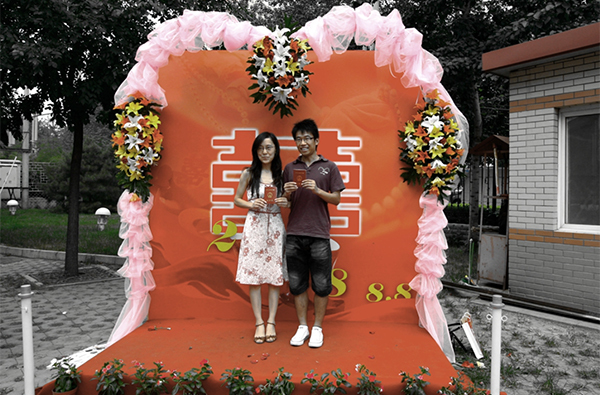
Qixi Festival Spending Plummets, Marriage Registrations Drop Sharply (Getty Images)
[People News] This year, the number of posts showcasing love on social media for 520 has noticeably decreased. In previous years, this time was filled with images of rose bouquets, luxury gifts, and couples dining out; now, we mostly see posts about 'rational consumption', 'low-desire living', or simply no posts at all. It’s not that young people have suddenly lost interest in love, but rather that they feel they cannot afford to pursue it.
It's truly a struggle; there’s no money to show love, and expressions of affection have been cut from spending priorities. Even more disheartening is the recent data released by the Ministry of Civil Affairs: in the first quarter of 2026, there were only 1.697 million marriage registrations nationwide, a decrease of 113,000 compared to the previous year, marking a 6.24% drop and setting a historical low for this period.
This situation is not just a simple shift in customs; these trends have been developing for a long time and are closely tied to the ongoing macroeconomic downturn. Romantic occasions like Valentine's Day, Qixi, and 520 often experience a collective decline, reflecting the tangible impact of macroeconomic pressures on everyday life. Young people are opting for a 'lying flat' lifestyle, choosing not to marry or have children, and avoiding home purchases, not out of a carefree attitude or selfishness, but as a rational response to the high costs and uncertainties they face. Official media, such as the People's Daily, have attempted to shift some of the blame onto the 'bad habit' of high bride prices in rural areas, which they claim has contributed to the decline in marriage and childbirth rates. This is simply a poor excuse for deflecting responsibility.
Romantic occasions have turned into cold realities.
First, let's examine 520 and the romantic economy. In recent years, businesses have marketed 520 as the 'Internet Valentine's Day,' with flowers, jewellery, dining, gifts, and high-end luxury spending once driving a market worth hundreds of billions. Data from flower auctions in Kunming, Yunnan, indicate that rose prices often double during this holiday. However, the atmosphere in 2026 is strikingly different, having shifted from a peak to a trough. Many flower shops report a lack of orders, and some platforms have seen a significant year-on-year decline in flower sales, while high-end restaurants are experiencing a drop in reservation rates. Young people are increasingly choosing not to spend at all.
This trend is consistent with macro consumption data. According to the National Bureau of Statistics, the total retail sales of consumer goods in the first quarter of 2026 increased by 2.4% year-on-year. While this growth rate is 0.7 percentage points faster than in the fourth quarter of the previous year, it still reflects a relatively weak performance. Specifically, retail sales of goods grew by 2.2%, while retail sales of services increased by 5.5%. Although there has been some growth in upgraded consumption categories like gold, silver, and jewellery, this is largely driven by policies encouraging the replacement of old goods with new ones for essential and durable items. Discretionary spending on romance and experiential consumption is clearly lacking.
Marriage and fertility statistics have seen a dramatic decline.
The marriage statistics present an even grimmer picture. The 1.697 million couples recorded in the first quarter not only reflect a year-on-year decline of 6.24%, but also represent less than half of the figures from the same period in 2017, and are even lower than the levels seen at the onset of the pandemic in 2020. The total number of births projected for the entire year of 2025 is merely 7.92 million, marking a new low since 1949, with a birth rate of 5.63‰ and a total fertility rate that has fallen below 1.0, estimated to be around 0.97-0.98. The population has now experienced negative growth for four consecutive years, with official statistics indicating that by the end of 2025, the total population will stand at 1,404.89 million, a decrease of 3.39 million compared to the previous year. Furthermore, data from mainland public security departments suggest that China's actual population has been around 1 billion since the pandemic, and the country is facing significant ageing.
As the population experiences a dramatic decline, obstetric services and kindergartens are encountering an unprecedented wave of closures.
Beginning in April 2025, numerous hospitals in regions such as Guizhou, Sichuan, Jiangxi, Guangdong, Jiangsu, and Zhejiang have announced the suspension of obstetric inpatient delivery services, or are planning to consolidate operations with at least a few institutions. Some top-tier hospitals have also been affected. Many hospitals report obstetric bed occupancy rates exceeding 80%, with healthcare staff far outnumbering patients, resulting in ongoing financial losses. In 2026, a large obstetrics and gynaecology hospital in Wuxi suspended core services such as obstetrics and gynaecology; a women and children's hospital in Huaihua, Hunan, was deregistered; and a certain obstetrics and gynaecology hospital in Xi'an ceased operations. The crisis in obstetrics has now spread from specialised hospitals to general hospitals, further impacting pediatric services. Experts are expressing concerns about the potential 'collapse' of obstetrics, predicting that pediatric and children's medical resources will also face significant reductions in the future.
According to the Ministry of Education's "2024 National Education Development Statistical Bulletin," the total number of kindergartens in the country for 2024 is 253,300, which represents a decrease of 21,100 from the 274,400 reported in 2023. This translates to approximately 57-58 closures each day, or about 2 per hour. This decline has persisted for three consecutive years since 2022, with a cumulative closure of around 41,500 kindergartens over this period, marking a reduction of 14.08%. In 2024, the number of children enrolled in kindergartens is 35,839,900, reflecting a year-on-year decrease of about 5.09 million. Over the five-year period from 2020 to 2024, there has been a total reduction of 12.34 million children, amounting to a decrease of approximately 25%. It is anticipated that around 26,000 additional kindergartens may close in 2025. By 2030, the number of kindergartens in the country could fall to about 163,700, which is a reduction of approximately 130,000 from the peak observed in 2021.
The Dilemma During Economic Downturns
While officials continue to boast about a 5.0% year-on-year GDP growth in the first quarter, which is an acceleration of 0.5 percentage points compared to the previous year's fourth quarter, the general public remains largely unconvinced by the official narrative of economic optimism. Young people have transitioned seamlessly from "performing love" to adopting a "low-desire survival" mindset.
Despite the ongoing decline in housing prices across China, the price-to-income ratio in many regions has soared to 20-30 times, significantly exceeding the internationally accepted range of 3-6 times. Traditional urban-rural expectations often dictate that marriage requires a house, a car, and a betrothal gift. The costs associated with education, healthcare, and raising children after marriage are exceedingly high, leading many young people to perceive having children as a "million-dollar project."
With the economic downturn, young people are finding it significantly harder to secure jobs than to find romantic partners. Between 2025 and 2026, the unemployment rate for urban youth aged 16-24 is expected to fluctuate between 16% and 19%, with peaks exceeding 18%. This year, over 12 million college graduates are facing a severe structural mismatch between job openings and the qualifications of graduates, highlighting a disconnect between education and market demand. Issues such as low wages, hidden unemployment, flexible employment, and slow job placements contribute to unstable incomes, making young people hesitant to spend or take on debt. Marriage, childbirth, and parenting are perceived by young people as the heaviest burdens.
Consequently, young people's traditional aspirations for marriage, childbirth, home ownership, career advancement, and high consumption have significantly diminished. They are increasingly turning to minimalist lifestyles, singlehood, saving, or seeking small pleasures, making rational choices, downgrading their consumption, and engaging in low-desire emotional spending.
Party media has shifted the blame to rural customs that are dragging down marriage and childbirth statistics.
Recent articles from party media outlets such as Xinhua News Agency, People's Daily, and Ban Yue Tan have criticised the high bride price customs in rural areas, which have contributed to the poor marriage and childbirth statistics.
In 2019, the Communist Party of China took the unprecedented step of including exorbitant bride prices in the Central No. 1 Document for governance. For six consecutive years, this issue has remained a focus of the central rural work agenda. The Communist Party has elevated the topic of marriage and bride prices from a private family matter to a public policy issue that relates to national governance, rural revitalisation, and social stability. The underlying concern is that the supply of young labour is dwindling, and there are fears that in a few years, the party elites will have no more young labour to exploit.
The China Women's Network reports that a research team from the School of Sociology at Wuhan University has discovered through nationwide survey data that the average bride price in rural areas has surged from around 10,000 to 20,000 yuan in the year 2000 to approximately 140,000 yuan in 2021. The bride price is not the only aspect of the 'marriage standard'; when considering the costs of buying a house and car in county towns, wedding banquets, the 'three golds' (gold jewellery), and various cash gifts, the total expenditure for a typical farming family to marry off a son usually falls between 600,000 and 1,000,000 yuan.
In contrast, the per capita disposable income for rural residents in China is projected to be 23,119 yuan in 2024. This means that a rural family would need to work without eating or drinking for 26 to 43 years to save enough for their son's wedding. Consequently, the idea of 'marriage impoverishing three generations' has discouraged young people from getting married. Party media has vehemently criticised this so-called rural custom, describing it as a systemic social issue that encompasses population structure, urbanisation paths, family ethics, and grassroots governance.
However, the Communist Party has consistently deflected responsibility. Over the past three to four decades, the CCP has made substantial profits from land sales, driving up property prices, while the so-called urbanisation process has displaced farmers from their land. Marriage necessitates housing, and someone from either side must make a purchase. Given the market dynamics favouring the bride's family, the bride price has inevitably skyrocketed to astronomical levels. This is a systemic issue stemming from CCP policies; how has it been reduced to a mere rural custom?
Furthermore, the economy is experiencing a downturn, leading to significant instability in employment. For those in rural areas, job opportunities have always been limited. In the past, migrant workers would move to cities to engage in hard labour for income, but with the real estate market's decline, 300 million migrant workers have returned home to adopt a 'lying flat' lifestyle. How can newly married couples find stable housing and employment? Many will inevitably depend on the one-time asset accumulation they had before marriage; this instinct for survival is not merely a matter of bad habits but is closely tied to the failures of the Chinese Communist Party's governance. The CCP has deteriorated the overall environment and then shifted the blame onto the vulnerable groups who are suffering under this pressure.
Comments from netizens are sharp and to the point. "The bride price is merely a scapegoat; the real villain is the housing market. The bride price may reach a few hundred thousand, but housing prices are in the millions. Who is truly undermining marriage and childbirth?" "With the 996 work culture, involution, low aspirations, high youth unemployment, and poor income expectations—why aren’t these issues criticised by the party media?"
Some netizens have directly pointed to systemic issues: "Regulating bride prices in rural areas is straightforward because they are manageable; however, who dares to address housing prices, systemic involution, and class entrenchment?" Many have highlighted that the root cause lies in the gender imbalance created by family planning policies: "The blood debt of family planning is now being repaid by men at the bottom of society?"
This time, the CCP's strategy of shifting blame has backfired.
(First published by People News)△








News magazine bootstrap themes!
I like this themes, fast loading and look profesional
Thank you Carlos!
You're welcome!
Please support me with give positive rating!
Yes Sure!