
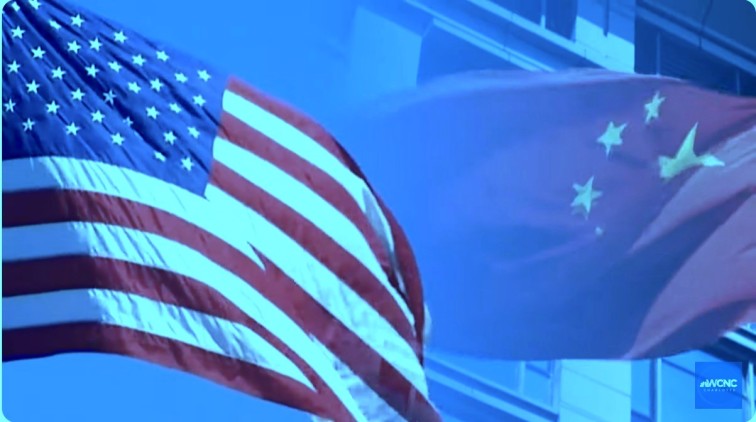
U.S.-China Confrontation. (Video screenshot)
[People News] On November 19, 2026, the much-anticipated 'Summit of the Three Giants: the U.S., China, and Russia' in Shenzhen has just concluded. The cameras captured the three leaders shaking hands and exchanging pleasantries, with a ceremonial guard providing a grand send-off. However, once they turned away, U.S. President Trump and the accompanying press corps stepped onto 'Air Force One' to prepare for their return to the U.S. Inside the cabin, a scene reminiscent of a spy thriller unfolded—staff members immediately instructed all reporters and aides to hand over their mobile phones and electronic devices that had been used in China. These devices were then placed into specialised 'Faraday bags' designed to block wireless signals. Even the disposable phones (burner phones) used by White House aides had to be collected and destroyed.
This moment was more genuine and ironic than any diplomatic language found in the summit's communiqué.
Preventing 'Electronic Trojan Horses' During Visits
Those familiar with White House press protocols know that when the U.S. President visits traditional allies such as the UK, Japan, or France, accompanying reporters typically board the plane with their personal mobile phones to file reports and check in without any issues. The situation of 'collectively surrendering phones upon boarding' simply does not happen.
However, as soon as one enters China (along with Russia and other nations deemed top-level cyber threats by U.S. intelligence), the entire scenario shifts to a Cold War-style counter-espionage mode: reporters and photographers must secure their regular smartphones, laptops, and smartwatches in signal-blocking bags for 'hibernation' before their flight lands in Shenzhen on the 18th, opting instead for temporary disposable phones for emergencies. By the time they depart Shenzhen on the 19th, once they board Air Force One, any device that has connected to the internet or communicated while in China is regarded as a 'high-risk potential spy carrier' and must be immediately sealed and isolated until the plane lands on U.S. soil, at which point it can be unsealed and returned.
No amount of high-level pomp can disguise the underlying mutual suspicion.
Consider how absurd this situation is: in preparation for this summit, Shenzhen has been entirely shut down, military aircraft are spraying colored smoke in tribute, and security measures and face-saving efforts are taken to the extreme. Yet, once the guests board the plane, even the smartphones used by accompanying reporters in Shenzhen are treated like 'time bombs' and placed in shielding bags for strict security, out of fear that a moment of carelessness could result in the implantation of some 'Chinese characteristic' Trojan program that might infiltrate the core of the White House through Air Force One's communication system.
In the end, regardless of how long the red carpet is rolled out on the diplomatic stage, how firm the handshakes are, or how extravagant the banquets may be, it all serves as a mere performance for the cameras, a matter of 'face.' Meanwhile, the small 'Faraday shielding bag' in the cabin of Air Force One holds the most authentic concerns and boundaries of the U.S. regarding the Chinese Communist regime. In a system where even the information network is heavily weaponised and surveillance is pervasive, even if they appear to sit down for discussions on cooperation, no one is willing to risk their communication security on the 'trustworthiness' of the other side.
This silent act of 'confiscating phones' likely provides a more precise commentary on the Shenzhen summit than any diplomatic statement could. △



News magazine bootstrap themes!
I like this themes, fast loading and look profesional
Thank you Carlos!
You're welcome!
Please support me with give positive rating!
Yes Sure!