

Soaring unemployment rates have led to an increasing number of young people seeking refuge in "paid self-study rooms," pretending to study hard to alleviate their inner anxiety and fear. (Video screenshot)
[People News] China's economy has been in a prolonged slump, resulting in a persistently high unemployment rate. To alleviate their families' concerns, many unemployed individuals leave home on time each day to pretend they are going to work. This phenomenon has unexpectedly generated over 600 million views and sparked lively discussions across various social media platforms, highlighting the collective mindset of young people in mainland China facing structural employment pressures.
'Pretending to work' emerges as a trending topic online in China
Recently, the topic of 'pretending to work' has resonated widely on Chinese social media, with related content amassing an impressive 610 million views on Douyin alone, while Weibo has recorded 320 million views.
Numerous netizens are sharing tips on how to spend those 8 or 9 hours pretending to work without incurring expenses and feeling at ease. Posts addressing relatives' inquiries about employment often attract significant attention, with some posts on Xiaohongshu exceeding 70 million views.
These posts provide insights on how to spend an entire day outdoors, including leisurely visits to parks, libraries, cafes, and shopping malls. Many videos illustrate how to enjoy time at mountain pavilions or under large trees in agricultural fields, where individuals can picnic, read, nap, and effectively spend 9 hours without spending any money.
Moreover, many netizens have expressed that they can barely afford phone bills and are sharing information about locations in certain cities where free Wi-Fi is available.
Some posts take the form of daily diaries, including one titled 'Day 30 of Unemployment: A Month of Pretending to Work,' where the author recounts their experience of failing in 80 job applications.
In the comment sections of these videos or posts, many users have shared their experiences, saying things like: 'I have been pretending for a year and a half', 'I also pretend every day', 'I pretended to go to school when I was young, and now I hide from my family pretending to go to work', 'I go to my colleague's company and just sit there every day', 'Sister, I have really been stuck for several months', and 'I have been living this way for half a year'...
Some even try to find humour in their situation, commenting that while the job is easy, the pay is low.
To avoid family inquiries, they spend their days wandering around.
32-year-old Li Keke (Coco Li) previously worked for a state-owned real estate company in China but resigned over six months ago due to a heavy workload and lack of recognition. On one occasion, she nearly shared a photo of her homemade lunch in the family group chat but quickly refrained, fearing her mother might ask why she wasn't at work.
Li Keke told Reuters that her mother's worries 'actually do not solve my problems.' Whenever her parents visit, she finds herself wandering around parks, libraries, cafes, and shopping malls to dodge their questions.
36-year-old former visual effects producer Miss Zhang lost her job in August due to layoffs caused by AI. She prefers to keep her surname private. She remarked, 'I never thought the library would be so crowded on a weekday.'
28-year-old Sun Susan (Susan Sun) has been concealing her layoff from her family since she was let go by an internet company at the end of last year. In May, her mother and stepfather moved from their hometown to Chongqing to live with her while searching for work.
However, this situation compels her to leave home before 9 a.m. each day and return only after 6 p.m. to evade her family's inquiries. Currently, Sun Susan survives on a monthly unemployment benefit of 1,864 yuan (approximately 280 USD) along with her remaining severance pay.
She expresses that she enjoys living a simple life without a job, but the only pressure she feels comes from her parents. They frequently urge her to save money, citing the poor economic conditions, which causes her significant anxiety.
Examining the mindset of pretending to go to work
Mainland netizens have shared several typical viewpoints in their comments and discussions:
1. The dignity of not being a burden
Many netizens who have tried 'paid work' (such as spending a few dozen yuan to rent a shared office or staying in a library) argue that one cannot remain in a chaotic state indefinitely. Dressing neatly and going out each day, sitting at a desk to update resumes or engage in self-study, helps maintain a sense of dignity and the psychological reassurance of 'I am still trying,' preventing complete 'wastefulness.'
2. It's not a lack of effort; it's the environment that pressures them
Many voices online contend that 'pretending to go to work' is not a sign of laziness among young people (lying flat); rather, many are more anxious than ever, submitting resumes, taking exams, and pursuing side jobs during the day. This absurd phenomenon reflects the frustration of an era where 'you can't keep up with the competition, nor can you simply lie flat.'
3. Aiming to cleverly deceive parents
On Xiaohongshu, numerous popular guides instruct users on how to plan their daytime activities and how to handle relatives' probing questions, such as: 'Where are you working now?' and 'What is your year-end bonus?'.
Netizens have humorously dubbed this an upgraded version of 'renting a girlfriend to go home for the New Year,' describing it as a form of 'performance art' for adults dealing with family anxiety during transitional periods in the workplace.
4. Unintentionally Highlighting the 'New Economy'
As this trend gained traction, some enterprising individuals quickly established 'pretend to work companies.' These businesses offer desks, chairs, Wi-Fi, refreshments, and even quirky services like 'getting scolded by the boss,' leading netizens to mockingly refer to it as 'unemployment economics' and suggest that 'everything can be monetised, even unemployment requires paid clock-ins.'
By the end of July 2025, a space called 'Pretend to Work Unlimited Company' in Binjiang, Hangzhou, became an online sensation. Following its popularity, similar establishments began to emerge in other cities across China.
This 'company' features a 400-square-meter area with dozens of workstations, meeting rooms, and printers. The walls are adorned with rules prohibiting tardiness, napping at workstations, smoking, drinking, swearing, and office romances, yet everything is 'fake.' The 'employees' who come to work do not earn a salary; instead, they are required to pay a daily rent of 30 yuan to the company.
The facade is bound to crumble eventually.
Experts note that the phenomenon of pretending to work serves as a silent cry for help from a large unemployed demographic during an economic transition, as they strive to maintain a semblance of order in their lives, seek solace among like-minded individuals, and communicate their struggles to society.
The trend of pretending to work highlights the ongoing decline in China's job market. Most individuals who opt for this strategy significantly cut their expenses during this time, spending as little as 15-30 yuan per day on a paid study room or simply ordering a cheap coffee to occupy a seat at McDonald's for the entire day. Given a monthly minimum survival cost of 1,500-3,000 yuan, those with savings of 20,000-30,000 yuan can only maintain this facade for about six months to a year.
During holidays or family gatherings, when faced with parents' questions about income, tax filings, or the pressure of social security contributions (or the burden of paying for social security themselves), maintaining these lies becomes increasingly challenging over time.
In truth, this "disguise" may appear relaxed, but it is mentally exhausting. The daily act of deceiving family members, pretending to be busy in public, and grappling with anxiety and guilt about the future can lead to significant mental strain. Many young people do not stop pretending due to financial constraints, but rather because they reach a breaking point. Media reports suggest that this psychological limit typically peaks within three to six months.
The job market continues to weaken.
The phenomenon of pretending to work reflects the persistent weakening of China's employment landscape. The Chinese economy is becoming increasingly dependent on exports, while domestic demand remains extremely weak. The long-standing real estate crisis, coupled with strained local government finances and the rapid spread of automation and artificial intelligence (AI), has all adversely affected employment and income.
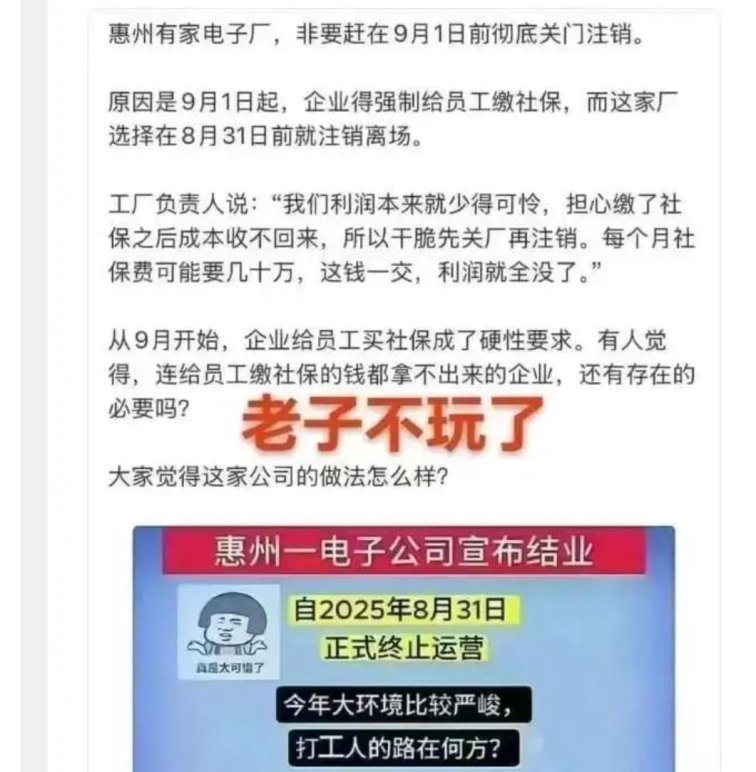
On October 19, the third-quarter data released by the Communist Party of China (CPC) revealed that Chinese manufacturers are facing intense competition while also grappling with mandatory social security contributions imposed by the authorities. In response, many are resorting to price cuts and layoffs, while placing heavier workloads on the remaining employees, leaving numerous individuals struggling to cope.
Furthermore, the New Employment Form Research Centre under the Ministry of Human Resources and Social Security of the CPC published the '2025 Employment Research Report on China's Blue-Collar Workforce' this year, asserting that by 2025, the number of individuals in flexible employment in China will reach 280 million, an increase of 40 million from 2024, with projections to rise to 320 million by 2026.
According to official data from the CPC, the national employment population is expected to be 725 million in 2025, a decrease of approximately 9.35 million from 734 million in 2024. Analysts have estimated that if the newly added flexible employment figures are excluded, there could be a loss of at least 50 million formal jobs by 2025.
It is widely recognised, even among the mainland populace, that the CPC's release of such data is often embellished to avoid presenting a bleak picture and to spare the authorities from embarrassment.
Critics also question the overly broad definitions used in official employment statistics. The National Bureau of Statistics of the CPC has redefined 'flexible employment' to include anyone who engages in paid work for more than one hour a week. This means that a significant number of gig workers, food delivery personnel, and ride-hailing drivers are counted as 'employed', thereby obscuring the true unemployment situation. It is likely that more individuals will join the ranks of those pretending to be employed in the future.
Experts warn that weak social security systems make such deceptions unsustainable.
Some have drawn parallels between this phenomenon and the situation during the Asian financial crisis of the 1990s, when many office workers in South Korea and Japan hid their unemployment status and opted to roam around aimlessly.
Yige Dong, an assistant professor of sociology at the University at Buffalo, argues that in contrast to Japan and South Korea in the 1990s, China's social security system is relatively weak, which may make it more challenging for the unemployed to maintain their facade.
She noted that at some point, "individuals may become increasingly concerned about gathering resources from all available avenues, including borrowing money from family and relatives." △






News magazine bootstrap themes!
I like this themes, fast loading and look profesional
Thank you Carlos!
You're welcome!
Please support me with give positive rating!
Yes Sure!