
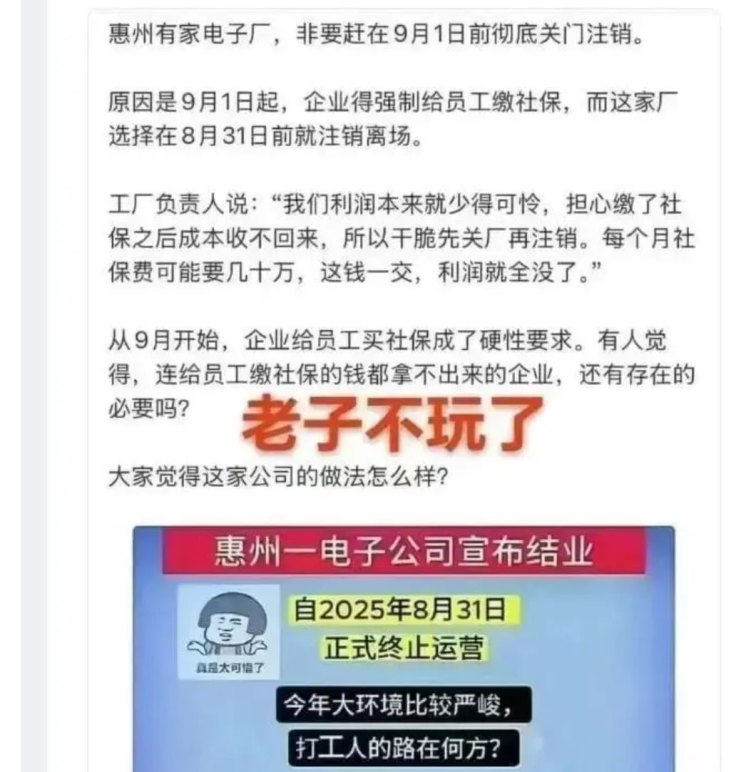
With mainland China’s compulsory social security contribution policy taking effect on September 1, an electronics factory in Huizhou, Guangdong, chose to deregister its business on August 31. (Online screenshot)
[People News] On October 13, the International Monetary Fund (IMF) published its latest "World Economic Outlook" report, which has revised its forecast for China's economic growth rate in 2026 down from 4.6% in July to 4.5%, a reduction of 0.1 percentage points. The report also indicated that China's economic growth is expected to further decline to 4.0% in 2027, also down 0.1 percentage points from the July forecast of 4.1%.
This downward revision is directly linked to ongoing structural issues in China's economy, such as weak domestic demand, pressure on the real estate sector, and a decline in investment momentum. China's economic growth rate for the second quarter was only 4.3%, falling short of expectations. While exports remained strong, they could only partially mitigate the negative effects of weak domestic consumption and slowing investment, failing to enhance the overall economic situation of China, which is currently grappling with a deflationary spiral crisis. Additionally, rising global oil prices, long-term uncertainties, and external adverse factors stemming from structural adjustments further hinder the economic outlook for the Chinese Communist Party.
The Chinese government set an official GDP growth target of 4.5% to 5% during this year's Two Sessions. The IMF's forecast has already landed at the lower end of this range, and although it suggests that policy support could prevent a more significant slowdown, reversing the long-term trend of deceleration remains a challenge.
According to data from the National Bureau of Statistics, the construction industry has seen a significant decline of 4.1%, while the real estate sector continues to experience negative growth of 0.2%. This has been a key factor contributing to the downturn in the secondary industry, which only grew by 3% in the second quarter. Regionally, the national GDP growth rate for the first half of the year was 4.7%. However, around 10 provinces met or exceeded the lower limit of their annual targets, with 8 of these being major economic provinces. Conversely, about 22 provinces did not reach the lower limit of their annual targets during the same period. Notably, Zhejiang and Anhui are among the few provinces that surpassed their upper limits in the first half of the year, despite having clear interval targets.
Customs data indicates that China's trade surplus reached 805.51 billion USD in the first eight months of 2026, and in 2025, it achieved a historic record of 1.2 trillion USD for the entire year. This high reliance on exports does not mask the weakening of domestic demand and fails to fundamentally reverse the ongoing economic decline.
Micro-level data may be even more concerning. The median disposable income for residents nationwide stands at 19,036 yuan, reflecting a growth of 4.7%. However, this median is only 82.8% of the average income, suggesting that the earnings of ordinary individuals are being skewed upward by the wealth of the affluent. During the same period, per capita consumption expenditure was 14,836 yuan, with a nominal increase of 3.7% and a real increase of 2.7%. The growth rate of consumption is notably lower than that of income, indicating that residents remain cautious about their spending.
Not only are the poor tightening their wallets, but the wealthy are also adopting a cautious approach to their finances, leading to a significant slowdown in high-end consumption. The third-quarter financial report from the French luxury group LVMH reveals that its core revenue from fashion and leather goods dropped by 5% year-on-year, a decline that surpassed analysts' expectations, primarily due to a slowdown in demand within the Chinese consumer market. When excluding the impacts of exchange rates and mergers and acquisitions, the group's revenue for the first three quarters fell by 2% year-on-year, with only a marginal increase of 1% in the third quarter alone. LVMH has issued a clear warning: there is no definitive timeline for the recovery of consumer confidence among Chinese shoppers, indicating that the era of rapid growth for luxury goods is likely coming to an end. The market is expected to transition into a low-growth and stable phase, supported by sectors such as jewellery, beauty, retail, and spirits.
These macro and micro signals together paint a consistent picture: the internal driving forces of the Chinese economy are continuing to contract, with slow growth in household income, subdued consumer sentiment, and increasingly cautious corporate investment. In this context, the Chinese Communist authorities have recently taken strong measures to promote new social security policies. On the 10th, an official from the Ministry of Human Resources and Social Security introduced the concept of 'policy optimisation and data-driven recruitment' during a press conference at the State Council Information Office. The goal is to encourage those who have not yet enrolled in insurance to participate, particularly targeting flexible workers, migrant labourers, and individuals in new employment forms to join the employee pension insurance scheme, while also establishing a collaborative funding mechanism involving employers, platform companies, and workers.
Officials assert that "everyone should be insured", stressing the need to "find out where these individuals are through various means". However, netizens have pointed out that this is akin to "advising homeless people to get a gym membership"—it's not that they don't want to participate in insurance, but that they simply cannot afford it. The Chinese Communist Party (CCP) is in a state of panic over the national social security deficit, akin to ants on a hot pan, and has been making continuous adjustments to social security policies in recent years. In September of last year, the Supreme People's Procuratorate even issued judicial interpretations mandating that both companies and individuals must contribute to social security. Following this, the Ministry of Human Resources and Social Security exerted pressure on major platforms to ensure that delivery workers and couriers are covered by social security. This year, they have initiated "data-driven searches for people", but it seems they are not looking for those who are merely alive, but rather for those who refuse to be exploited.
Recently, a resident in Shanghai succinctly captured the CCP's misguided approach by stating that "ordinary people cannot have it all". He received a call from his community, which claimed to mobilise him to pay social security through "data-driven searches", explaining that if he pays 500 yuan a year, he would receive 500 yuan monthly upon retirement. The notion that "good things, no waiting in line, and ordinary people" can all happen to one individual is simply unrealistic.
The video he shared resonated with many netizens, with comments such as: "How long do you have to pay, how much, when can you start receiving benefits, and how much will you get? It’s all determined by them, and they can change it at any time." "If you have the ability, let my employer pay for me... If not, then don’t call me." "Data-driven searches for people, yet not a single missing person can be found, while they pressure people to pay money at any moment." "If you send me money, I will pay; without money, what can I pay with?" Some even confronted the Ministry of Human Resources and Social Security directly: "In the Communist Party's society, can good things ever come to the common people?"
Under the current social security contribution system in China, employees in enterprises are responsible for 8% of their pension insurance, while employers contribute 16%. In contrast, flexible workers must shoulder a full 20% on their own. A delivery worker earning approximately 10,000 yuan per month reported that after paying rent and living expenses, his participation in the insurance directly reduces his income by 2,000 yuan each month, leaving him with little to no savings. Factors such as unstable income, significant cash pressure, and poor integration of social security systems between urban and rural areas have resulted in a low willingness to participate in the insurance scheme.
Beginning September 1, 2025, a judicial interpretation from the Supreme People's Court will clarify that any agreements between employers and employees to avoid paying social security, or any promises by employees to waive their social security rights, are invalid. Workers will have the right to terminate their contracts and seek economic compensation based on this ruling. Previously, many small and medium-sized enterprises had informal agreements with employees to either not pay or to pay less in social security contributions in exchange for higher cash wages. Surveys indicate that less than 30% of enterprises are fully compliant with the regulations. With the introduction of these new rules, employment costs are expected to rise significantly: the social security burden for employers typically accounts for 30% to 40% of pre-tax wages, while employees contribute 10% to 20%, potentially exceeding 50% in total. Employees in the restaurant sector estimate that their after-tax wages could drop by thousands of yuan, exacerbating mortgage pressures. As a result, small and micro enterprises may be forced to reduce formal positions, shift to outsourcing, or even shut down, further worsening the employment situation. This approach by the Communist Party can be seen as a desperate measure that ultimately harms the economy.
The underlying issue stems from the structural deficit within the government social security fund itself. According to official data, by the end of September 2026, the number of participants in basic pension insurance, unemployment insurance, and work injury insurance reached 1.079 billion, 251 million, and 327 million, respectively, with a cumulative balance of 11.2 trillion yuan across these three social insurance funds, which may seem sufficient at first glance. However, this figure conceals the actual income and expenditure situation. Excluding fiscal subsidies, the basic pension insurance has been in deficit since around 2013. For instance, in 2024, total income is projected to be approximately 8.19 trillion yuan, total expenditure around 7.28 trillion yuan, resulting in an apparent surplus of 0.81 trillion yuan. However, this surplus includes about 1.93 trillion yuan in fiscal subsidies, which accounts for 23.6% of total income. Without these subsidies, the deficit would exceed 1.12 trillion yuan.
The current pay-as-you-go model of social security is a flawed system where one generation supports the next. With declining birth rates and an accelerating ageing population, the number of contributors is decreasing while the number of beneficiaries is rising, leading to an increasing sustainability crisis.
As of the first quarter of 2026, online statistics and related estimates indicate that the number of individuals actively discontinuing their social security contributions nationwide has surpassed 58 million. In March 2025, this figure was over 42 million, reflecting an annual increase of 38%. The primary demographic discontinuing contributions consists of young individuals aged 20 to 35 and those in flexible employment, with the 20-35 age group making up over 60% of those discontinuing contributions. Among young people of eligible age for insurance, nearly one-third have opted to suspend or abandon their employee social security. The discontinuation rate among flexible employment workers is notably high, primarily due to the significant disparity between their low actual income and the heavy burden of self-contribution.
In response to the social security issues within the Chinese Communist Party, a netizen made a pointed observation: 'The biggest problem with social security is not money, but trust. When they say in 2024 that the retirement age will be delayed, it will indeed be delayed: men from 60 to 63, women from 50 to 55. A single document can alter the retirement plans of hundreds of millions. Today they can change the retirement age, and tomorrow they can adjust the contribution rates and calculation methods. What you have signed is a 'contract' that the other party can unilaterally amend at any time. Is this what we call insurance? This is more like a compliance test.'
The data provided by the Chinese Communist Party is essentially a pretext for creating trouble; it’s a scam that has ensnared you.
(First published by People News) △







News magazine bootstrap themes!
I like this themes, fast loading and look profesional
Thank you Carlos!
You're welcome!
Please support me with give positive rating!
Yes Sure!