
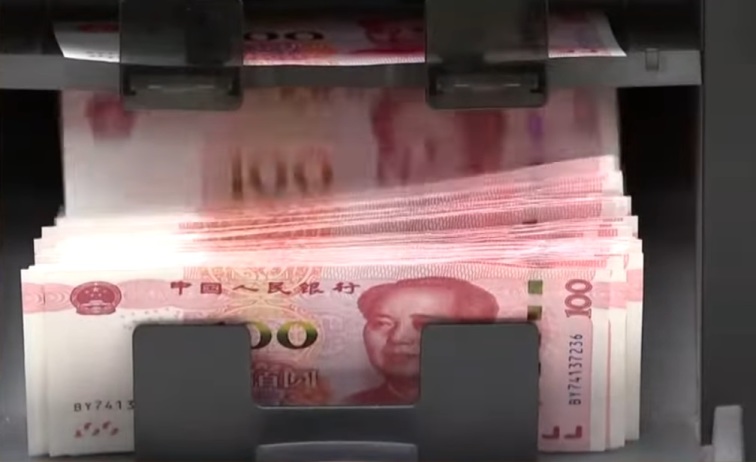
Renminbi Banknotes (Video Screenshot)
[People News] On October 19, 2026, the China Banking and Insurance Regulatory Commission and the central bank issued strong signals simultaneously. The Banking and Insurance Regulatory Commission stressed that "all financial activities must be regulated, achieving full coverage without exception." Meanwhile, Central Bank Governor Pan Gongsheng announced the expansion of the Standing Lending Facility's applicability and the establishment of liquidity support tools to address large redemptions by non-bank institutions.
At the same time, the National Bureau of Statistics of China reported that the GDP for the third quarter was 4.5%, barely meeting the lower limit of the target. When these two seemingly unrelated policy measures are examined in the context of GDP growth, the situation becomes more intricate. It highlights the most sensitive aspect of the current Chinese economy: the adjustment in the real estate sector has escalated from an industry issue to a potential "ticking time bomb" within the financial system. Regulatory authorities and the central bank are attempting a dual strategy of "strict control" and "liquidity preparedness" to prevent risks in the real estate market from transforming into a systemic financial crisis.
Real estate investment, sales, and funding are facing significant pressure on three fronts.
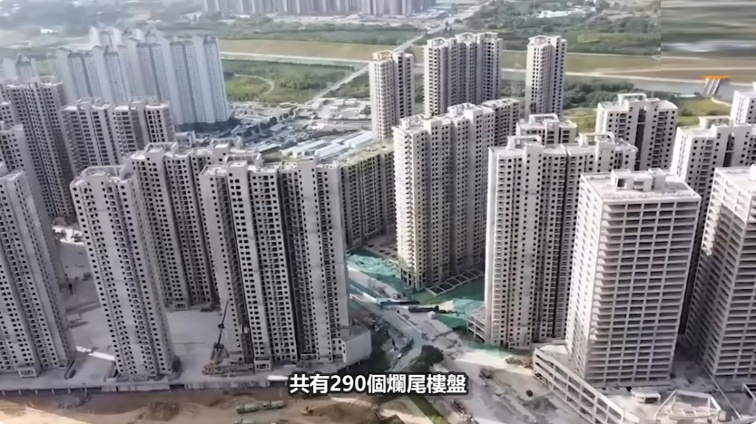
Let's start with the data. From January to September 2026, the total investment in national real estate development reached 53,364 billion yuan, marking a year-on-year decline of 20.6%, with residential investment also down by 20.5%. The area of new housing starts fell by 24.9% compared to the previous year, while the area of completed buildings decreased by 25.1%. The sales area of newly constructed commercial housing dropped by 13.2% year-on-year, and sales revenue fell by 13.9%. Funding for real estate development companies decreased by 21.6%, with domestic loans down by 33.1% and personal mortgage loans down by 22.1%. These figures suggest that both investment at the front end of the real estate chain and sales and collections at the mid-end are still experiencing a downward trend.
Regarding prices, data from the National Bureau of Statistics indicates that in September, the sales prices of newly built commercial residential properties in first-tier cities decreased by 0.5% year-on-year, with the decline narrowing by 0.4 percentage points. Second- and third-tier cities experienced declines of 2.4% and 3.9%, respectively. In Beijing, new home prices fell by 2.7%, significantly impacting the overall market; conversely, Shanghai saw an increase of 2.8%. For second-hand homes, first-tier cities recorded a year-on-year decrease of 1.5% (with a notable narrowing of the decline), while second and third-tier cities saw decreases of 4.5% and 5.4%, respectively. Month-on-month, new homes in first-tier cities rose by 0.1%, and second-hand homes increased by 0.2%; the declines in second- and third-tier cities generally narrowed or remained stable. The number of cities experiencing month-on-month price increases has grown, suggesting that recent stimulus measures by the Communist Party, such as lowering mortgage interest rates, have had some temporary effect, although year-on-year data continues to show a downward trend.
Notably, there are structural changes occurring: from January to September, the area of online signed transactions for second-hand homes increased by 10.7% year-on-year, clearly surpassing the scale of new home sales and marking the market's official transition into the 'stock era.' The area of newly built commercial housing available for sale has decreased by 1.5% year-on-year, with the area for properties on the market for less than three years dropping by 5.0%. Residential inventory has fallen below approximately 400 million square meters for the first time. While there has been progress in reducing inventory, new construction has contracted significantly, suggesting that future supply will continue to shrink. Although the second-hand housing market is experiencing growth, it has not stimulated the upstream and downstream sectors of the real estate market, and expectations regarding housing prices and sales have not fundamentally changed. Residents' willingness to buy homes and developers' investment intentions remain relatively cautious.
The transmission mechanism of the Communist Party's real estate sector to the financial system is both direct and clear. The debts of real estate companies are closely linked to bank credit, bonds, and trusts. A downturn in the real estate market directly reduces land transfer revenues, which in turn impacts local finances and the debts of urban investment platforms. The wealth contraction effect resulting from falling housing prices will significantly suppress consumer spending among residents. Employment and income in related upstream and downstream sectors, such as building materials, home appliances, and renovations, are being adversely affected. According to the National Bureau of Statistics, fixed asset investment in the first three quarters has decreased by 7.2% year-on-year, and even after excluding real estate, it still fell by 4.2%, indicating that the drag from real estate is affecting broader investment.
There are structural pressures arising from the current situation of external heat and internal cold.
Meanwhile, the overall economy under the Chinese Communist Party (CCP) is characterised by a phenomenon of 'external heat and internal cold.' In the first three quarters of 2026, GDP experienced a year-on-year growth of 4.6%, with a slight improvement to 4.5% in the third quarter, which was marginally better than market expectations. Regardless of the accuracy of the data, a clear indicator is that the growth rate of total retail sales of consumer goods remains low; although it rebounded to 1.1% in September, there is a noticeable lack of inherent momentum in overall consumption and investment. The nominal growth of per capita disposable income for residents stands at 5.3%, while the actual growth is only 4.4%, with real consumption expenditure growing by 2.7%. Interest rates have entered the '1' era, yet the propensity for residents to save remains high, making defensive savings a widely accepted necessity. While exports and high-tech manufacturing have shown relatively strong performance, the risks associated with excessive reliance on exports are increasing. High-tech manufacturing has limited capacity to absorb employment, and it is unlikely to reverse the deteriorating fundamentals of the CCP's economy in the near term.
In the stock market, the CSI 300 Index has seen a decline for 10 consecutive weeks, with a significant cumulative drop that is nearing a technical bear market. Indices related to technology innovation have experienced even greater declines in the latter half of the year. The market anticipates that 'national team' funds may need to step in; previously, the CCP injected capital into banks and insurance companies, partly to create a financial buffer for the stock market. The volatility in the stock market, combined with adjustments in the real estate sector, pressure on corporate profits, and weak consumer spending, is contributing to a resonant wave of economic downturn.
In this context, the financial risks faced by the Chinese Communist Party have expanded beyond traditional bank bad debts to encompass the bond market, fund redemptions, and the liquidity of non-bank financial institutions. Given the overall fragility of the economic chain, a negative cycle of concentrated redemptions and asset sell-offs in the broader financial sector could lead to fluctuations that adversely affect financing for the real economy and undermine market confidence.
With comprehensive regulation and liquidity backstops in place, the threat of financial risk explosions is imminent.
Ding Xiangqun, the head of the China Banking and Insurance Regulatory Commission, emphasised at the 2026 Financial Street Forum that all financial activities will be fully regulated, aiming for comprehensive coverage without exceptions. He highlighted the need to focus on key areas, improve disposal mechanisms, enhance risk resources, and prudently manage high-risk institutions through methods such as mergers and acquisitions and market exits. He also stressed the importance of holding accountable those responsible for significant financial risks, ensuring that the regulatory framework acts as a 'live high-voltage wire.'
Simultaneously, Pan Gongsheng, the governor of the central bank, announced a series of measures: in collaboration with the China Banking and Insurance Regulatory Commission and the China Securities Regulatory Commission, liquidity support tools will be established to address large redemptions by non-bank institutions, along with a bond market stability mechanism as a new tool for macro-prudential management. The scope of institutions eligible for the Standing Lending Facility (SLF) will be expanded to include both domestic and foreign-funded corporate banks, ensuring full coverage of domestic deposit-taking financial institutions. Additionally, efforts will be made to facilitate the interconnection of the bond market, allowing foreign institutions to participate in domestic and foreign exchange markets, and to promote the internationalisation of the renminbi. The design of these tools will focus on activation in specific scenarios, requiring high-quality collateral and adherence to macro-prudential standards to balance the prevention of systemic risks and moral hazards.
In straightforward terms, there are two main approaches: one aims to confine financial activities within a regulatory framework to prevent risks from emerging and spreading in unregulated areas; the other prepares for situations where panic redemptions occur in the market and liquidity tightens, allowing the central bank to provide conditional liquidity support to prevent temporary shortages from escalating into widespread financial turmoil.
Why are these measures being implemented now? The immediate context for these policies stems from the accumulation of risks such as the downturn in the real estate sector, local government debt, and the failures of certain small and medium-sized financial institutions. Although the banking system of the Chinese Communist Party appears stable at first glance, large banks have relied heavily on fiscal injections, with nearly a trillion yuan injected over the past two years. Meanwhile, many small and medium-sized institutions are facing operational pressures, household credit demand remains weak, and the quality of real estate-related assets is deteriorating year by year. Financial risks have expanded beyond traditional credit to encompass a broader market that includes bonds, funds, and insurance. The central bank is attempting to extend the scope of financial stability protection from the banking system to a wider financial market, indicating that risks within this financial system have already undergone structural changes and systemic spread.
Within the political context of the Chinese Communist Party, the ultimate goal of maintaining financial stability is to support political stability. When financial institutions face difficulties, it poses a significant problem that could undermine the confidence of hundreds of millions of depositors, affect household wealth, corporate financing, urban employment, local fiscal capabilities, and many other interconnected areas. A single issue can have widespread repercussions. Financial crises are particularly likely to trigger broader social stability concerns, which is a highly sensitive issue for the Chinese Communist government.
Key indicators that require ongoing monitoring in the market include the bank's non-performing loan ratio and capital adequacy ratio, risks associated with real estate-related loans and bonds, local government debt, liquidity and redemption pressures in the bond market, as well as the financing costs and availability for financial institutions. For investors, support from the central bank in terms of liquidity can help ease panic, but it does not guarantee an increase in asset prices or prevent losses. For real estate-related entities, managing financial risks can alleviate some pressure on the funding chain, but it cannot independently address deeper issues such as insufficient demand, weak expectations, and the downturn in the industry.
From a macro perspective, the current economy is marked by external growth and internal stagnation, with the real estate bubble still unresolved and structural issues related to weak domestic demand. Simple liquidity support and tightened regulations cannot directly tackle the fundamental reasons behind residents' reluctance to consume and businesses' hesitance to invest. Additionally, the worsening imbalance in government fiscal revenues and expenditures, severe population ageing, social security deficits, and persistently high youth unemployment rates mean that the dual-track policies of the banking regulatory authority and the central bank can only postpone issues rather than provide fundamental solutions.
(First published by People News)△






News magazine bootstrap themes!
I like this themes, fast loading and look profesional
Thank you Carlos!
You're welcome!
Please support me with give positive rating!
Yes Sure!