

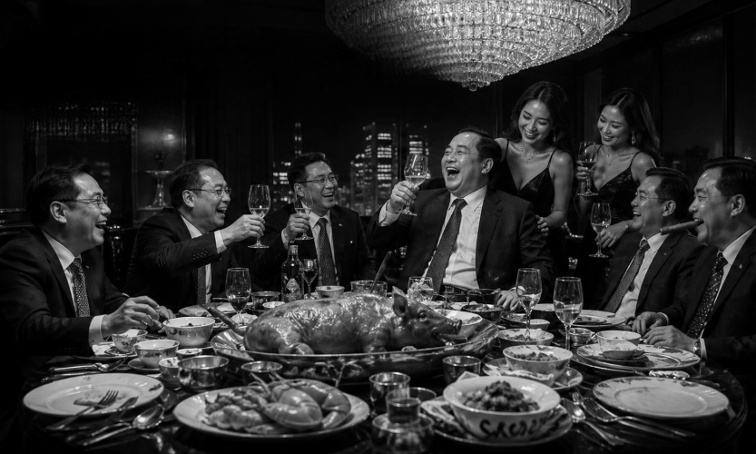
A video of Chinese netizens shooting at a 'Dragon Robe Pig Head' has gone viral from China to overseas. (Video screenshot)
[People News] Xi Jinping, who has just returned to Beijing from the distant United States, has issued new directives. On September 28, the Chinese Communist Party's Safe China Construction Work Conference convened in Beijing, where Xi's important instructions were conveyed, although it was not specified who delivered them.
Official records indicate that this conference has only been held three times to date, with the first two meetings taking place in June 2013 and November 2020. In all three instances, Xi has provided directives.
In this latest instruction, Xi brazenly asserted that "the construction of a Safe China has achieved significant results, with people living and working in peace and social order being stable and orderly," claiming that China is now "one of the safest countries in the world," a boast not made in the previous two meetings.
It is widely recognized that mainland China is the country with the strictest speech control globally and also the one with the least political security. Any criticism of the party leader, the Communist Party, or social issues is not only suppressed but can also lead to imprisonment for the critics. A notable example is real estate tycoon Ren Zhiqiang, who was sentenced to eighteen years in prison in 2020 for criticizing Xi Jinping. Under such stringent laws, Chinese citizens, including elites within the system, have opted for silence and have learned to self-censor.
Beyond political insecurity, the economic, social, and personal safety of the Chinese people are also precarious. Amidst economic downturns, the continuous incidents of 'loyalty demonstrations' have resulted in the tragic deaths of many innocent citizens. Each year, a significant number of individuals go missing and are trafficked to Cambodia, with the horrific practice of organ harvesting lurking behind these events. Additionally, numerous petitioners with grievances find themselves with no avenue for redress... Where can the people find stability and prosperity? Where is the social order and security?
In this context, Xi Jinping and the Chinese Communist Party have chosen to ignore these issues, shamelessly asserting that China is 'one of the safest countries in the world.' What has happened to the conscience of Xi and the senior officials of the CCP? In their quest to retain power, they live in a state of self-deception, completely disregarding their moral obligations.
The fact that this meeting is being convened again after six years underscores the reality that Chinese society is far from peaceful. The widespread anger among the populace has left the CCP authorities feeling increasingly anxious. The so-called 'safety' exists only in the rhetoric of high-ranking officials and in party media. In his subsequent comments, Xi referred to 'preventing and resolving various risks,' which reveals his profound concerns.
When discussing how to mitigate 'various risks,' after boasting about his achievements, Xi stressed the importance of being guided by 'Xi Jinping Thought,' implementing the overall national security concept, and 'upholding and strengthening the party's overall leadership,' among other directives. It is evident that if the CCP does not change its course and continues its adversarial stance towards the people, the notion of a Safe China will remain fundamentally unattainable.
Notably, when addressing the creation of a Safe China, Xi mentioned 'upholding and strengthening the party's overall leadership.' This phrase did not appear in similar meetings during his initial rise to power in 2013 or when his authority peaked in 2020.
Since the news of Xi Jinping's stroke surfaced in July 2024, there have been numerous signs indicating a decline in his military and party authority. One notable sign is Xi's repeated references to 'the leadership of the party' in public, particularly following the Fourth Plenary Session's formal endorsement of 'the centralized and unified leadership of the Party Central Committee'.
In January 2026, after Xi managed to oust Zhang Youxia and Liu Zhenli, he briefly regained some of his power. The upper ranks of the Communist Party of China (CPC) experienced significant turmoil for a time, but by June at the latest, a compromise was reached among the CPC leadership, affirming the need to adhere to the Fourth Plenary Resolution, which emphasizes the continuation of 'the centralized and unified leadership of the Party Central Committee'. While Xi is still considered the 'core', he has lost his 'one supreme' status, and it is an undeniable fact that his power has diminished.
In the months that followed, both Xi's statements and those of senior officials in the CPC Politburo have supported this observation. For example, Xi's use of the phrase 'under the leadership of the party' has become a consistent theme, and his close ally, Huang Kunming, the top official in Guangdong, has not shown support for Xi... The author has previously published several analytical articles on this topic and will refrain from further elaboration here.
Moreover, during the recent meeting, Chen Wenqing, a member of the Political Bureau of the CPC Central Committee and Secretary of the Central Political and Legal Affairs Commission, echoed this sentiment in his remarks.
While Chen Wenqing continued to commend Xi, asserting that the achievements in building a peaceful China are guided by 'Xi Thought', he also emphasized that these accomplishments are 'under the strong leadership of the Party Central Committee', 'fundamentally relying on the Party Central Committee with Xi at its core to navigate and steer', and 'under the centralized and unified leadership of the Party Central Committee'. Previously, high-ranking CPC officials typically framed it as 'fundamentally relying on General Secretary Xi Jinping to navigate and steer'.
One notable change this year is the absence of the loyalty phrase 'two four four two' in the speeches. In contrast, during 2020, Guo Shengkun, who was then the Secretary of the Central Political and Legal Affairs Commission, personally conveyed Xi Jinping's directives in his speech and specifically mentioned the loyalty phrase 'four four two'. If Xi Jinping remains the supreme leader, could such a change have occurred?
Since June, there has been a noticeable weakening of Xi Jinping's power, along with unusual behaviors among high-ranking Politburo officials and a significant reshuffling of senior officials. These developments suggest that the Chinese Communist Party is preparing for the Fifth Plenary Session scheduled for October. Whether Xi will step down and who might succeed him will be key points to watch.
(First published by the People News)△






News magazine bootstrap themes!
I like this themes, fast loading and look profesional
Thank you Carlos!
You're welcome!
Please support me with give positive rating!
Yes Sure!