
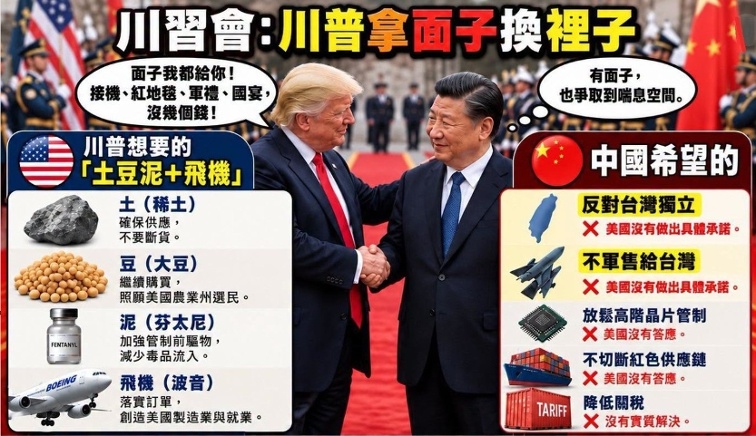
An image created by senior media figure Shibata Akio illustrates the recent Trump-Xi meeting, showing that Trump secured the 'substance' he sought, while Xi Jinping did not achieve his intended outcomes. (Facebook screenshot)
[People News] The highlight of Xi Jinping's three-day visit to the United States was his meeting with U.S. President Trump at the White House. Although both parties described the talks as 'great', aside from the previously announced agreement to extend the trade truce for two months, the other specific results released after the meeting remain limited. As for the Taiwan issue, which is viewed by the CCP as a diplomatic tool, the U.S. has not yet made a statement, with only the CCP's Xinhua News Agency providing a unilateral perspective.
In fact, every negotiation between China and the U.S. raises the question of who gains face and who gains substance. The recently concluded Trump-Xi meeting has sparked discussions on this very issue.
Xi Received a Red Carpet, While Trump Got 'Mashed Potatoes + an Airplane'
On the 25th, Shibata Akio, Executive Director of the Indo-Pacific Strategic Institute, posted on Facebook, highlighting that at this summit, Trump effectively traded 'face' for 'substance'.
Shibata Akio noted that since Xi Jinping places great importance on face, Trump ensured he received ample recognition: a warm airport reception, a red carpet, military honors, and a state banquet—everything that could be offered was provided. For Trump, maintaining face is relatively inexpensive. Handshakes, photo opportunities, and flattering remarks incur almost no cost. The crucial question remains: what did the U.S. gain in return?
He summarized that what the United States gained can be described as: "mashed potatoes + airplanes." Here, "earth" refers to rare earths, "beans" to soybeans, "mud" to fentanyl, and additionally, Boeing airplanes.
Akira Yabuki analyzed that the United States is approaching midterm elections. Rare earths are linked to high technology and the military industry, soybeans are important for agricultural state voters, fentanyl represents a significant social issue, and Boeing is tied to manufacturing and employment. Therefore, what Trump seeks are tangible results for voters: ensuring that rare earth supplies remain stable, continuing soybean purchases, maintaining regulation of fentanyl precursors, and expediting airplane orders. Essentially, China has agreed to these demands.
On the other hand, Xi Jinping's primary desire is for the United States to concede on the Taiwan issue, opposing Taiwan independence and halting arms sales to Taiwan. He also wants the U.S. to ease restrictions on high-end chips, stop severing the "red supply chain," and reduce tariffs. However, it currently appears that the United States has not made any concrete concessions on these critical issues.
Akira Yabuki emphasized that, of course, China is not returning empty-handed. Xi Jinping received a high-profile state visit and managed to secure an extension of the trade truce. Thus, this transaction is quite intriguing; Xi Jinping gained prestige and breathing room, while Trump obtained something to present to American voters.
Akira Yabuki noted that both sides also discussed a considerable amount of history during this meeting. Diplomacy can sometimes unfold this way; when current issues cannot be resolved, discussions shift to historical contexts. This is because the structural contradictions between China and the U.S. regarding technology, chips, trade, Taiwan, and military matters remain unresolved.
Akio Yabuki noted that many people in Taiwan hope the United States can deliver a decisive blow to China, but the U.S. strategy resembles 'controlling competition,' gradually undermining China's national strength. What Trump needs now is not a 'century agreement' that resolves all structural issues between the U.S. and China, but rather concrete results that American voters can see and feel.
Yabuki candidly stated that Trump wants to profit from China while avoiding the fallout from a potential collapse of the Chinese economy. Thus, Trump's strategy focuses on limiting China's access to advanced technology, reducing supply chain risks, maintaining military deterrence, and preventing conflicts from spiraling out of control.
Yabuki compared the situation to 'giving a stick and then a sweet date.' After offering the sweet date, competition continues. Therefore, when the U.S. provides concessions to China, Taiwan need not feel immediate anxiety, as the long-term structure of U.S.-China competition remains unchanged.
Yabuki emphasized that the red carpet is merely for appearances, while 'mashed potatoes + airplanes' represent the real substance. To truly understand U.S.-China relations, one should focus less on superficialities and more on the underlying realities to grasp the true direction.
Foreign media: Xi did not achieve all his goals
In terms of which side gained more from the Trump-Xi summit, Western media have released their observations and conclusions.
Some foreign outlets pointed out that the Chinese Communist Party believes the U.S. is attempting to contain China's rise as a superpower, and thus hopes Washington will not obstruct China, particularly regarding trade, technology, and Taiwan issues. During this visit to the U.S., Xi Jinping received the high-level treatment he sought, but he did not obtain everything he desired.
An article published by the British Broadcasting Corporation (BBC) on Thursday (September 24) presented the aforementioned perspective. The United States and China had previously agreed to suspend their escalating tariff conflict, thereby preventing further deterioration of the situation. The ceasefire was initially scheduled to end on November 10, and Beijing had hoped to extend it for at least another year, as Xi Jinping aimed to navigate through the remainder of Trump's presidential term. Ultimately, however, the ceasefire was only extended by two months, from November 10 to January 10 of the following year.
According to the BBC article, this implies that critical issues regarding tariffs, China's dominance in rare earth supplies, and access to advanced American chips will be deferred for further negotiations. This suggests that the U.S. is looking for China to take additional steps to honor its commitments under the agreement before considering any long-term concessions.
Given the Chinese Communist Party's (CCP) track record of not fully delivering on its promises, the manner in which the CCP fulfills its commitments has consistently been a point of concern for the U.S.
Last year, the CCP imposed export restrictions on various rare earth minerals, including yttrium. Following this, Trump and Xi Jinping met in Busan, South Korea, in October, where Xi promised to restore the supply of these minerals in exchange for Trump lifting some tariffs and export controls. However, the CCP's adherence to this promise has been inconsistent. Data from the General Administration of Customs of China indicates that in January, May, and June of this year, the export volume of this highly sought-after metal to the U.S. was zero.
In May, U.S. Trade Representative Jamieson Greer commented on the slow shipments of Chinese rare earths, saying, "Sometimes, we have to step in to clarify our position."
For Xi Jinping, a troubling reality is that China's domestic economy is in distress: it is experiencing stagnation, the real estate market is virtually inactive, youth unemployment remains high, and consumer spending among Chinese citizens is weak.
Retail sales serve as a reliable indicator of the overall living conditions of households. After adjusting for inflation, China's retail sales in August saw a year-on-year decline of 0.4%. In contrast, U.S. retail sales increased by 2.6%, and retail sales in Japan, Canada, and even Western Europe are also experiencing growth.
Trade is playing a crucial role in supporting China's economic growth, making it more vital than ever for Chinese products to penetrate overseas markets. Xi must safeguard these exports from the destructive tariffs that the U.S. implemented last year, which makes extending the tariff truce for as long as possible particularly significant for the Chinese Communist Party.
However, despite traveling all the way to the White House, the U.S. was only willing to grant a 2-month extension. It appears that Xi Jinping is returning home with a sense of disappointment. △





News magazine bootstrap themes!
I like this themes, fast loading and look profesional
Thank you Carlos!
You're welcome!
Please support me with give positive rating!
Yes Sure!