
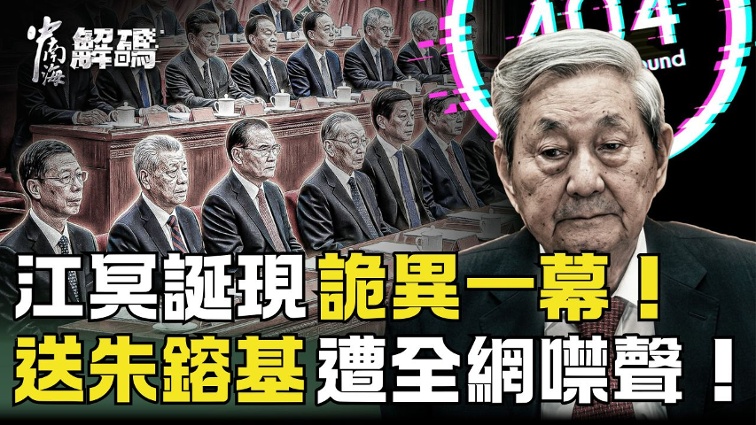
In the Underworld Memorial, Observing the Universe: Jiang Zemin's Farewell Ceremony and the Sound of Thunder (Video)
[People News] Since Xi Jinping took power as the General Secretary of the Communist Party at the 18th National Congress, he has been consolidating power for 14 years. Initially, he launched a significant purge against the Jiang Zemin faction, but since around the 19th National Congress, he has shifted leftward, facing accusations of regressive policies and a return to the Cultural Revolution era. After the 20th National Congress, Xi's allies have fully occupied key positions in the party, government, and military.
In the power struggle surrounding Xi, it has been revealed that he engaged in four secret political transactions with Jiang Zemin and the Jiang faction. These include: Xi's promise to protect the Jiang family's interests in exchange for Jiang Zemin designating him as his successor; securing Jiang faction support for Xi's constitutional amendments and re-election by ensuring party stability and pushing Wang Qishan out; Xi collaborating with the Jiang faction to eliminate the Tuanpai at the 20th National Congress; and leveraging Jiang Zemin's centenary death to play the 'dead man card' to 'elevate Jiang and protect Xi'.
On April 19, 2026, independent commentator Du Zheng published an article in Taiwan's 'Shang Bao', revealing that since the era of Deng Xiaoping, the Communist Party has been engaging in a scheme of designating successors across generations. This is driven by the needs of power struggles and concerns for family interests, as designating a successor can ensure that the next two generations of leaders protect their family interests. For instance, Deng Xiaoping designated Hu Jintao, Jiang Zemin designated Xi Jinping, and Hu Jintao designated Hu Chunhua. However, in order to maintain long-term power, Xi Jinping directly sidelined Hu Chunhua.
The first transaction was mediated by Moutai liquor.
Du Zheng's article indicates that Jiang Zemin's designation of Xi Jinping as his successor was, in fact, quite secretive.
A report from "Moutai News" dated June 30, 2005, indicates that on June 20, 2005, Xi Jinping, who was then the Secretary of the Zhejiang Provincial Committee, met with and hosted a banquet for Ji Keliang, Chairman of Moutai Group, General Manager Yuan Renguo, and others at the Xihu State Guesthouse. During the meeting, Xi disclosed that he has a particular fondness for Moutai and had hosted Jiang Zemin and his wife with 80-year-old Moutai in 2004. Local official media reported that Jiang Zemin conducted his seventh inspection of Zhejiang from July 21 to 23, 2004.
In 2007, Xi Jinping advanced from being a Central Committee member to a member of the Politburo Standing Committee during the 17th National Congress of the Communist Party of China. The article notes that Jiang Zemin did not resign as Chairman of the Central Military Commission until September 2004, and his visit to Zhejiang prior to stepping down was to personally evaluate Xi Jinping, designating him as Hu Jintao's successor as General Secretary of the Communist Party. "The crucial condition for Xi to be appointed as a successor from a different generation was that he needed to safeguard the interests of the Jiang family after assuming office."
This marked the first transaction between Xi and Jiang. Consequently, Xi Jinping came to believe that his source of power stemmed from Jiang Zemin (not from the Chinese people), which explains why he declared after Jiang Zemin's death that he would 'inherit the will'.
The second transaction involved maintaining the constitutional amendment to abolish term limits.
After Xi Jinping assumed power, he initiated an anti-corruption campaign during his first term under the pretext of saving the party, targeting Jiang faction figures such as Zhou Yongkang, Xu Caihou, and Guo Boxiong. At that time, there was indeed a movement to hold Jiang Zemin accountable as the 'backer of corruption,' but Du Zheng noted in his article that this was merely a façade. The primary reason is that while going after Jiang Zemin would benefit the nation and its people, it would also require removing Jiang's 'Three Represents' from the party constitution, a move that was too radical and could risk the party's survival. Xi opted to protect the party and once again struck a deal with Jiang Zemin, allowing Wang Qishan, who was leading the anti-corruption efforts, to take a back seat. In return, the Jiang faction supported Xi Jinping's constitutional amendment in 2018 to abolish term limits, enabling Xi to maintain power indefinitely.
Furthermore, in November 2021, tennis star Peng Shuai publicly accused former Jiang faction Standing Committee member Zhang Gaoli of sexual assault. However, the incident concluded with Peng Shuai being silenced, and Zhang Gaoli faced no consequences. This was also one of the results of the agreement between the Jiang faction and Xi regarding the constitutional changes.
The Third Transaction of the Youth League Faction
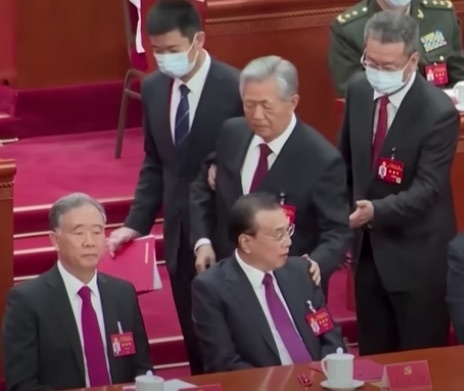
By the time of the 20th National Congress of the Communist Party of China in 2022, Xi engaged in a third deal with the Jiang faction. Xi Jinping was successfully re-elected as General Secretary, and his faction members took over completely, while figures from the Youth League faction, such as Li Keqiang and Wang Yang, were ousted. An incident occurred at the closing meeting where Hu Jintao was escorted out of the venue, and Hu Jintao's designated successor, Hu Chunhua, was also removed from the Politburo, effectively eliminating the Youth League faction from the power center.
Du Zheng pointed out that this was orchestrated by a collaboration between the Jiang faction and Xi.
Following the reshuffle at the 20th National Congress, officials with Jiang faction backgrounds still hold high positions, including Wang Huning and Zhao Leji, who remained on the 20th Politburo Standing Committee, and Han Zheng, who continued as Vice President of the State.
Following the 20th National Congress, Xi Jinping's faction faced intense internal conflict, exemplified by Central Military Commission Vice Chairman Zhang Youxia's defeat of Military Commission Vice Chairman He Weidong, who was ultimately ousted as well. Li Xi, the Secretary of the Central Commission for Discipline Inspection, also removed his former deputy in Guangdong, Ma Xingrui, among others. Nevertheless, during this time, the Jiang faction's princelings quietly 'seized the city' in economic terms.
Since 2025, Jiang Zemin's grandson, Jiang Zhicheng, has made substantial investments in the Chinese market. In addition to forming a joint venture with Starbucks to operate in China, where he holds up to 60% equity, he has also acquired approximately 42-45% of Beijing SKP (a high-end department store); engaged in cornerstone investments in companies such as Mixue Ice City, Contemporary Amperex Technology Co., Ltd. (CATL), and Heng Rui Medicine; and has controlling stakes in Jinke Service, among others. Another princeling from the Jiang faction, Liu Lefei, son of former Standing Committee member Liu Yunshan, controls the private equity firm CPE Yuanfeng, which holds about 83% of Burger King's operations in China.
Du Zhengwen noted that in the past, the Jiang faction's elite figures in the financial and internet sectors 'seized the city' amid rumors of significant political ambitions. Their collaboration is believed to be underpinned by a hidden, audacious plan—carefully positioning themselves in core industries like the internet and finance, so that when the political landscape shifts, they can swiftly elevate their own allies to the top of the political hierarchy and seize control of the Chinese Communist Party.
Du Zheng believes that after the 20th National Congress, the Jiang faction's princelings have re-emerged in the economic arena. In addition to their privileged backgrounds, they benefit from protection through high-level political negotiations, which allows them to operate with greater freedom.
During the recent purges of the party, government, and military, Jiang Zemin's eldest son, Jiang Mianheng, who is also Jiang Zhicheng's father, has indeed been touched upon, but Xi is unlikely to take any real action against him.
Jiang Mianheng was appointed Vice President of the Chinese Academy of Sciences in November 1999, a position he held until November 2011. Thanks to his father's connections, Jiang Mianheng, who lacked a background in aerospace, became involved in the aerospace and military sectors. Many high-ranking officials who have since fallen from power, such as Politburo member Ma Xingrui and Zhu Zhizong, a member of the Shanghai Municipal Committee Standing Committee and Secretary of the Pudong New Area Committee, were once trusted allies of Jiang Mianheng.
The Fourth Political Transaction: 'Raise Jiang to Protect Xi'
Du Zheng remarked that in the past three years, Xi Jinping has dismissed many of those he promoted, and regardless of his claims of 'self-revolution,' this cannot be justified. The more purges he conducts, the deeper Xi sinks into a governance crisis characterized by having power without authority. In this context, Xi Jinping may need to engage in a fourth political transaction with the Jiang family. To secure his re-election at next year's 21st National Congress, he is prepared to exploit the centenary of Jiang Zemin's death this year, playing the 'death card' to 'raise Jiang to protect Xi.'
As anticipated, on August 17, 2026, the Chinese Communist Party held a high-profile memorial conference for the centenary of Jiang Zemin's death, during which Xi Jinping praised Jiang Zemin extensively in his speech. A documentary aired simultaneously on CCTV titled 'Jiang Zemin' extolled his so-called achievements in domestic governance, foreign affairs, and military management. The documentary also detailed the suppression of Falun Gong, heavily discrediting the group.
Recently, the official Chinese Communist Party announced that the Mao Zedong Memorial Hall in Beijing will undergo internal renovations from March 16 to August 31, during which it will be temporarily closed to the public. Speculation suggests that the renovations may aim to add a memorial for Jiang Zemin on the second floor, alongside the existing memorials for Mao Zedong, Zhou Enlai, Liu Shaoqi, Zhu De, Deng Xiaoping, and Chen Yun, in order to achieve the political objective of 'elevating Jiang to protect Xi.'
Xi Jinping is engaging in political dealings with the Jiang faction, openly praising Jiang Zemin, which undoubtedly continues the legacy of Jiang Zemin's crimes, including the Tiananmen Square massacre and the persecution of Falun Gong. In fact, since Jiang Zemin launched the crackdown on Falun Gong on July 20, 1999, the persecution has persisted for 27 years, with 14 of those years occurring during Xi Jinping's tenure.
If Xi continues to uphold Jiang Zemin's legacy, following this path to its conclusion, he will inevitably face the wrath of the heavens and the anger of the people, leading to a complete reckoning.
△




News magazine bootstrap themes!
I like this themes, fast loading and look profesional
Thank you Carlos!
You're welcome!
Please support me with give positive rating!
Yes Sure!