
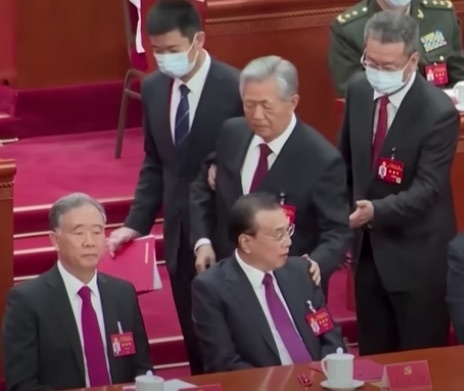
During the closing ceremony of the 20th National Congress of the Communist Party of China, Kong Shaoxun, who was then the Deputy Director of the General Office and Secretary of the Secretariat (Figure right one: behind Hu Jintao's left), led security personnel to escort Hu Jintao out of the venue. (Video screenshot)
[People News] On September 2, former Deputy Director of the General Office of the CPC Central Committee and Secretary of the Secretariat, Kong Shaoxun, has been appointed by the CPC authorities as the Acting Governor of Gansu Province. At the end of August, Kong had already been transferred from Beijing to Gansu, where he was appointed as the Deputy Secretary of the Gansu Provincial Committee and Secretary of the Party Group of the Gansu Provincial Government.
In this way, Kong Shaoxun, who is neither a member nor an alternate member of the Central Committee, was unexpectedly promoted to a senior provincial-level official and became one of the candidates for the Central Committee of the 21st National Congress of the Communist Party.
What led to Kong Shaoxun's exceptional promotion by the CPC authorities? Based on my observations, there are likely three main reasons:
First, he assisted Xi in executing an action that sent shockwaves through the ranks of officials.
The 20th National Congress of the CPC in October 2022 marked a 'high point' for Xi Jinping. Not only did Xi secure a 'third term,' but he also appointed individuals to the most critical positions within the highest echelons of the CPC's party, government, and military.
At the closing ceremony of the 20th National Congress, Xi took a shocking action: in front of the cameras of mainstream international media, he ordered the escorting out of Hu Jintao, the former highest leader of the CPC's party, government, and military, who had been retired for 10 years, was 80 years old, had provided Xi with significant support, and posed no threat to Xi's authority.
One of the individuals who assisted Xi in this action was Kong Shaoxun, then Deputy Director of the General Office and Secretary of the Secretariat.
At that moment, Hu Jintao sought to review a red document, but Su Zhankuo, the former member of the Standing Committee of the Political Bureau of the Communist Party of China and Chairman of the National People's Congress, refused to let him see it. Despite Hu's insistence, Su remained unyielding. Upon noticing this, Xi Jinping turned to find assistance, and Kong Shaoxun quickly approached him, whereupon Xi whispered a few words to him. Kong then went off to find someone. Shortly after, a man dressed in black (likely from the Central Guard Bureau) arrived at Xi's side. After receiving a few instructions from Xi, the man in black seized one of Hu's arms and forcibly pulled him up from his seat, intending to escort him away. Kong then approached and gestured for Hu to leave. Hu resisted, but Kong continued to signal for him to go. Subsequently, the man in black held Hu's arm and led the way, with Kong closely following behind, together escorting Hu out of the venue.
At that time, the representatives present had just voted to approve the lists for the 20th Central Committee and the Central Commission for Discipline Inspection. Two prominent figures from the Communist Youth League faction, Li Keqiang and Wang Yang, both born in 1955 and aged 67, were not re-elected to the Central Committee; however, Wang Huning, Cai Qi, He Lifeng, and Wang Yong, who were also born in 1955, were re-elected, while the older Xi Jinping, Wang Yi, and Zhang Youxia continued in their positions.
Hu Jintao may have raised objections regarding the absence of Li Keqiang and Wang Yang from the list of the 20th Central Committee members.
Nevertheless, Xi believed he was the primary architect of the personnel arrangements for the 20th National Congress, and the list he established was not subject to dispute by anyone, including Hu Jintao. This may have been one of the reasons why Xi ordered Hu to be escorted away.
At that time, high-ranking officials from the upper echelons of the Chinese Communist Party, including retired officials, were present at the venue. Xi's actions may have been aimed at all the high-ranking officials in attendance. Within the CCP, Xi now holds the ultimate authority, and he is the one in charge.' Anyone who disagrees with Xi's decisions will face his disapproval.
About half an hour after Hu was forcibly removed, Kong Shaoxun returned to Xi's side, whispered a few words to him, and then left. Kong may have been informing Xi that the matter had been resolved and that he could rest assured.
Hu Jintao's forcible removal from the venue of the 20th National Congress was captured by reporters from internationally renowned media outlets such as AFP, AP, and Reuters. The video quickly went viral around the world, generating widespread attention and discussion.
Kong Shaoxun, who typically maintains a low profile and has worked quietly behind the scenes, gained international recognition for the first time due to his involvement in this shocking event.
Additionally, he has become an important informant for Zhongnanhai in the northwest region.
Born in 1969, Kong Shaoxun graduated from the Economics Department of Renmin University of China and has long been engaged in secretarial work. He has held various positions, including deputy-level secretary in the General Office of the Yinchuan Municipal Government of the Ningxia Hui Autonomous Region, deputy director and director of the Secretariat of the Ningxia Hui Autonomous Region Party Committee, deputy director of the General Office of the Ningxia Autonomous Region Party Committee, and deputy secretary-general of the Ningxia Autonomous Region Party Committee. In December 2009, he was temporarily transferred to Shanghai, where he served as the deputy commander of the Shanghai World Expo 600-Day Action Urban Management Command. In December 2010, he was transferred to Zhongnanhai. Kong Shaoxun has worked in the General Office for nearly 16 years, holding positions such as deputy secretary of the Party Committee of the General Office, secretary of the Discipline Inspection Commission, director of the Personnel Bureau, and deputy director of the General Office, while also serving as the director of the Secretariat.
During his time at the Central Office, Kong Shaoxun worked under four directors: Ling Jihua, Su Zhankui, Ding Xuexiang, and Cai Qi. He spent 1 year and 9 months with Ling Jihua, 5 years each with Su Zhankui and Ding Xuexiang, and 3 years and 5 months with Cai Qi.
Kong had the briefest tenure with Ling Jihua. His transfer to the Central Office may have been influenced by Zhao Shengxuan, the deputy director at the time, as both are alumni of Renmin University of China. After Ling was investigated, Kong likely distanced himself from him quickly, which shielded him from the fallout of Ling's scandal.
Su Zhankui, Ding Xuexiang, and Cai Qi are all trusted allies of Xi Jinping. Kong Shaoxun's work was evidently acknowledged by these three confidants of Xi. Notably, after Cai Qi assumed the role of director of the Central Office while also serving on the Politburo Standing Committee, he became the chief overseer of the national party and government secretariat. Secretaries for leaders across provinces, autonomous regions, and municipalities, as well as those in central and national commissions, ministries, and bureaus, report directly to Cai Qi, acting as informants for Zhongnanhai to monitor the thoughts and actions of both central and local officials.
Coming from a secretarial background, Kong Shaoxun had a long tenure as a secretary in Ningxia before moving to the Central Office, where he advanced to deputy director and head of the secretariat, continuing to perform secretarial tasks. One of the key skills of a secretary is to be observant and perceptive, adept at reading situations and understanding the leader's intentions.
At a pivotal moment during the 20th National Congress, when called upon by Xi, Kong quickly understood Xi's intentions and executed them decisively, earning both Xi's appreciation and Cai Qi's recognition.
Next year, the Communist Party of China will hold its 21st National Congress, and the party is currently making intensive adjustments to local party and government leadership in preparation for personnel arrangements for this upcoming congress.
Gansu is a key province on the northwestern frontier of China. For the Chinese Communist authorities to effectively manage Gansu from a distance, they need a reliable individual who can continuously report on local political developments to Zhongnanhai. Kong Shaoxun, who has spent nearly 16 years working at Zhongnanhai and has been recognized by Xi and Cai, is likely seen as a suitable candidate.
Thirdly, 'political loyalty' is prioritized above all else.
According to his public resume, Kong Shaoxun has never held a top position in local government (such as township head, county head, mayor, or provincial governor), nor has he served as the head of any committee, ministry, bureau, or office under the State Council. He lacks experience in leading local governments at various levels and has not overseen central committees, ministries, or offices.
Regarding qualifications, Kong Shaoxun's current role as acting governor of Gansu province indicates that he is likely to be 'elected' as the official governor soon, but this arrangement raises concerns about its appropriateness.
As the head of a province, one must manage the economic and social development of the entire region, which requires a deep understanding of social conditions, official sentiments, and public opinion. It also demands extensive professional knowledge and skills. Without the experience of gradually advancing through government ranks and without having personally dealt with urgent, complex, and critical tasks, there is a significant gap in experience. This may also hinder his ability to earn the respect of senior officials who have long served in government.
Nevertheless, in Xi Jinping's 'new era', when he promotes and relies on officials, professional competence takes a backseat to 'political loyalty'.
What matters most to Xi Jinping is whether officials of the Communist Party of China (CPC) have fulfilled the 'Two Establishes'—which means establishing Xi's core position within the Party Central Committee and the entire Party, as well as establishing the guiding role of Xi Jinping Thought. Additionally, he looks for the 'Two Safeguards,' which involve resolutely protecting Xi's core position in the Party Central Committee and the authority of the Party Central Committee, ensuring centralized and unified leadership. Furthermore, he expects the establishment of the 'Four Consciousnesses,' which include political consciousness, overall awareness, core awareness, and alignment consciousness. In essence, it boils down to whether they maintain a high degree of alignment with Xi, listen to him, follow his lead, and serve as effective cadres under his leadership. With this standard in place, everything else becomes secondary.
For instance, during the 20th National Congress of the CPC in 2022, Xi's newly formed Politburo Standing Committee included Li Qiang in the second position. Notably, Li had never held the roles of Vice Premier, Executive Vice Premier, or State Councilor, nor had he been the head of any central or state agency, ministry, bureau, or office. This lack of experience is a significant shortcoming in terms of qualifications. However, Xi views Li Qiang as one of his own, demonstrating 'political loyalty.' During the pandemic, Li firmly implemented Xi's 'zero-COVID policy,' leading the extensive lockdown in Shanghai and aligning closely with Xi's directives. Consequently, Xi insisted on promoting Li Qiang to the Politburo Standing Committee and, the following year, appointed him as Premier of the State Council.
For instance, during his time as acting mayor, mayor, and secretary of the Beijing Municipal Committee from 2016 to 2017, Cai Qi was neither a member nor an alternate member of the Central Committee of the Communist Party of China. Nevertheless, Xi Jinping insisted on promoting Cai Qi to these positions. At the 19th National Congress of the Communist Party of China in October 2017, Xi promoted Cai Qi in a single move, allowing him to leap three ranks to become a member of the Politburo. The crucial factor is that Xi views Cai Qi as demonstrating 'political loyalty.'
Although Kong Shaoxun has never held any position as a township head, county head, mayor, or provincial governor, and lacks any government work experience, Xi considers Kong to be 'politically reliable,' which suffices for him.
Conclusion
Since the 20th National Congress of the Communist Party of China, several high-ranking officials who were personally, exceptionally, and rapidly promoted by Xi have faced issues. For example, He Weidong, who was neither a member nor an alternate member of the 19th Central Committee, nor a member of the 19th Central Military Commission, was promoted three levels at once by Xi, being directly appointed as a member of the Central Committee, a member of the Politburo, and vice chairman of the Central Military Commission. However, He Weidong was 'missing' after just two and a half years in office and was later expelled from the Party and military and referred for judicial trial due to 'betrayal of loyalty' and 'seriously violating the principle of Party command and the responsibility system of the chairman of the Military Commission.'
Yet, Xi appears to have learned no lessons and continues to personally, exceptionally, and rapidly promote high-ranking officials, making personnel arrangements for his 'fourth consecutive term' at the 21st National Congress, and persists in the approach of 'if you say you can, you can; if you say you can't, you can't; if you don't comply, you can't.'
Kong Shaoxun has been appointed as the acting governor of Gansu Province, which is likely to cause dissatisfaction among many members of the 20th Central Committee and alternate members. Additionally, those holding top and deputy positions in the State Council, ministries, bureaus, and offices, as well as leaders in the 31 provinces, autonomous regions, and municipalities, are also expected to be unhappy with this decision.
Some have labeled Xi as the 'General Accelerator' who is hastening the Communist Party of China's decline; perhaps, Xi is indeed 'accelerating' once more.
--Dajiyuan
△





News magazine bootstrap themes!
I like this themes, fast loading and look profesional
Thank you Carlos!
You're welcome!
Please support me with give positive rating!
Yes Sure!