
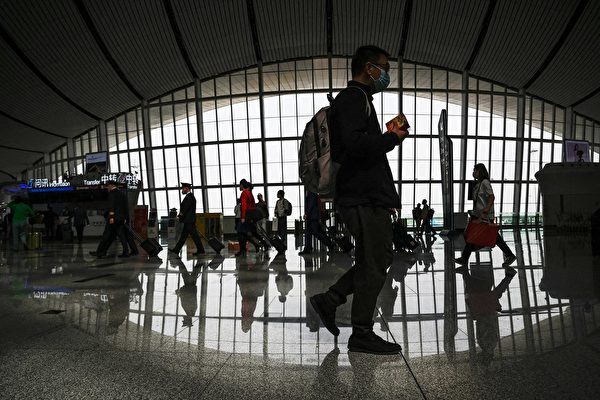
Passengers at Beijing Daxing International Airport on April 28, 2023. (Jade Gao/AFP via Getty Images)
[People News] Beginning September 15, new exit and entry management regulations will be officially enforced at various entry and exit ports across China, imposing stricter limitations on residents' outbound travel. Informed sources indicate that the new rules adopt a 'who approves, who is responsible' system, requiring civil servants, employees of state-owned enterprises, and public institutions—including university teachers, doctors, executives of publicly listed companies, and university students—to submit applications and secure approval prior to traveling abroad. Should approved individuals overstay or fail to return from abroad, the person who signed the approval will be held accountable.
According to a report by Radio Free Asia, Chen Guoming (pseudonym), a senior official in China's financial system, informed reporters that the aforementioned personnel must receive approval from their superior's principal leader before departing. For instance, a section chief must obtain approval from the department head, the department head from the bureau chief, and the bureau chief from the minister, and so forth. If an approved individual overstays abroad, the signatory will be responsible: 'Who approves, who is responsible.' Supervisors in financial institutions and public hospital departments are permitted to apply for outbound travel only once a year, with a maximum stay of one week in Hong Kong and Macau.
On Wednesday (September 2), Radio Free Asia uncovered two screenshots online revealing a letter titled 'Consent to Apply for Exit and Entry Documents,' which mandates national staff to secure consent from their units; another conversation among bank staff dated July 23 mentioned, 'The head office stipulates a maximum of two trips abroad per year, and passports must be submitted to the branch within three days of returning to the country.' The screenshots did not disclose the identities of the relevant units and personnel, and Radio Free Asia could not independently verify the information.
Mr. Shen, an insider, disclosed to Radio Free Asia that the regulations have been in effect internally for some time, and the newly announced 'Regulations' will formalize these internal rules into law, primarily introducing restrictions on the outbound travel of financial and scientific research personnel, as well as university students. He stated, 'Over the past year, a significant outflow of AI talent and technology data from the tech sector has already impacted the development of AI in China. The mainland has been compelled to hire Western engineers at high salaries to fill the talent gap, while also attempting to retain university students in critical fields like IT. Moving forward, it will not be as easy for these university students to travel abroad. A friend of mine took his child to Hong Kong Disneyland in August, and after applying a month in advance, he was only granted four days of leave.'
University Students Stopped from Traveling Abroad
On the overseas social media platform X, a netizen shared a screenshot of an online chat indicating that two university students, who had already purchased their tickets and were preparing to travel abroad, were intercepted by border inspection officials on the grounds of 'safety concerns.' An informant in the chat remarked, 'They detained the two students, claiming they were unsafe. They had already bought their tickets, yet they were still stopped.'
On August 16, a video circulated on platform X. In the video, a Chinese female university student recounted that when she was passing through the self-service channel at Nanning Airport in Guangxi on the 15th, the machine signaled a red light, and she was subsequently taken into a room colloquially known as the 'little black room.' She reported that her visa had been canceled. Additionally, she stated, 'My phone, chat logs, bank statements, return tickets, hotel bookings, and luggage were all inspected.' The border inspection officials informed her that there were students from her university who were stranded in Spain and had not returned, resulting in restrictions on outbound travel for approximately 60,000 students at the institution.
Reports indicate that the Chinese Communist Party has imposed various restrictions on outbound residents as early as a month ago. When residents apply for passports at the entry and exit administration, they must provide documentation from their workplace or neighborhood committee, specifying the purpose of their travel, destination, overseas address, and other details. There have been reports that border control personnel at ports have required outbound travelers to unlock their phones for inspection, with the majority of those scrutinised being young individuals.
Mr. Zhang, a lawyer from Hubei, remarked that the restrictions on young people's ability to leave the country may be linked to the declining birth rate: "There are numerous factors limiting outbound travel, such as preventing asset transfers, the outflow of technological talent, and the emigration of young people. Many young people wish to go abroad, and the primary reason for passport application rejections is related to telecom fraud. However, leaving the country is a citizen's right, and the government should not impose various restrictions."
Scrutiny of overseas employment and long-term expatriates.
In addition to restricting residents from leaving the country, on August 30, a user on social media platform X shared images and text stating that on August 24, a Chinese colleague working in Singapore was required by the local police station to submit seven documents during a business trip back to China. These included a passport, proof of overseas employment and medical insurance, work photos, company signage photos, landmark photos, and a specific address. The police personnel also informed that failure to provide these materials "may affect their ability to exit the country."
On the same day, a Chinese netizen residing long-term in the United States also shared WeChat chat records. Screenshots revealed that staff from her local police station contacted her via WeChat, indicating that individuals identified by "big data" as having been abroad for an extended period without returning must verify whether they are living and working legally overseas.
The staff requested that she submit her passport, visa or labor contract; photos of her daily life and work; screenshots of her WeChat chat records; and also asked for a video call and to share her real-time location. They indicated that they had already inquired with her brother in China about her exit, marital status, and work situation.
The netizen asked the staff to provide a police badge number so that her family could verify their identity with the police station. She also pressed for details on which system or type of list she had been filtered from, what specific work this related to, and the legal basis for requesting the aforementioned personal materials. The existing chat screenshots did not show any explanation from the staff on this matter.
In the comments section, several Chinese netizens residing in countries such as Singapore, Australia, and the United States reported experiencing similar investigations. Some individuals mentioned that their parents had been contacted by the police station or community, urging them to persuade their children to comply.
△









News magazine bootstrap themes!
I like this themes, fast loading and look profesional
Thank you Carlos!
You're welcome!
Please support me with give positive rating!
Yes Sure!