
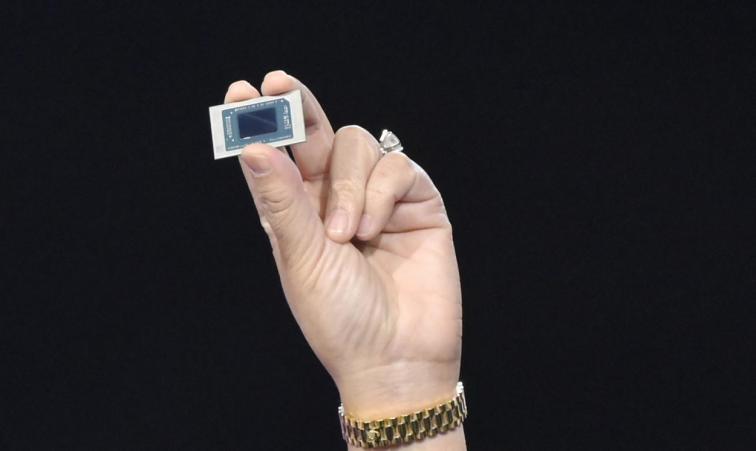
Illustrative image showing the ADM Ryzen 7040 series chips displayed at CES 2023 at the Venetian Hotel in Las Vegas, Nevada on January 4, 2023. (Getty Images)
[People News] Taiwan's prosecutorial authorities have filed charges against nine suspects on Monday (August 24) for their involvement in the illegal sale of advanced artificial intelligence servers to China. This group includes employees from Nvidia and Super Micro Computer's Taiwan branch.
Voice of America reports that the Keelung District Prosecutor's Office announced in a press release that the suspects are accused of smuggling 130 servers manufactured by Super Micro Computer, which contain Nvidia's B300 high-end AI chips, to China through Indonesia, Japan, and other locations. Of these servers, 74 have been successfully resold, while the remaining 56 were intercepted by customs officials due to regulatory non-compliance.
The investigation by the Keelung District Prosecutor's Office began in May of this year, focusing on three suspects involved in the illegal resale of high-end AI chips to China. After expanding the investigation to include additional suspects and conducting searches at relevant locations, the case has now been concluded with charges against the nine individuals. They are also suspected of committing other offenses, including breach of trust and forgery.
Since 2022, the U.S. government has banned Nvidia and Super Micro from selling high-end artificial intelligence products to mainland China, Hong Kong, and Macau.
According to a press release from the Keelung District Prosecutor's Office, an employee named Zhang from NVIDIA Taiwan, along with employees named Lin and Wang from Advanced Micro Devices (AMD) Taiwan, are implicated in this case. The prosecution is seeking prison sentences ranging from one and a half to six years, depending on the degree of their involvement. Two of the defendants admitted to their criminal activities during the investigation and cooperated with the authorities by providing information about other accomplices, prompting the prosecution to recommend lighter sentences.
The press release indicated that both AMD and NVIDIA maintain strict controls over product distribution, end users, and intended uses. Buyers must undergo a review process by both companies and submit declarations regarding the end use and users before making a purchase. Furthermore, the products cannot be resold to others. However, the defendants allegedly misrepresented a Taiwanese company renting a location in Taiwan as the end user, and through this company, they transferred the purchased servers to China via Indonesia and Japan, or through Hong Kong to China.
Voice of America reached out to NVIDIA for comments but had not received a response by the time of publication.
The Keelung District Prosecutor's Office had previously conducted a search of a suspect named Zhang's residence and office on July 24 and interviewed him. On July 28, they announced the detention of an NVIDIA employee, accusing him of smuggling NVIDIA chips, which are subject to U.S. regulations, into China.
While the prosecutor's statement did not disclose the specific identity of the suspect, Taiwanese media reports indicate that the suspect named Zhang is Zhang Denglong, a senior business development manager at NVIDIA, who is suspected of aiding in the smuggling of NVIDIA B300 AI chips, which are subject to U.S. export controls, into mainland China.
The United States has initiated lawsuits against individuals connected to Super Micro Computer. In March of this year, the U.S. Department of Justice filed lawsuits against three individuals associated with Super Micro Computer, including one of the company's co-founders. The Department of Justice accused these individuals of facilitating the smuggling of servers valued at over $2.5 billion, equipped with high-end NVIDIA chips, to China through covert methods such as transhipment in Southeast Asia, which constitutes a serious violation of federal export control regulations.
In recent years, both parties in the U.S. Congress have regarded the export of AI chips and hardware to China as a central issue in the strategic competition between the U.S. and China, as well as a matter of national security. Congress has been actively pursuing legislative measures and applying pressure on the executive branch to curb the illegal acquisition of U.S. high-end AI technology by the Chinese Communist Party.
On March 26 of this year, the U.S. House Foreign Affairs Committee passed the bipartisan Chip Security Act, which aims to prevent U.S. semiconductors from being smuggled to China and other so-called 'foreign adversaries.'
Taiwan plays a vital role in the global semiconductor industry, producing the majority of the world's leading chips. The island has also implemented regulations designed to restrict the outflow of sensitive technology. △







News magazine bootstrap themes!
I like this themes, fast loading and look profesional
Thank you Carlos!
You're welcome!
Please support me with give positive rating!
Yes Sure!