
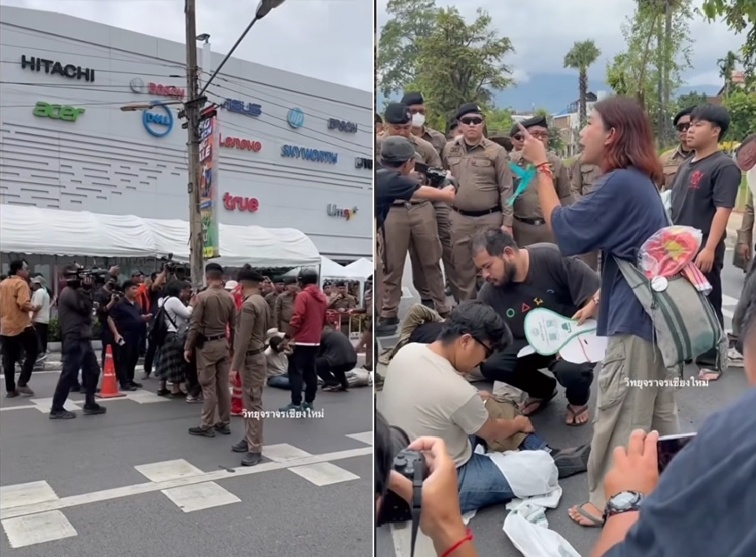
On July 8, 2026, Thai civil groups held a protest against Chinese investment pollution in front of the Chinese consulate in Thailand. (Video screenshot)
[People News] In solidarity with the protest against Chinese investment pollution that occurred on July 6 in northern Thailand, on July 8, several Thai civil groups gathered to protest in front of the Chinese Embassy in Thailand, with some wearing masks depicting Chinese leader Xi Jinping. They condemned the police for using violence to disperse demonstrators outside the Chinese consulate in Chiang Mai on July 6 and demanded that the Chinese government be held accountable for the cross-border pollution caused by Chinese investments in Myanmar's mines, as well as the environmental issues arising from the Belt and Road Initiative.
On July 6, a network called 'Protect the Mekong River, Kok River, and the People of the Mekong' was initiated by civil society in northern Thailand. They had originally planned to peacefully deliver a petition to Xi Jinping at the Chinese consulate in Chiang Mai, urging Chinese investments to take responsibility for the cross-border pollution they caused in neighboring countries. However, on that day, the Chiang Mai police deployed over 100 officers and erected barbed wire and metal fences. When the demonstrators attempted to approach the consulate on the sidewalk, the police forcibly obstructed and pushed them back. The resulting conflict led to serious injuries for two Thai environmental activists, one suffering a broken left arm and the other a dislocated shoulder. The police's violent actions against local environmentalists to protect the Chinese consulate have sparked widespread outrage within Thai society.
On July 8, dozens of individuals from various Thai environmental and human rights organizations gathered to form the "Non-Governmental Organization Development Coordination Committee" (NGO-COD) and protested in front of the Chinese Embassy in Thailand. The demonstrators held banners that read "Pollution knows no borders, and neither does responsibility" and "With the green Belt and Road, is toxic water coming all the way?" Some participants donned masks resembling Xi Jinping's face and shouted slogans loudly.
According to reports from the Central News Agency, images from the protest showed individuals holding placards with large Chinese characters that read "This is Thailand, not Tiananmen," along with English translations.
After delivering a statement in front of the Chinese Embassy, the protesters symbolically poured wastewater onto a signboard featuring a map of Thailand, representing the toxic pollution of Thailand caused by mining activities.
Thai environmental and human rights advocate Lertsak Kumkongsak criticized the Thai government for "choosing to align with Chinese capital that profits from the destruction of rivers and the lives of people, rather than protecting the rivers of their homeland and defending the people's right to a healthy environment and safety."
NGO-COD issued a statement indicating that tributaries of the Mekong River, such as the Kok River and Sai River, are facing a serious cross-border pollution crisis. The statement highlighted that investigations conducted over the past year by Thai government agencies, scholars, and civil society organizations have shown that river pollution has affected over 90 species of native fish and has impacted the livelihoods of residents in the basin.
NGO-COD also asserted that the Chinese government should take responsibility for the various issues arising from cross-border environmental and human rights concerns due to "Belt and Road" investments that have led to pollution in neighboring countries.
Pollution Exported to Multiple Countries through the Belt and Road Initiative
According to long-term monitoring by the World Bank, the World Wildlife Fund (WWF), and various international independent think tanks, among the over 140 countries involved in the Belt and Road Initiative, at least several dozen have faced severe river and land pollution, as well as ecological destruction, after engaging in infrastructure and energy projects initiated by the Chinese Communist Party (CCP). This situation is a direct consequence of the CCP's harmful transfer of domestically phased-out "high-pollution, high-energy consumption" production capacities to other countries.
Destruction of the Mekong River Basin
In the realm of water conservancy and hydropower projects, the CCP's "infrastructure mania" has led to irreversible ecological devastation of the primary rivers in several countries.
The CCP has aggressively constructed dozens of large dams (such as the Sayaboury Dam in Laos and the Xayaburi-Xan Nane Dam) along the upper (known as the Lancang River in China) and lower reaches of the Mekong River. Experts in hydrology have noted that these dams have disrupted the sediment transport and fish migration routes of the Mekong River. Consequently, fish yields in Cambodia's Tonle Sap Lake have plummeted, while land in Vietnam's Mekong Delta has suffered from salinization and significant subsidence, devastating the livelihoods of millions of farmers who depend on the river for fishing and irrigation. The affected countries include Cambodia, Laos, Thailand, and Vietnam.
As a "flagship project" of the Belt and Road Initiative, the CCP has constructed large hydropower stations (such as the Karot Hydropower Station) in the Kashmir region controlled by Pakistan, which has directly altered the course of local rivers, resulting in severe heavy metal pollution in surrounding water sources, and tens of thousands of residents downstream have lost access to clean drinking water.
Severe Land Pollution and Coal-Burning Black Holes: Indonesia and Africa
Xi Jinping has vocally declared the goal of establishing a 'green Belt and Road', yet in practice, the Chinese Communist Party has been selling off numerous inefficient coal-fired power plants and heavily polluting smelting facilities, which are prohibited domestically, to developing nations.
In Indonesia, the Chinese Communist Party has made significant investments in nickel smelting and related coal-fired power plants, such as the Delong Industrial Park on Sulawesi Island. Local fishermen have protested, claiming that these power plants frequently discharge high-temperature wastewater resembling hot water during the late night hours and dump coal into the water, driving fish away from the shore and severely disrupting traditional fishing livelihoods.
Investigations by international environmental organizations have revealed that these factories are discharging large quantities of heavy metal-laden wastewater directly into nearby seas and rivers, resulting in widespread coral reef die-offs, severe contamination of farmland with toxic dust, and a collective outbreak of respiratory illnesses among local villagers.
In Africa, the 'Mombasa-Nairobi Railway' constructed by the Chinese Communist Party directly bisects Nairobi National Park and Tsavo National Park, disrupting the migration routes of wildlife. In Zimbabwe, Chinese-funded coal and gold mining operations extensively utilize highly toxic cyanide and mercury, leading to significant land contamination and rivers turning into black, lifeless waters.
The comprehensive ecological collapse of 'high-risk biodiversity areas'
In 2017, the World Wildlife Fund (WWF) issued a report warning that the planned routes of the Belt and Road Initiative significantly overlap with over 1,700 key biodiversity areas (IBAs) globally.
In standard international aid practices, such as those from the World Bank or the Asian Development Bank, projects are required to undergo rigorous Environmental and Social Impact Assessments (ESIA). In contrast, the Chinese Communist Party's Belt and Road Initiative promotes a model of 'no conditions attached (including environmental protection)', operating in a black box that circumvents necessary reviews and environmental assessments.
To meet tight deadlines and maximize profits, Chinese companies are recklessly engaging in deforestation, mining, and waste discharge in the rainforests of Southeast Asia, the grasslands of Africa, and the deserts of Central Asia. This has resulted in the fragmented destruction of Malaysia's tropical rainforests, while the habitat of the critically endangered Sumatran orangutan is facing extinction due to the construction of Chinese-funded dams.
The export of debt also brings with it toxic pollution.
Among the countries involved in the Belt and Road Initiative, many are suffering ecological consequences because their politicians lack a clear understanding of the Chinese Communist Party's malevolent nature. They have been deceived by the CCP's flowery rhetoric and are eager to achieve short-term political gains, which has allowed the CCP's reckless actions to go unchecked.
Domestically, the CCP can destroy footballs and suppress private enterprises for the sake of 'the leader's image'; internationally, it can also, in an effort to shift the domestic production capacity crisis and manipulate the geopolitical landscape of other nations, recklessly poison the land and rivers of other countries.
This Belt and Road Initiative, which claims to promote 'common prosperity', has ultimately devolved into a systemic disaster where 'China provides loans, Chinese enterprises profit immensely, local corrupt officials take kickbacks, and the grassroots citizens of participating countries suffer from dried-up rivers, poisoned land, and enormous debts for future generations.' This black gold super warfare, disguised under a green facade, is turning the beautiful landscapes of dozens of developing countries into permanent ecological disaster zones!
Green mountains and clear waters have been transformed into toxic mountains and polluted waters.
In fact, during the decades of reform and opening up, the Chinese Communist Party (Zhonggong) has faced significant pressure regarding 'performance legitimacy,' necessitating the use of economic data to validate its governance. Under the extreme focus on 'GDP-only theory' and the mantra of 'quietly making a fortune,' the Chinese Communist Party has recklessly harmed the local environment in China, endangering the natural resources that future generations of the Chinese nation depend on for survival.
In its quest for rapid wealth, local governments of the Chinese Communist Party have facilitated the introduction of industries that developed countries in Europe and America have banned or phased out due to strict environmental regulations. These include high-pollution sectors such as electronic waste recycling, electroplating, chemical manufacturing, and heavy metal smelting, which have been brought into China in large quantities. Regions like Guizhou's Guiyu and Zhejiang's Taizhou have become notorious as the 'toxic waste dumps' of the world.
The once beautiful Huai River, Hai River, and Tai Lake have transformed into foul-smelling industrial sewage channels, devoid of fish and shrimp within just a few decades. More than one-third of China's seven major river systems are now facing severe pollution.
The long-term irrigation of farmland with industrial wastewater has led to heavy metals deeply contaminating the soils of China's 'granary.' Major grain-producing provinces such as Hunan and Jiangxi have repeatedly faced crises involving 'cadmium rice.' These toxic grains and vegetables have entered the food supply of people across China through modern logistics networks.
'Cancer villages' have proliferated throughout China.
According to research conducted by Chinese scholars and international organizations, hundreds of densely populated 'cancer villages' have been identified on the map of China. These villages are situated near chemical factories or polluted rivers, where residents are afflicted with stomach cancer, esophageal cancer, and liver cancer in alarming numbers, often affecting entire families. To conceal the truth, the Chinese Communist Party has long classified this information as 'state secrets' and has resorted to violent suppression of villagers who seek to assert their rights.
The "Belt and Road" initiative, launched by the Chinese Communist Party in 2013, has only been operational for 13 years. However, media reports reveal that the drying of the Mekong River, the contamination of fishing grounds in Indonesia, and the disruption of ecological corridors in Africa are strikingly similar to the earlier collapse of the Huai River and the resurgence of cadmium-laden rice. The grassroots communities participating in the Belt and Road initiative are experiencing the same painful repercussions as the villagers from China's cancer villages did in the past.
These facts underscore the reality that the Communist Party is a source of calamity; wherever it operates, the local populations bear the brunt of the consequences.
(Originally published in the People News)
△




News magazine bootstrap themes!
I like this themes, fast loading and look profesional
Thank you Carlos!
You're welcome!
Please support me with give positive rating!
Yes Sure!