

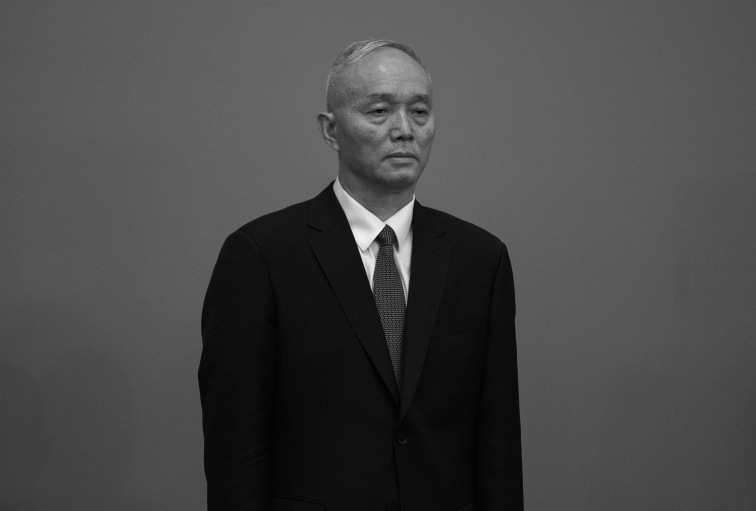
The picture shows Cai Qi, a member of the Politburo Standing Committee of the Chinese Communist Party, attending the National People's Congress on March 12, 2023. (Screenshot from the web)
[People News] As the 21st National Congress of the Communist Party of China approaches, the high-level power structure is experiencing a rare and intense upheaval. On June 5, Cai Qi, a member of the Politburo Standing Committee, officially appeared as the president of the Central Party School, leading to the quiet retirement of Chen Xi, who previously wielded significant personnel authority and was regarded as Xi Jinping's 'personnel strategist.' This personnel change is not just a simple generational shift; it is seen by observers as a pivotal moment in the internal power struggle of the 'Xi family army.' Independent commentator Du Zheng wrote in Taiwan's 'Shang Bao' that Chen Xi's early exit was orchestrated by Cai Qi, who utilized Chen Xi, a former head of the Organization Department, to take the blame for Xi Jinping's 'ill-advised promotions' of officials.
In a political environment characterized by highly concentrated power and a lack of checks and balances, this struggle reveals much about Zhongnanhai and introduces significant uncertainty for the future dynamics of the 21st National Congress of the Communist Party of China.
Cai Qi's Rise and Chen Xi's Departure
Cai Qi has now emerged as the undisputed 'top red figure' in Zhongnanhai. He holds several key positions, including a member of the Central Political Bureau Standing Committee, first secretary of the Central Secretariat, and director of the General Office, effectively controlling the core decision-making and execution system of Zhongnanhai. In contrast, Li Qiang, the nominally second-ranked premier responsible for economic affairs, has clearly been overshadowed by Cai Qi in terms of power.
However, Cai Qi's ascent has not been without challenges; he faces a powerful internal rival in Chen Xi, who has long dominated the Organization Department and the Central Party School.
Chen Xi, hailing from Putian in Fujian, is not only a classmate of Xi Jinping at Tsinghua University but also served as Xi's early political mentor and introducer to the Communist Party. During his time at Tsinghua, he played a crucial role in helping Xi Jinping earn his doctoral degree.
The article discloses that throughout Xi Jinping's first two terms, Chen Xi leveraged his control over the Organization Department to place numerous former students and associates into key positions, thereby establishing a substantial personnel network known as the 'Fujian Gang.' For Cai Qi, Chen Xi's entrenched influence within the organizational system represents a significant challenge, akin to a 'thorn in the throat.'
Cai Qi's political motivation for launching this struggle ostensibly revolves around holding individuals accountable for 'personnel failures.' Data indicates that since the 20th National Congress of the Communist Party of China, nearly a hundred Central Committee members have either been dismissed or have mysteriously vanished. This 'collapse-style failure' has caused considerable upheaval within Xi's faction. Cai Qi cleverly exploited the fact that many of these fallen officials were promoted under Chen Xi's leadership, placing the blame squarely on Chen Xi for 'ineffective reviews' and 'improper personnel decisions.' This strategy of 'killing with a borrowed knife' not only successfully transferred the responsibility for the personnel collapse to Chen Xi but also provided Xi Jinping with a scapegoat to alleviate public pressure regarding 'problematic promotions.' Chen Xi's early retirement marks not only a significant expansion of Cai Qi's political influence but also a systematic purge of the old power structures within Xi's faction.
Li Ganjie's reassignment and the decline of the Hunan faction.
In this power struggle, Li Ganjie, a subordinate of Chen Xi, has become another major target of Cai Qi's attacks. As an alumnus of Tsinghua University, Li Ganjie is viewed as Chen Xi's successor within the organizational system, and he was initially expected to continue managing personnel behind the scenes. However, with the developments surrounding the 'Hunan Seven Young Masters Case,' Li Ganjie's political career has entered a crisis.
This case originated from the fall of Liu Wenjie, the director of the Hunan Provincial Department of Finance, and the subsequent exposure of the 'Hunan Seven Young Masters' list has vaguely pointed to Li Ganjie's influence. Cai Qi quickly seized this opportunity, insisting on removing Li Ganjie from the core Organization Department and instead assigning him to the relatively less significant United Front Work Department, overseen by Wang Huning. In his place, Cai Qi appointed Shi Taifeng, whom he considered easier to control. This adjustment illustrates that Cai Qi not only demands political loyalty from party officials but also insists on the absolute centralization of personnel power. Through this personnel purge, Cai Qi has effectively transformed the Organization Department into an extension of his own power, further solidifying his dominant position within Xi Jinping's faction.
Chongqing Official-Business Corruption Case: Chen Xi's Final Blow
If the earlier personnel struggle was still heavily influenced by power dynamics, the recent emergence of the 'Chongqing Official-Business Corruption Case' serves as the critical 'firebomb' that has completely pushed Chen Xi into the abyss.
The article notes that the downfall of Chongqing officials such as Hu Henghua and Luo Lin has implicated the Fujian Sanan Optoelectronics bribery case, and the arrest of Lin Xiucheng and his son-in-law has directly affected Chen Xi.
For many years, during his time at Tsinghua University, Chen Xi developed a strong "industry-university-research" partnership with Lin Xiucheng, which later transformed into a covert channel for power and money exchanges. In China's unique political landscape, private enterprises must depend on connections within the government to survive, and Chen Xi has long served as the "invisible backer" for the Fujian faction. With Lin Xiucheng disclosing the list of bribery recipients, the corrupt collusion between Chen Xi in academia and the political sphere has become an undeniable reality. Cai Qi seized this opportunity, using the pretext of preserving the "purity" of the Central Party School to initiate a final crackdown on Chen Xi. This not only marked the end of Chen Xi's political career but also illustrated that the Xi family faction is willing to discard former allies at any moment for self-preservation.
The Root of Infighting in the Xi Family Faction: The Curse of Overconcentrated Power
The article analyzes that this internal struggle within Zhongnanhai reveals a significant systemic crisis: when power is excessively concentrated in one individual and lacks effective checks and balances, the circle of confidants surrounding the core figure quickly fractures into various factions, engaging in fierce internal conflicts to vie for the core's favor and power resources.
Xi Jinping's third term was expected to be a time when the Xi family faction had complete control over the situation, yet the reality is marked by ongoing internal strife. From Wang Yi's purging of Qin Gang within the diplomatic system, to the tensions between He Weidong and Zhang Youxia in the military, and now Cai Qi's comprehensive removal of Chen Xi, the Xi family faction has descended into a state of "everyone against everyone."
Cai Qi, currently regarded as the 'number two figure', has experienced a rapid expansion of his power, which has generated widespread fear and resentment among other members of Xi Jinping's faction. As the Beidaihe meeting approaches, what was once a platform for the elders to express their views has now turned into a battleground for Xi's faction to divide political interests, engage in negotiations, and confront one another.
According to the article, Cai Qi's assertive performance presents a double-edged sword for Xi Jinping. On one hand, Xi relies on Cai Qi's comprehensive control over political affairs and personnel to transform the 'roaring waves' of local officials into a foundation for personal adulation. On the other hand, this excessive accumulation of power has led to Cai Qi's isolation within the party, even resulting in arrogant actions such as publicly reprimanding Foreign Minister Wang Yi. Such behavior could have serious political repercussions for Cai Qi, especially if the internal balance of interests within Xi's faction collapses, potentially threatening the stability of the regime.
Political warning signs during the late Xi era
In conclusion, the retirement of Chen Xi, the reassignment of Li Ganjie, and the downfall of figures like Hu Henghua paint a complete picture of the power reshuffling in Zhongnanhai. The essence of this struggle is Cai Qi's violent reorganization of the old personnel structure to solidify his own power.
The article suggests that during this purging process, Xi Jinping's authority relies on Cai Qi for stability and execution. However, Cai Qi's power maneuvers are likely to provoke internal threats in the future, as there are many who do not conform to his leadership.
For the Chinese Communist Party, the intense infighting within Xi Jinping's faction signifies a decline in political culture and a deterioration of governance capabilities. As the personnel arrangements for the 21st National Congress of the Communist Party of China approach their final stages next year, the intensity of the factional struggle is expected to escalate further.
The article highlights that this situation represents the true crisis of the so-called 'Late Xi Era' and serves as a deep-rooted cause for external expectations that the Communist Party's regime may face a historic collapse due to internal conflicts. In this power struggle characterized by court politics, there are no winners; instead, there is a continuous accumulation of crises and a precarious gamble on the edge of a cliff.
△






News magazine bootstrap themes!
I like this themes, fast loading and look profesional
Thank you Carlos!
You're welcome!
Please support me with give positive rating!
Yes Sure!