
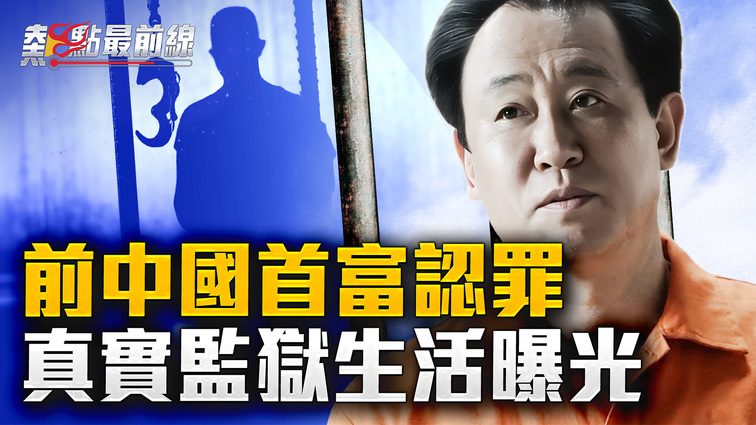
Xu Jiayin Submits Political Surrender Document: Who is on the 'Survival List'? (Video)
[People News] On the morning of August 20, various mainland media outlets reported that the Intermediate People's Court of Shenzhen City, Guangdong Province, imposed multiple penalties on Evergrande Group, including a fine of 8.82 billion yuan; Evergrande Real Estate was fined 7 billion yuan; and Xu Jiayin received a life sentence for multiple crimes, along with a lifetime deprivation of political rights and the confiscation of all his personal property. The news was accompanied by a photo of Xu Jiayin, who appeared with a head full of white hair during the sentencing.
This photo and the court's ruling have sealed the fate of the 'legend' of Evergrande and Xu Jiayin. Once a dominant figure navigating among various dignitaries, Xu Jiayin will now spend the rest of his life behind bars. Many high-ranking officials implicated in his case, including former Liaoning Province Governor Tang Yijun, former Guizhou Provincial Party Secretary Sun Zhigang, Haikou Municipal Party Secretary Zhang Qi, as well as former Bank of China President Liu Liange, former CITIC Bank President Sun Deshun, and former China Merchants Bank President Tian Huiyu, have also faced downfall.
It is evident that Xu Jiayin, who rose from humble beginnings, understood the significance of power for his own advancement and the officials' affinity for money and influence. His ascent with Evergrande Group was facilitated through financial maneuvering, capital entanglements, and transactions involving money and power, creating an extensive network of relationships that included business magnates and officials at all levels. The Evergrande performance troupe, boasting over a hundred members and numerous attractive women, served as Xu Jiayin's public relations strategy.
As the leader of Evergrande, which has grown powerful through collaboration with the elites of the Chinese Communist Party (CCP), Xu Jiayin's wealth is unlikely to be clean. He is likely well aware of the CCP's dark dealings and has, whether knowingly or unknowingly, become entangled in the factional struggles within the CCP, even being used by the party to engage in questionable activities. If the CCP wishes to exploit him and find incriminating evidence, it would not be a difficult task. After observing the significant public outrage directed at Xu and Evergrande, the CCP recognized that Xu no longer held much value for them, making it unsurprising that he was discarded like a donkey once the millstone was removed.
Is Xu Jiayin's fate unjust? Not at all. From the author's perspective, this is a form of retribution.
Let me share the story of the renowned 'red-top merchant' Hu Xueyan from the late Qing Dynasty. Hu Xueyan, who came from a humble background and began as an apprentice in a money shop, earned his first fortune through hard work and dedication: the shopkeeper Yu, who had no heirs, entrusted the money shop, valued at nearly 5,000 taels of silver, to Hu Xueyan.
Following this, Hu Xueyan established connections with the government and, with the support of local officials, gradually expanded his business. In addition to the money shop, he opened numerous other stores and became a local tycoon. During the Second Opium War, he even controlled more than half of Zhejiang's wartime economy. Later, he gained the recognition of the influential official Zuo Zongtang. He assisted Zuo Zongtang in establishing the 'Fuzhou Shipbuilding Bureau' in Fuzhou; raised military funds for Zuo Zongtang's westward expedition to Xinjiang; and helped Zuo Zongtang create the earliest state-run light industry enterprise in modern Chinese history, the 'Lanzhou Woolen Textile Bureau,' among other contributions. Zuo Zongtang praised him for being 'public-spirited and righteous, sincere and capable.'
Hu Xueyan was later appointed as a candidate official in Jiangxi and granted a second-rank official title. His ancestors were honored with first-rank titles for three generations, along with rewards such as the yellow jacket. Hu Xueyan became the only 'red-topped merchant' in Qing Dynasty history.
After 1870, Hu Xueyan's accumulated wealth reached tens of millions, with some accounts suggesting that at his peak, his fortune soared to 120 million taels of silver, making him one of the wealthiest individuals in the world. Despite his immense wealth, Hu Xueyan was known for his charitable deeds, funding free ferries and private schools, and regularly providing tea, medicine, clothing, and congee. He also made numerous donations for disaster relief in flood- and drought-affected regions such as Zhili, Shaanxi, Henan, and Shanxi.
However, Hu Xueyan ultimately faced a downfall. In early 1884, the imperial court ordered his removal from office and the confiscation of all his assets. Following this, the Qing government seized his properties, including his luxurious residence in Hangzhou, 'Hu's Zhi Garden,' which was sold off, leaving his wives, concubines, and children destitute. Hu Xueyan passed away from illness in the winter of 1885 at the age of 62, marking the end of an era for the red-topped merchant.
On the surface, Hu Xueyan's downfall seemed to stem from the failure of his silk speculation. The 'Admonition Record' compiled by Liang Gongchen during the Qing Dynasty attributed his decline to two main factors: first, he was not a genuinely virtuous person and had committed wrongs; second, he indulged excessively in luxury, with thousands of concubines, and eventually became arrogant and complacent, which eroded the blessings he had accumulated.
Xu Jiayin's experiences share similarities with those of Hu Xueyan; the higher he rose, the more tragic his fall became.
Data indicates that the fallout from Evergrande's crisis is staggering, with as many as 5 to 6 million homeowners and families directly facing the risks of unfinished projects and delivery delays, which involve an estimated 1.62 million undelivered residential units. Additionally, tens of millions of individuals are caught up in wealth management, supply chains, financial institutions, and related businesses. How many have taken on massive debts for a single home? How many have resorted to suicide out of desperation? How many lives have been thrown into turmoil due to Evergrande's unfinished developments?
From a Buddhist perspective on causality, actions that harm lives or deceive people out of their money carry significant karmic consequences, especially when so many are affected. Can Xu Jiayin (Xu Jiayin) avoid facing retribution?
Moreover, Xu Jiayin's lavish lifestyle has come to light. An internal document from Evergrande that has circulated online reveals that he maintains exceptionally high standards for his diet. He exclusively consumes imported fruits, such as Shizuoka melons from Japan, fragrant green grapes, and Qingwang watermelons, all of which are quite costly. Notably, a single Qingwang watermelon can cost thousands of yuan, while certain types of Hami melons are priced by weight, reaching as much as 1,400 yuan per jin.
Regarding his choice of alcoholic beverages, he favors premium options like Feitian Moutai and Royal Salute, which are staples for any dining or relaxation occasion. Furthermore, he has specific demands for mineral water, insisting on only drinking French Evian and requiring it to be replaced daily with the freshest stock.
In terms of fashion, Xu Jiayin also seeks luxury. He is consistently seen in high-end, luxurious suits, complemented by premium ties and Hermès belts, making his ostentatious style particularly noticeable in any crowd.
Regarding his residences, Xu Jiayin owns several luxurious properties in cities like Beijing, Shanghai, and Shenzhen. Notably, his luxury home in Shenzhen spans 16,000 square meters and is valued at over 1 billion yuan. The interior is lavishly decorated and equipped with various amenities, including a swimming pool, gym, and cinema.
When it comes to transportation, Xu Jiayin has a fleet of luxury cars and private jets at his disposal. His private jets include high-end models such as the Airbus A319 and Gulfstream, allowing him to meet his travel needs anytime and anywhere.
Of course, he is also surrounded by beautiful women. However, his excessive indulgence, combined with his arrogance and self-importance, has led to a depletion of his accumulated fortune, ultimately resulting in his downfall.
As the saying goes, one reaps what one sows. This principle applies not only to Xu Jiayin but also to all wealthy individuals and high-ranking officials of the Communist Party. If they fail to engage in charitable deeds and accumulate virtue, their fates will not be favorable after squandering their inherent blessings.
(First published in People News) △





News magazine bootstrap themes!
I like this themes, fast loading and look profesional
Thank you Carlos!
You're welcome!
Please support me with give positive rating!
Yes Sure!