

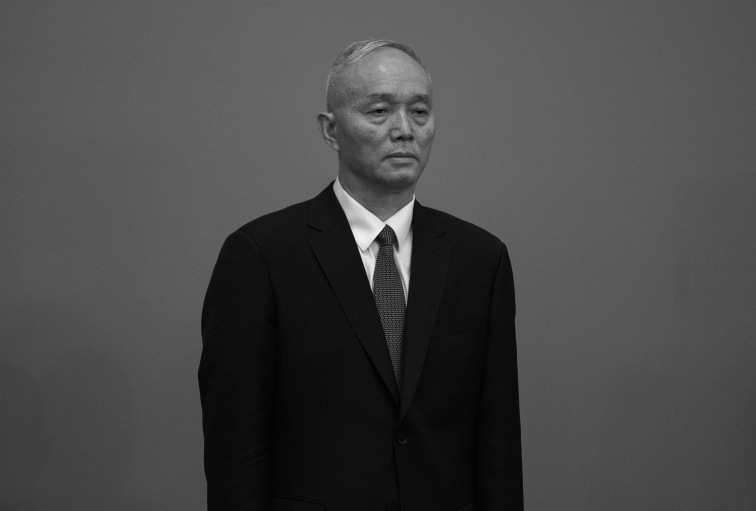
The picture shows Cai Qi, a member of the Politburo Standing Committee of the Chinese Communist Party, attending the National People's Congress on March 12, 2023. (Screenshot from the web)
[People News] Recently, there has been a notable shift in the high-level power structure of the Chinese Communist Party (CCP). Cai Qi, who holds several key positions, has taken over as the president of the Central Party School, succeeding the former president Chen Xi, whose reasons for stepping down remain unclear, leading to rampant speculation. Yuan Hongbing, an Australian scholar well-versed in CCP political dynamics, asserts that Cai Qi's ascension is a significant development, indicating that a powerful political earthquake is unfolding behind the scenes.
According to official CCP reports from June, the over-70-year-old Cai Qi has replaced the nearly 73-year-old Chen Xi, now serving concurrently as the president of the Central Party School and the National Academy of Administration.
Chen Xi, a former classmate of CCP leader Xi Jinping at Tsinghua University, was promoted to Executive Vice Minister of the Organization Department shortly after Xi assumed power at the 18th National Congress. At the 19th National Congress, Chen Xi became the Minister of the Organization Department and entered the Politburo, later taking on the role of president of the Central Party School, a position traditionally held by Standing Committee member Wang Huning (he also became the president of the National Academy of Administration in 2018). After the 20th National Congress, Chen Xi, no longer a Central Committee member, delayed his resignation as Minister of the Organization Department until April 2023, and only recently stepped down as president of the Central Party School. There are claims that Chen Xi has effectively controlled personnel decisions since Xi's rise to power, overseeing three appointments.
Cai Qi is currently regarded as the fifth-ranking official in the CCP, but it is widely believed that his standing within the party is second only to Xi Jinping. Serving as the Director of the General Office, Cai Qi is consistently seated next to Xi Jinping at both China-U.S. and China-Russia summits. In the National Security Council, which is chaired by Xi, Li Qiang, Zhao Leji, and Cai Qi serve as vice chairmen, but Cai Qi effectively oversees the council's operations.
Cai Qi's Replacement of Chen Xi Signals a Political Earthquake
Australian legal scholar Yuan Hongbing analyzed for The Dajiyuan that Cai Qi's ascension to the presidency of the Central Party School, replacing Chen Xi, indicates a significant political upheaval within Xi Jinping's personal authoritarian regime. 'The magnitude and impact of this political earthquake are comparable to the turmoil caused by Xi Jinping's need to purge Zhang Youxia.'
Yuan Hongbing explained that following the 20th National Congress of the Communist Party of China (CPC), the entire Xi family military system had been firmly established. Xi Jinping believed that he had successfully consolidated control over both the military and the party-government apparatus.
However, less than six months after the 20th National Congress, major cases of political disloyalty emerged, first involving Li Shangfu and Wei Fenghe. This was followed by serious cases involving Miao Hua and He Weidong, which were also classified as politically disloyal. Subsequently, during a meeting of the Political Bureau of the Central Committee, Zhang Youxia raised concerns about reorganizing the Central Military Commission and its leadership structure, asserting that one-man rule should not continue and that decisions should not rest solely with one individual; particularly regarding military appointments, there should not be a 'family business.'
Yuan Hongbing stated to The Dajiyuan that Zhang Youxia's actions effectively represented the princeling faction, specifically a segment of the princeling forces led by Deng Pufang, Liu Yuan, and Hu Deping, challenging Xi Jinping's authority. He was essentially demanding the right to appoint senior military generals from Xi Jinping, at the very least seeking to share this power.
Zhang Youxia, vice chairman of the Central Military Commission, was officially announced to have been dismissed from his position in late January, alongside Military Commission member Liu Zhenli, and it is widely believed that this is related to a power struggle over military authority within the CPC.
Yuan Hongbing stated that the recent series of events, from the downfall of Li Shangfu to Zhang Youxia, has inflicted a significant political blow to Xi Jinping, reminiscent of the shock that the Lin Biao incident caused Mao Zedong in the past.
He further explained that while Zhang Youxia was Xi Jinping's last crucial support within the military, Chen Xi served as an important political pillar for Xi within the party and government framework. With Cai Qi now replacing Chen Xi, it indicates that the organizational and cadre training systems previously under Chen Xi's control are also facing issues of political disloyalty. It is possible that during his tenure overseeing organizational work and the Central Party School, Chen Xi used his authority to shield a number of individuals and officials who were seen as potential threats to Xi Jinping.
"Before the 21st National Congress, Xi Jinping must initiate a comprehensive rectification of party and government officials, even before completing the military system's cleansing and restructuring. The aim is to eliminate Chen Xi's influence," he remarked.
There are indications that personnel arrangements ahead of the 21st National Congress of the Communist Party of China in 2027 have already commenced. Insiders within the system disclosed to The Dajiyuan that the Communist Party has recently been screening senior officials through its organizational, party affairs, and military anti-corruption mechanisms, with a focus on removing those suspected of 'disloyalty' even if there is no clear evidence of disciplinary violations. (See previous report: Insider: Major purge before the Communist Party's leadership transition focuses on removing disloyal individuals)
Yuan Hongbing believes that this major rectification is an inevitable political consequence following Cai Qi's succession of Chen Xi. As a result, it can be said that party and government officials within the Communist Party system are currently experiencing a sense of unease.
Chen Xi is likely to be under soft control.
Rumors have been circulating online regarding Chen Xi's sudden departure and his demotion to retirement (from a vice-state level to a vice-department level), but there has been no official confirmation.
Yuan Hongbing expressed his belief that Chen Xi is currently under a state of soft control. His fate is likely to mirror that of Wang Qishan, who served as the first Secretary of the Central Commission for Discipline Inspection after Xi Jinping assumed power.
"This implies that all individuals he has promoted, his allies, confidants, and officials he has relied on—especially those in critical positions—will be completely purged. As for Chen Xi himself, he may face treatment akin to that of Wang Qishan, effectively being placed under soft or semi-house arrest."
Yuan Hongbing elaborated that Xi Jinping is keen to avoid inciting greater political unrest before the 21st National Congress, which is why he is employing a softer approach towards these veteran officials. Xi's primary objective at this moment is to ensure his continued tenure after the 21st National Congress, with aspirations for lifelong leadership.
In the lead-up to the 21st National Congress, Cai Qi is initiating a new "cult of personality movement."
On June 15, a national symposium on party-building work of the Communist Party of China convened in Beijing, where Cai Qi attended and delivered a speech. During this meeting, he introduced a so-called "party-building thought" of Xi for the first time, urging the entire party to treat "learning and implementing Xi Jinping's party-building thought" as "a significant political task for the entire party in the current and forthcoming period."
Yuan Hongbing remarked that this lays the foundation for the new cult of personality movement. Xi even aims to eliminate the General Secretary position during the 21st National Congress and reinstate the role of Chairman of the Central Committee of the Communist Party. He aspires to stand alongside Mao Zedong in achieving lifelong rule and to be regarded on the same ideological and theoretical level as Mao Zedong. This represents a crucial political task following Cai Qi's leadership at the Central Party School.
Yuan Hongbing stated that issues have arisen with Zhang Youxia and Chen Xi, the two key political pillars supporting Xi Jinping within the military and the party-government system, which suggests that Xi Jinping is currently facing a serious political crisis.
"Xi Jinping now bears a striking resemblance to the later years of Mao Zedong. He is persistently dismantling the existing organizational structures to ensure absolute loyalty to himself. Currently, Xi Jinping is dismantling the military he personally nurtured, aiming to reconstruct a cadre team that is entirely loyal to him before the 21st National Congress. However, he lacks the capability to accomplish this and can only rely on a regime of secret police to sustain his personal dictatorship," he remarked.
△






News magazine bootstrap themes!
I like this themes, fast loading and look profesional
Thank you Carlos!
You're welcome!
Please support me with give positive rating!
Yes Sure!