
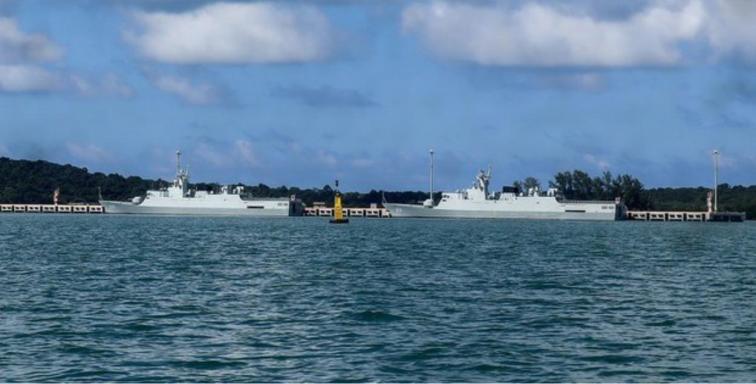
The image shows two Chinese Navy Type 056A missile frigates docked at Cambodia&9;s Ream Naval Base in August 2024. They are the Aba (hull number 630) and the Tianmen (hull number 631). (Radio Free Asia)
[People News] On July 6, the Chinese People's Liberation Army Navy launched a ballistic missile equipped with a training simulation warhead into the Pacific Ocean, prompting concerns and criticisms from the international community. While the Chinese Communist Party (CCP) emphasized that the test was a routine military exercise not aimed at any specific target and that relevant countries in the region had been informed in advance, the United States remains cautious about Beijing's nuclear weapons expansion and urges China to engage in arms control measures.
According to the Dajiyuna, Chinese Navy spokesman Wang Xuemeng stated on the 6th that a navy submarine 'launched a strategic missile carrying a simulation warhead into the relevant high seas of the Pacific, and the missile accurately landed in the designated sea area.' This marks the first public test of an intercontinental ballistic missile in the Pacific by the CCP in nearly two years, which has drawn condemnation from the United States, Japan, Australia, New Zealand, the Philippines, and Taiwan.
The U.S. State Department remarked that while the United States is working harder than ever to prevent nuclear proliferation, Beijing is moving in the opposite direction; the rapid and opaque expansion of Beijing's nuclear arsenal has raised significant concerns both regionally and globally.
Taiwanese authorities reported that a long-range ballistic missile capable of nuclear strikes, launched by a Chinese submarine, flew over several Pacific island nations before ultimately landing in the waters near Tuvalu.
According to a report by the Liberty Times, Lyle Morris, a senior researcher at the American think tank 'Asia Society Policy Institute' (ASPI), analyzed that the recent missile test indicates that Beijing's expanding military options are no longer confined to land-based missile launches. It also demonstrates that the People's Liberation Army has the capability to target the U.S. mainland from the waters surrounding China.
Reports from AFP and the Australian Broadcasting Corporation (ABC) indicate that on the 7th, Australian Prime Minister Anthony Albanese met with Val, the leader of the Solomon Islands, in the capital, Honiara. During a joint press conference, Val expressed that as the chair of the Pacific Islands Forum (PIF), he represents the Pacific nations that are concerned about Beijing's latest missile test. On the 6th, he had already lodged a 'strong protest' with the Chinese ambassador, and the Solomon Islands also submitted a formal protest note.
Val remarked, '(Launching missiles) is not the behavior of friends.' He emphasized, 'We do not want to see any more countries testing intercontinental missiles in the Pacific Island region; this is our bottom line,' and added, 'Do not threaten us.'
According to ABC, Val is the first leader of a Pacific Island nation and the current chair of the forum to directly criticize China for this missile test activity. AFP noted that the Solomon Islands have been one of China's closest partners in the South Pacific for many years, making this criticism particularly significant. After Val was elected Prime Minister earlier this year, his stance towards Beijing has become somewhat cooler, and he has committed to reviewing the confidential security agreement signed between the two countries in 2022.
James Marape, the Prime Minister of Papua New Guinea, emphasized that all global military powers should respect the wishes of the people living in the Pacific region. He remarked, "Our region has endured wars, nuclear tests, and military activities imposed by larger nations, and we do not want to see history repeat itself." He further stated, "We hope our waters remain free from nuclear tests, harmful weapon trials, and any form of military weaponry, whether launched from the air, sea, or land."
Reports from Reuters and the Australian Broadcasting Corporation (ABC) indicate that both sides of the Australian political spectrum have condemned the missile launches by the Chinese military. During a visit to the Solomon Islands on the 7th, Australian Prime Minister Anthony Albanese described the launches as "undoubtedly a provocative act by China that undermines regional stability." He confirmed that Australia has raised this issue directly with China, stating, "We have conveyed our concerns to China in both Canberra and Beijing, and I have clearly expressed our concerns here in Honiara as well."
Albanese pointed out that such tests are usually communicated 48 hours in advance, but he had not received any notification from China. He added, "We do not wish to see any actions that destabilize or threaten peace, security, and stability in the Pacific and this region."
Australian Defense Minister Richard Marles expressed that China's test launch activities are "very concerning and extremely destabilizing," indicating that "China is expanding the range of deployable nuclear weapons." He concluded, "We are striving to create a peaceful Pacific region, and this action is undermining those efforts."
The leader of the Australian opposition Liberal Party and the shadow defense minister have both condemned China's actions as 'unacceptable', highlighting a broader pattern in China's approach to the Pacific region that involves destabilization, threats, and intimidation.
On the 6th, China conducted a test launch of a submarine-launched intercontinental ballistic missile, which is said to be capable of carrying a nuclear warhead, in the Pacific. NATO Secretary General Mark Rutte remarked that this indicates 'we cannot afford to be naive about China'.
Rutte stressed that the recent developments 'underscore a reality: we cannot be naive about China', which is also why NATO works so closely with IP4, as 'the level of interconnection and interlinkage between theaters is on the rise'.
△





News magazine bootstrap themes!
I like this themes, fast loading and look profesional
Thank you Carlos!
You're welcome!
Please support me with give positive rating!
Yes Sure!