
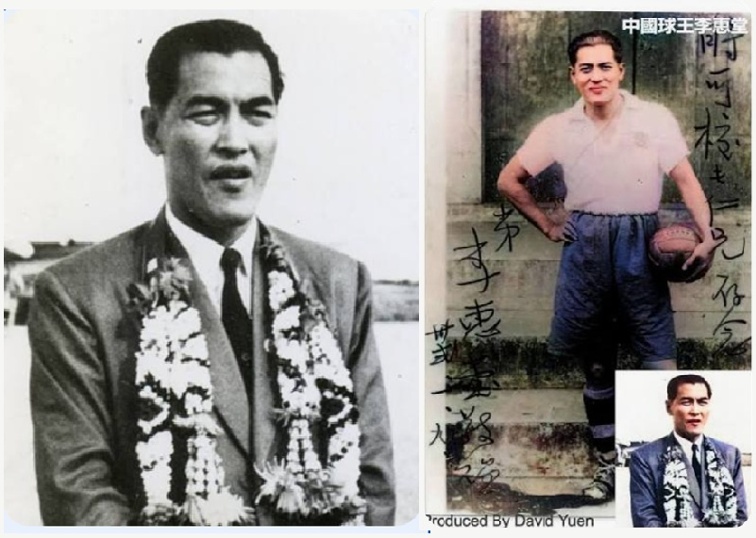
The world's foremost football legends: China's football king, Li Huitang. (Internet image)
[People News] The 2026 World Cup, hosted by the United States, Canada, and Mexico, will expand to 48 teams, with Asia's quota increasing to 8.5. However, the Chinese men's football team's performance has been dismal; they lost 0-1 to the traditionally weak Indonesian team in the qualifying round, prematurely confirming their absence from the World Cup. This has led to widespread disappointment and a public outcry among the Chinese populace. In light of the long-standing poor performance of the national team, fans and various sectors of society generally feel a sense of 'expected yet hard to accept' helplessness, with many fans unable to restrain their frustration, exclaiming: 'It's like trying to lift up rotten mud.'
Since qualifying for the World Cup for the first time in 2002, the Chinese men's football team has failed to win a single match in the Asian group stage and has not qualified for the World Cup for six consecutive tournaments. In terms of actual strength and world ranking, the Chinese national football team has not even made it into the top 48 in the world.
The most ironic aspect of this situation is that FIFA, in a bid to secure substantial sponsorship and broadcasting fees from the Chinese market, has forcibly expanded the Asian quota to 8.5 for the 2026 World Cup, effectively handing the 'cheat sheet' and 'easy question' directly to the national team. However, under the Communist Party's rule, this 'Sea Cucumber Team' has managed to turn this easy question into an epic disaster film, characterized by a gang-like culture of openly trading national players and collectively engaging in match-fixing.
However, today's Chinese football fans may be unaware that historically, the Chinese national football team once enjoyed a remarkable legacy, achieving the impressive feat of 'eight consecutive championships in Asia' and producing a world football legend: Li Huitang. In stark contrast, the current Chinese national football team has deteriorated to a 'third-rate status in Asia', prompting reflection on the profound influence of the political system on the realm of sports.
The 'Nine-Time Champion' Legend of East Asia
Today's Chinese football fans can hardly imagine that nearly a century ago, during the Republic of China era, Chinese football was a formidable 'giant' in Asia that struck fear into its rivals.
The inaugural Far Eastern Championship Games (the precursor to the Asian Games) commenced in Manila in 1913, during a tumultuous period marked by warlord conflicts, foreign invasions, and severe material shortages in China. Despite these challenges, the national football team of the Republic of China embarked on a glorious journey that spanned two decades. Over the course of 10 editions of the Far Eastern Championship Games, the Chinese team claimed the championship title 9 times, including one remarkable 'eight consecutive championships'. At that time, Japanese football was essentially a novice compared to the Chinese team. In matches held in Tokyo, Shanghai, and Manila, the Chinese team consistently overpowered the Japanese team, showcasing their dominance in both skill and physical prowess.
During that period, despite China's weakened national strength and the hardships faced by its people, cities such as Shanghai, Hong Kong, and Guangzhou had developed a mature football culture due to their early exposure to Western influences. Many players emerged from schools, churches, and grassroots clubs, regularly participating in regional competitions that fostered a healthy competitive environment. Stars of that era, including Li Huitang (李惠堂), thrived in this relatively free football ecosystem, which was primarily driven by clubs and social forces rather than government directives.
Players from the Republic of China era exhibited a modern spirit of chivalry and professionalism that had been long absent. On the pitch, they relied on pure intelligence, exceptional skills, and an unwavering sense of national pride. They could strike a Japanese goalkeeper with such force that it would leave him bloodied; they could intimidate Japanese penalty takers with just a glance. Their souls were free, their thoughts nimble, and they carried no political burdens.
In 1934, China's GDP was less than half that of Japan's, and its industrial output was significantly behind. At that time, Chinese football lacked financial backing from the Republic government, yet it still held the title of East Asian champion. In contrast, today, despite the Chinese Communist Party's astronomical investments, the competitiveness of Chinese football has not improved, and even qualifying for the World Cup has become a daunting task. This presents a systemic issue that deserves thorough reflection.
The greatest of the five football kings: Li Huitang
The figure at the heart of this glorious era was Li Huitang, often referred to as the 'King of Asian Football.' A popular saying of the time went: 'To watch a play, one must see Mei Lanfang; to watch football, one must see Li Huitang.'
Li Huitang was a forward known for his powerful shots, capable of piercing the nets of his opponents. Throughout his remarkable professional career, he scored over 1,000 goals, according to statistics. In 1976, authoritative sports media in West Germany recognized Li Huitang as one of the 'World's Five Greatest Football Kings,' alongside Brazil's Pelé, Argentina's Maradona, and the Netherlands' Cruyff. This recognition stands as a monumental achievement for Chinese football, showcasing their pure talent and indomitable spirit on the global stage.
A Tragic Expedition of 27 Matches Selling Tickets
What resonates most about football during the Republic of China is not the number of medals won, but the profound national spirit that is deeply ingrained in their culture.
In 1936, Li Huitang led his team to qualify for the Berlin Olympics. However, the Nationalist government was preoccupied with both internal and external challenges. On one front, the Communist Party was establishing bases and launching armed revolutions; on another, the Nationalist government was struggling to repay the massive foreign debts and reparations inherited from the late Qing dynasty (such as the Boxer Indemnity). Faced with a significant fiscal deficit, the Nationalist government could not afford the high travel costs for the team to go to Europe.
What could they do? The team refused to give up. Li Huitang and his players set off two months early, determined to find their own way. They traveled in worn-out straw sandals and cloth shoes, making their way to the South Seas, passing through Hong Kong, and venturing into Singapore. Over the course of two months, they played 27 exhibition matches, enduring scorching sun and heavy rain, relying solely on ticket sales to fund their journey.
To save money, the team members opted for the cheapest dormitory accommodations and subsisted on the roughest leftover food. Many developed blisters on their feet, which they wrapped in gauze to continue competing on the field. By the time they boarded the cruise ship to Berlin, this team, which was 'selling their skills for a cause,' had successfully raised 50,000 yuan for travel expenses for their country.
Although they arrived in Berlin exhausted from their long journey, the team faced the then-world-class powerhouse, England, in the first round and narrowly lost 0:2. Nevertheless, the Chinese team played fearlessly throughout the match, even threatening the English goal on several occasions. After the game, the entire European media stood up and applauded, hailing this Chinese team as 'true gentlemen and iron-blooded warriors.'
At that time, the predecessors did not have the benefit of hundreds of billions in funding from the National Sports Administration, nor the interference of political officials, and certainly no sea cucumbers to boost their health. However, they possessed a pure love for football, an independent professional dignity, and a free spirit. It was for this reason that fate granted them the fortune of being the champions of Asia.
The Party Leader's 'Three Wishes' Bring Misfortune
After the Chinese Communist Party (CCP) took power in 1949, football, a sport that was originally vibrant and creative, became ensnared in the bureaucratic 'national system' and the constraints of 'politics in command.' Particularly after the authorities linked the national football team's victories to concepts like 'the rise of a great power,' 'the prosperity of a strong nation,' and 'greatness, light, and justice,' the national football team entered a 'period of misfortune.'
Xi Jinping, the current leader of the CCP, is a self-proclaimed football enthusiast. He has publicly expressed his personal 'three wishes' for Chinese football: first, for China to qualify for the World Cup again; second, for China to host the World Cup; and third, for China to eventually win the World Cup championship.
In a totalitarian regime, the 'interests' of the supreme leader translate into the highest administrative commands. To align with this 'sacred will,' the entire national machinery, real estate tycoons, and the bureaucratic system went into a frenzy, pouring hundreds of billions of public funds into the market to acquire foreign players and grant Brazilian players passports for 'great naturalization.' Local players' annual salaries soared to several million yuan, while these foreign players could earn over 100 million yuan. However, this massive financial investment did not lead to any significant improvement in the national football team's performance.
The CCP leader's expectations for the national football team have instead cast a fatal 'bad luck' and curse upon the sport.
'Unashamed' Match-Fixing and the Black Hole of Gambling
The authorities have recklessly funneled over a hundred billion yuan of public funds into the national football team, resulting in an acceleration of corruption within the team. In recent years, a significant purge within the upper ranks of the Football Association, along with court trials and official documentaries, has exposed fans to the most sordid realities of the national team: in this environment, gaining a spot on the national squad and appearing on the field has become a business with a clear price tag.
According to the testimony of former national team head coach Li Tie, once he took on the role, the national team jersey became a commodity. He admitted to engaging in a shady deal with Wuhan Zall Club, forcibly including four players who lacked the capability for the national team in exchange for 60 million yuan.
Furthermore, even the head coach position is up for sale. To secure his role, Li Tie convinced the club to bribe then Football Association president Chen Xuyuan with 2 million yuan, while he personally paid 1 million yuan to bribe the secretary-general of the Football Association.
During his coaching tenures at Huaxia Happiness and Wuhan Zall, Li Tie reportedly spent tens of millions of yuan to directly bribe opposing coaches, referees, and players to fix matches during the league's final stages. Former national player Li Bing publicly expressed his outrage, stating, 'Everyone on the opposing team took money; how can we play this match?'
On the international stage, many national players are linked to illegal gambling syndicates. To meet the betting lines of external websites, players have intentionally employed 'eye defense', committed basic errors, and even scored own goals during matches. For them, the honor of the country pales in comparison to the black money they have wagered.
This team, constructed from connections and a mountain of renminbi, faced a harsh reality check: a staggering 1:5 defeat to Thailand and a 1:3 loss to Vietnam. Ultimately, the chairman of the Football Association, Chen Xuyuan (sentenced to life imprisonment for accepting over 81 million in bribes), head coach Li Tie, and other senior officials found themselves behind bars, turning into a political laughingstock in the international football community, while also discarding the nation's hopes for football into the trash.
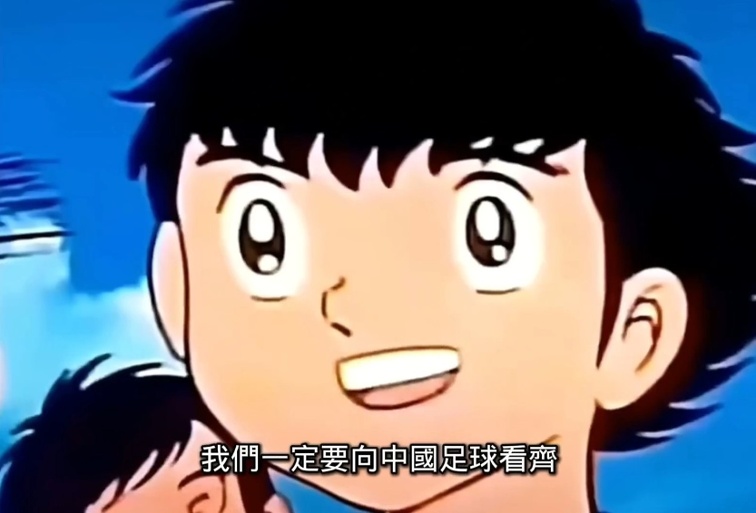
The classic Japanese football anime "Captain Tsubasa" began its serialization in 1981. At that time, the Chinese national football team was regarded by the Japanese as the most promising Asian contender for the World Cup finals. (Video screenshot)
"Respect and Fear" in the Comic World
Notably, a remarkable reversal of strength has occurred between the Chinese and Japanese teams in the realms of "reality and the comic world."
In the 1980s, Japanese manga artist Takahashi Yoichi created the globally beloved anime "Captain Tsubasa." Within the manga's narrative, the Chinese youth team is depicted as Japan's most formidable "rival" in Asia, with the Chinese captain, Xiao Jun Guang, being a fictional character who is the first in the story to score against Japan's legendary goalkeeper, Genzo Wakabayashi, from outside the penalty area. In the series, Japanese players express, "We must aspire to match the Chinese team," highlighting the historical strength disparity between the two teams.
This narrative is not merely a product of imagination. In reality, during the 1970s and 1980s, the Chinese men's football team held a dominant advantage over Japan, exemplified by a 1:0 victory in 1980, a 3:0 triumph in 1981, and a 2:0 win in Tokyo in 1987 that secured an Olympic qualification spot.
The Frigid 'Zero Win Rate' and the Humiliation of Ten to Zero
However, it was unexpected that after the Chinese Communist Party (CCP) committed the full force of the nation to persecuting Falun Gong in 1999, individuals who uphold the values of 'Truth, Compassion, Forbearance' faced severe repression. This led to a rapid decline in moral standards within Chinese society. The collapse of morality has profoundly impacted all aspects of society, resulting in a widespread obsession with wealth and rampant corruption in the political sphere. As a result, Chinese football has also inevitably succumbed to darkness. This has led to a dramatic reversal in the competitive balance between the Chinese and Japanese football teams. Japanese football has diligently pursued a path of youth development, rule of law, and pure marketization, with the entire team achieving world-class status in Europe; in contrast, Chinese football has been thoroughly undermined by corruption, much like the CCP's political landscape.
Data from the past decade (2016-2026) reveal that the national football team has been unable to secure a single victory against Japan (0 wins, 1 draw, 5 losses). In the World Cup qualifiers, the national team faced the Japanese national team and set a disheartening record of '0 shots, 0 on target' throughout the match. In the 2024-2025 World Cup Round of 18, the two matches resulted in a staggering aggregate score of 0:10, marking a historical disgrace.
The political system has stifled the development of football.
China has never been short of football enthusiasts, nor has it lacked talented young players.
What is genuinely lacking is a system that guarantees fair competition, respects professionalism, encourages grassroots development, and allows for social oversight. Factors such as investment in youth training, coach development, campus football, management of professional leagues, population participation rates, and social culture significantly impact the development of football. However, the authoritarian political system and governance model of the Chinese Communist Party (CCP) have consistently influenced how these factors function. Thus, we can assert that the CCP's authoritarian regime has severely obstructed the advancement of Chinese football.
Reflecting on a century of Chinese football history reveals a striking contrast: during the Republic of China era, Chinese football was a leader in Asia; however, after the CCP took power, the overall competitiveness of Chinese football began to decline, and today it has regrettably fallen to the status of a third-rate team in Asia.
Football serves as a mirror, reflecting not only the players' abilities but also the governance of society. When a system can ensure fairness, respect professionalism, and accommodate oversight, football has the potential to thrive; conversely, if power is overly centralized, oversight is lacking, and administration supersedes professionalism, no amount of investment can create a sustainable and healthy football ecosystem.
The significant transformations in Chinese football over the past century reaffirm a universal truth: the CCP authorities, burdened by the blood debts of the Chinese people, seek to use football teams to enhance their image. However, the CCP lacks the fortune to do so and has instead transferred its misfortunes to the Chinese national football team, leading it to decline from being an Asian powerhouse to a 'mud that cannot be lifted,' devolving into a money laundering group that feeds off the toxic tumor of the system.
(First published in People News)
△





News magazine bootstrap themes!
I like this themes, fast loading and look profesional
Thank you Carlos!
You're welcome!
Please support me with give positive rating!
Yes Sure!