
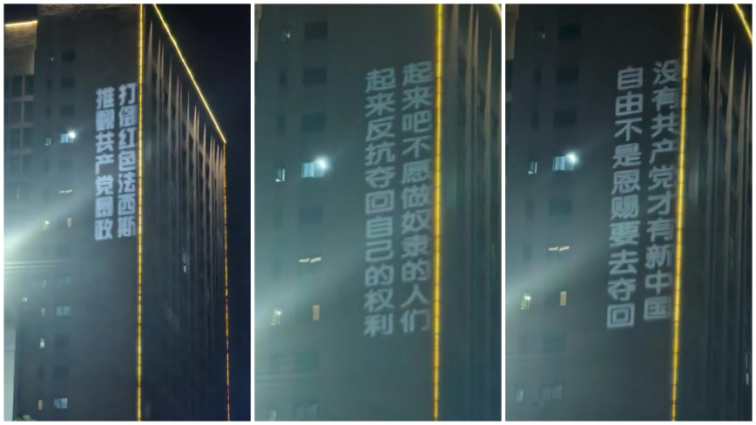
On the night of August 29, at Chongqing University, giant anti-CCP slogans were projected, calling for the overthrow of Communist Party tyranny. (Online image)
[People News] On June 29, a Twitter user known as 'Wall Country Frog Haha' shared a post that read: 'After the plane incident at the CITIC Tower (China Zun), someone printed flyers listing the top ten crimes of Xi Jinping against the nation and its people, and posted them in front of the Beijing base of China National Airlines, the company operating Xi Jinping's special plane, calling for anti-Communism, anti-dictatorship, and opposition to one-party rule!'
This is not the first time such incidents have occurred this year.
From anti-Xi slogans appearing in the underground parking lot of Xi'an Petroleum University to public complaints in Shenzhen demanding the Communist Party to resign; from young people on Douyin openly criticizing the Communist Party and Xi Jinping, to the ongoing emergence of slogans on bridges, in restrooms, and on street flyers, there is a growing number of these incidents and a significant amount of online discussion surrounding them, clearly indicating that people's social consciousness is undergoing two major changes.
Change One: From opposition to policies to opposition to the system.
Over the past twenty years, China has experienced numerous collective events annually, but most share a common trait: they focus on rights protection rather than challenging the system itself. Protesters typically target specific policies or local officials, expressing dissatisfaction with high housing prices, severe unemployment, healthcare difficulties, educational competition, and arbitrary fees imposed by local governments. They hope the central government will deliver justice, that the Communist Party will 'correct its mistakes,' and that the system can return to normal functioning.
Currently, an increasing number of people are directing their criticism at the system itself. They are beginning to understand that the issue lies not with local officials, but with the entire power structure that perpetuates these problems; it is not merely a failed policy, but rather a systemic lack of error-correction capabilities. Consequently, the discourse around 'anti-corruption' and 'anti-local government' is evolving into a broader 'anti-dictatorship' and 'anti-one-party rule'.
Change Two: Transitioning from opposing 'Xi' to opposing 'the Communist Party'.
Notably, many online comments have started to express a new perspective: 'Xi Jinping is not the root of the problem; the Communist Party system is the real issue.' This viewpoint was relatively rare in the past.
Previously, many believed that simply replacing the General Secretary would lead China back to reform and opening up. However, after enduring a significant economic downturn in recent years, coupled with increasingly harsh political repression and social control, a growing number of people are realizing that without systemic change, even a new leader may only perpetuate the same cycle. As a result, more individuals are shifting from 'anti-Xi' sentiments to 'anti-Communist Party' views.
A striking example can be seen in the anti-Xi flyers displayed in front of a certain Air China base in Beijing. Photos reveal that these flyers list Xi Jinping's ten major offenses, including 'undermining constitutional governance and establishing a dictatorship', 'suppressing dissent and persecuting human rights lawyers', 'censoring speech and blocking the internet', 'corruption', 'destroying education and brainwashing the next generation', 'neglecting people's livelihoods and ignoring disasters', among others. The flyers then directly target the Chinese Communist Party, urging everyone to 'unite to overthrow the CCP's tyranny and establish a new free and democratic China.'
In comparison to the rising number of protesters, this shift in public opinion deserves even greater attention.
The stability of any political system relies on a certain level of social acceptance, and the Chinese Communist Party (CCP) is no different. As an increasing number of Chinese citizens begin to reassess this acceptance—transitioning from opposing specific policies to opposing the system itself, and from 'anti-Xi' sentiments to 'anti-CCP' sentiments—this process, whether gradual or rapid, will become a significant factor that undermines the CCP's rule, potentially altering the current political landscape.
△








News magazine bootstrap themes!
I like this themes, fast loading and look profesional
Thank you Carlos!
You're welcome!
Please support me with give positive rating!
Yes Sure!