
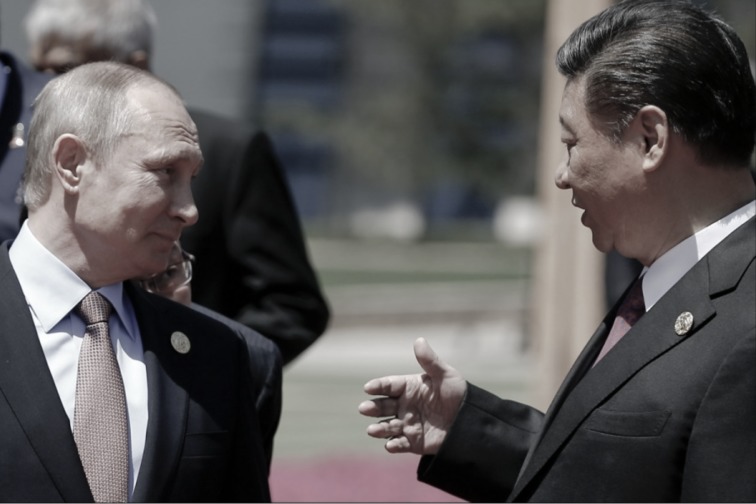
File Photo: Putin and Xi Jinping Posing for a Photograph
[People News] On June 29, Chinese Communist Party leader Xi Jinping met with Belarusian President Alexander Lukashenko at the Diaoyutai State Guesthouse in Beijing. This is Lukashenko's third visit to China in two years, and both Chinese state media and the Belarusian news agency covered the event. The Chinese media primarily used formal language and clichés, emphasizing the 'ironclad friendship' between the two nations. However, compared to last year, there was less focus on opposing U.S. 'hegemony and bullying, and safeguarding international fairness and justice' when discussing the strengthening of coordination and cooperation within the United Nations and the Shanghai Cooperation Organization. In contrast, the Belarusian news agency provided a more grounded account, revealing more authentic information.
According to the Belarusian news agency, Lukashenko's visit was classified as a working visit. Following international norms, visits by state guests and significant foreign dignitaries are typically categorized into four types: state visits, official visits, working visits, and other types of visits.
A 'working visit' is defined as a visit primarily focused on work, conducted by heads of state and government of foreign countries at the invitation of the host country's head of state, government leader, or national government. These visits usually have specific and clear objectives, such as discussions on specialized issues or exchanges of opinions. The duration of working visits is generally shorter than that of state and official visits, and the arrangements for etiquette and protocol are simpler, without welcome ceremonies or other ceremonial reception activities.
At first glance, Lukashenko's visit to China appears to be aimed at discussing further economic cooperation. According to a report from the Belarusian Telegraph Agency, during his meeting with Xi, Lukashenko primarily focused on the economic collaboration between the two nations, stating, 'Belarus is adopting advanced Chinese technology across various economic sectors. We are pleased with the quality of these technologies and products.' He described the 'Great Stone' China-Belarus Industrial Park as a 'model of successful cooperation' and acknowledged that 'most of the foreign investment comes from Chinese companies.' He also expressed gratitude for Xi's support in designating 2026-2027 as the China-Belarus Year of Industrial Cooperation, among other topics.
However, reports from both sides indicate that no new economic cooperation agreements were signed; instead, the discussions likely revolved around deepening existing cooperation and envisioning future prospects. Belarusian First Deputy Prime Minister Nikolai Snopkov confirmed in an interview that 'the president's core message is that the time is ripe for deepening the comprehensive investment and economic cooperation relationship between the two countries. This statement itself highlights the issue. The follow-up efforts will be jointly advanced by the governments and embassies of both nations in coordination with relevant national institutions.'
Specifically, Minsk hopes that the industrial cooperation with Beijing will encompass 11 critical key technologies that the Chinese Communist Party may agree to provide. However, the report did not specify what these technologies are.
Data indicates that the industries involved in the 'Great Stone' China-Belarus Industrial Park include high-tech sectors such as electronic information, biomedicine, fine chemicals, new materials, machinery manufacturing, and modern logistics. Why is Belarus suddenly requesting these 11 key technologies at this moment? This may reveal the true purpose behind Lukashenko's visit.
The Belarusian Telegraph Agency reported the following: Lukashenko told Xi, 'We often exchange views on the international agenda and regional situation. I will keep you updated on relevant circumstances at any time. I believe we should continue to maintain and deepen this communication.' Is it possible that Lukashenko is here to inform Xi about some relevant matters?
Interestingly, the report included this segment: Xi asked Lukashenko if he flew directly from Minsk to Beijing, to which Lukashenko responded, 'No, I flew from Moscow. We held talks with President Putin, and then I flew to Beijing.'
This raises an interesting question: why was this detail specifically included? Does Xi not know that Lukashenko flew directly from Moscow to Beijing after his meeting with Putin? And after meeting with Putin, did Lukashenko not pass on any messages to Xi on Putin's behalf? I believe he certainly would have.
According to the Belarusian Telegraph Agency, Putin and Lukashenko held a closed-door meeting on June 26 at the Russian residence in Valdai. The details of this meeting were not disclosed in advance, and both sides primarily focused on several key issues: regarding regional security, they engaged in an in-depth discussion about the security concerns of the Union State, particularly emphasizing the situation in Ukraine and related comments from Kyiv. In terms of economic and project cooperation, both sides evaluated the progress of their bilateral economic collaboration and advanced the implementation of joint projects in the economic sector. On the agenda of the Union State, they exchanged views on the integration process of the two countries and the broader geopolitical landscape. The discussions were held in a closed-door format without public sessions, joint statements, or signed documents.
The discussions between the two parties are closely tied to the current developments in the Russia-Ukraine war. Recently, Ukraine has launched drone attacks on the Russian capital and various oil refineries, inflicting significant damage on Putin. This has led to a fuel shortage in Russia, and the immense costs of the war have created an urgent need for external support in economic and military technology, with only the Chinese Communist Party (CCP) being capable and willing to provide such assistance.
If Putin shares the true situation with Lukashenko, it is likely that Lukashenko will travel to Beijing to relay this to Xi, seeking economic and technical support from the CCP, such as increased investment and collaboration in the 'Giant Stone' China-Belarus Industrial Park. However, who can guarantee that the high-tech industries within the park, including electronic information, new materials, and machinery manufacturing, are not directly or indirectly aiding Russia?
According to the CCP's official media, Xi is likely to agree to enhance cooperation and extend support to Belarus, which effectively means support for Russia. The specifics of this support, however, remain confidential. Yet, given the ominous trend that those who align closely with the CCP often face misfortune, what future can Russia and Belarus anticipate by accepting Xi and the CCP's backing?
(First published in People News)△







News magazine bootstrap themes!
I like this themes, fast loading and look profesional
Thank you Carlos!
You're welcome!
Please support me with give positive rating!
Yes Sure!