

The 2022 blockbuster 'Top Gun: Maverick' produced by Hollywood shattered the misconceptions about the Chinese market and refused to submit to the Chinese Communist Party. (Video screenshot)
[People News] Hollywood once believed it could use soft power to enter the Chinese market and reap substantial profits, even fantasising about the 'peaceful evolution' of Communist China. However, the reality was that the Chinese Communist Party wielded its censorship system as a tool to control, effectively stifling the essence of Hollywood's creative freedom. Senior American film producer Chris Fenton recently remarked that Hollywood's long-standing dependence on the Chinese market development model is no longer viable. He emphasised that the American film industry should redirect its focus towards domestic productions to create job opportunities and stimulate industry recovery.
'Bowing to Authoritarianism' Has Cost Hollywood Dearly
Historically, Hollywood has been willing to alter scripts and modify storylines for the Chinese market, as this market could generate hundreds of millions of dollars in box office revenue. For instance, "Avengers: Endgame" grossed around 4.24 billion yuan (approximately 627 million dollars) in China, making it the third highest-grossing film in Chinese history and the top-grossing imported film in the country for that year when it was released in 2019. In the film's trailer, the main character, U.S. Navy pilot Pete Maverick Mitchell, portrayed by Tom Cruise, dons the flight jacket from the 1986 film "Top Gun," although the Japanese flag and the flag of the Republic of China on the back of the jacket have been removed.
However, over the past two years, this financial backbone of Hollywood in the Chinese market has completely crumbled. With the Chinese economy experiencing a downturn and the film production techniques that China has adopted from Hollywood becoming increasingly sophisticated, China is now capable of producing visually impressive and impactful "patriotic brainwashing blockbusters." Furthermore, the authorities have implemented administrative measures to compel employees and students to watch domestic films, resulting in a dramatic decline in the market share of Hollywood films in China.
Currently, a Hollywood blockbuster has spent six months painstakingly working with Chinese authorities to pass censorship and make necessary revisions, only to potentially earn a few million dollars at the box office, with the majority of the revenue going to Chinese cinema chains. Hollywood executives, known for their business acumen, have suddenly realised the implications of this situation: the meagre profits from this arrangement come at the cost of alienating other global markets and risking the reputation of 'bowing to authoritarianism,' making it a financially unwise decision.
Consequently, some industry figures are beginning to awaken and reassess the operational model of 'dealing with the devil.' For instance, veteran Hollywood producer Fenton has suggested a shift away from the outdated reliance on the Chinese market and a renewed focus on producing films domestically in the United States.
From servility to ultimately 'no profit to be made'
According to a report by Fox News on Thursday (June 11), Fenton remarked in an interview that he had witnessed the peak of cooperation between the US and Chinese entertainment industries, during which China was widely regarded as a crucial overseas market. However, he later came to understand that this partnership with the Chinese Communist Party carries high costs.
Having worked in Hollywood for nearly 20 years, Fenton has been instrumental in introducing major films like 'Iron Man 3' and 'Oblivion' to the Chinese market.
He noted that some American film companies have had to modify their content and business strategies to comply with the demands of the dictatorial Chinese Communist Party in order to gain access to the Chinese market.
Hollywood's capitulation to an authoritarian regime not only facilitates the rapid growth of the Chinese film industry but also allows the Chinese Communist Party to dominate the narrative in films, enabling the global dissemination of its ideology through Hollywood productions.
Fenton referenced the 2012 science fiction film "Looper," featuring Bruce Willis and Joseph Gordon-Levitt. Initially, some plot elements were set in France, but they were later changed and filmed in China to comply with the censorship of the Chinese Communist Party.
He noted that these efforts ultimately failed to preserve Hollywood's standing in the Chinese market.
Fenton remarked, "Historically, the Chinese film market derived about 50% to 80% of its revenue from Hollywood films, but that figure has now plummeted to under 5%."
New Films 100% Made in America
Since around 2019, Fenton has been vocal about the dangers of Hollywood's excessive dependence on the Chinese market, aiming to showcase the viability of domestic productions through concrete examples. His latest comedy, "Bad Counsellors," exemplifies this approach.
The film is entirely "Made in USA," with all filming and production taking place in America, and featuring American actors, screenwriters, crew members, and suppliers. The plot revolves around two fraternity members who, while serving court-mandated community service, masquerade as Christian summer camp counsellors, resulting in comedic escapades. The production employed approximately 1,200 American professionals.
Fenton announced that the film will be released in U.S. theatres by Fathom Entertainment from July 23 to July 27.
In light of the significant layoffs that have recently occurred in the American film and television industry, along with the efforts of other countries to attract Hollywood film projects through subsidy policies, Fenton (芬頓) has called on the U.S. government to implement federal-level incentive measures to help keep film and television production within the country.
He emphasised that the United States has world-class film and television infrastructure and skilled professionals. If the U.S. can compete under the same conditions as other nations, it could potentially bring back around 2.7 million related jobs and nearly $250 billion in wage income.
Reflections on the 'Devil's Deal'
Fenton, a former Hollywood executive who played a key role in introducing major films like 'Iron Man 3' and 'Transcendence' to the Chinese market, exposes in his book 'Feeding the Dragon' the self-censorship mechanism that Hollywood films undergo due to their reliance on the Chinese market. This issue has recently become a central topic in the study of international geopolitics, cultural strategy, and the film industry.
In recent years, as U.S.-China relations have entered a phase of full confrontation, reflections on Hollywood's 'devil's deal' with the Chinese Communist Party by U.S. Congress, think tank scholars, veteran film critics, and independent media have progressed from initial discussions of 'profits and censorship' to more profound concerns regarding cultural sovereignty, cognitive warfare, and geopolitical regression.
For example, senior Wall Street Journal reporter Erich Schwartzel published an in-depth investigative book in 2022 titled 'Red Carpet: Hollywood, China, and the Global Battle for Cultural Supremacy.'
The central argument of the book is that "cultural hegemony wars" are more profound than military conflicts. The true competition among major powers extends beyond chips, warships, or GDP; it revolves around who can define the narrative of the world. Movies play a crucial role in shaping perceptions of: who is the hero? Who is the villain? Which system is superior? The author notes that historically, the United States has relied on Hollywood to project its values. Now, however, the Chinese Communist Party (Zhōngguó Gòngchǎndǎng) is attempting to export its own "Chinese-style narratives."
The author argues that while Hollywood seeks to profit from the Chinese market, the censorship authority of the Chinese Communist Party has seized the opportunity to extend its influence over Hollywood's creative processes. The Chinese Communist Party aims not only to sway Hollywood but also to "learn to become Hollywood." By leveraging Hollywood's global storytelling capabilities, the Chinese Communist Party seeks to reshape the world's perception of Communist China. In turn, Hollywood, reliant on the Chinese market, is increasingly engaging in "self-censorship" and making value concessions. The author characterises this trend as "preemptive obedience," which implies that individuals kneel down before being asked to do so.
The author presents a compelling observation: Hollywood believes it is profiting from China, while the Chinese Communist Party is learning how to supplant Hollywood. The Chinese Communist Party is harnessing the entertainment industry developed in the United States to challenge America's cultural hegemony. In essence, the United States created Hollywood, China is learning to emulate and surpass it, and ultimately, using Hollywood to outmanoeuvre Hollywood.
Fen Dun and Shi Wacai have criticised the greed and strategic blindness of Hollywood executives, highlighting the industry tragedy of 'paying a huge price and inviting wolves into the house.'
Hollywood has turned into an amplifier for the Chinese Communist Party's (CCP) 'cognitive warfare.'
The significant setbacks Hollywood has faced in China have also caught the attention of U.S. authorities.
In recent years, U.S. official agencies and leading think tanks have shifted away from a purely commercial viewpoint, elevating Hollywood's compromises to a matter of national security. Reports from Congress and think tanks have indicated that Hollywood has become an amplifier for the CCP's 'cognitive operations.'
1. The annual report from the U.S.-China Economic and Security Review Commission (USCC) explicitly states that Hollywood's 'self-censorship' to gain access to the Chinese market has repercussions that extend beyond China, affecting the global market.
The report notes that when Hollywood removes any negative references to Taiwan, Tibet, Xinjiang, or the human rights situation in China from its scripts, billions of viewers worldwide are presented with a 'parallel world' that has been sanitised and beautified by the CCP. Unwittingly, Hollywood has become a willing amplifier for the CCP's narrative of authoritarianism on a global scale.
2. A comprehensive investigation report by PEN America titled 'Made in Hollywood, Censored by Beijing' reveals that Hollywood's censorship system has become 'institutionalised' and 'subconscious.'
The report states that it is no longer necessary for Beijing to give its approval; Hollywood producers are now engaging in 'preventive castration' during the scriptwriting phase. They question themselves, 'If this villain is a Chinese Communist Party official, would Tencent still invest?' This relentless pursuit of economic gain is fundamentally undermining the essence of Western artistic expression—freedom of speech.
The two reports have set a critical tone in Western political and cultural spheres, characterising the compromises made by major studios in dialogue, national flags, and storylines to appease Beijing for profit as 'institutionalised self-censorship.'
3. The U.S. Department of Defense (Pentagon) has officially revised its 'Cooperation with the Film Industry Directive' (DoD Instruction 5410.16): In mid-2023, the Pentagon announced that if any Hollywood film is found to have altered its plot or removed elements such as the Taiwanese flag to meet the censorship demands of the Chinese Communist authorities, it will refuse to provide any substantial support, including aircraft carriers, fighter jets, and military bases.
This reflects an assessment of Hollywood's forced awakening after 'submitting to the CCP until it has nothing left' for market access, as well as the U.S. government's firm action to cut off the CCP's censorship influence.
4. Amendments related to the National Defence Authorisation Act (NDAA) passed by the U.S. Congress have directly influenced the film 'Top Gun: Maverick,' compelling it to feature Tom Cruise wearing a flight jacket adorned with the flags of the Republic of China and Japan. This incident has been widely referenced in recent years by major international film critics and social media as a significant milestone indicating Hollywood's 'decoupling' from the Chinese market and a return to core Western values.
The relationship between Hollywood and the 'devilish Communist Party' can be viewed as a classic tragedy of 'capital shortsightedness being precisely targeted by an authoritarian regime.' Hollywood initially sought to use cultural soft power to 'peacefully evolve' China, but its greed for profit led to a situation where the CCP's censorship 'systemically polluted' the entire Western creative industry.
Today, as the myth of the Chinese box office crumbles and the U.S. political and military sectors sever ties, Hollywood is facing a painful yet essential process of 'de-Chinafication' and self-redemption. This unfolding drama serves as a vivid example of how Western capital has lost its way and is awakening in the face of authoritarianism in the age of globalisation.
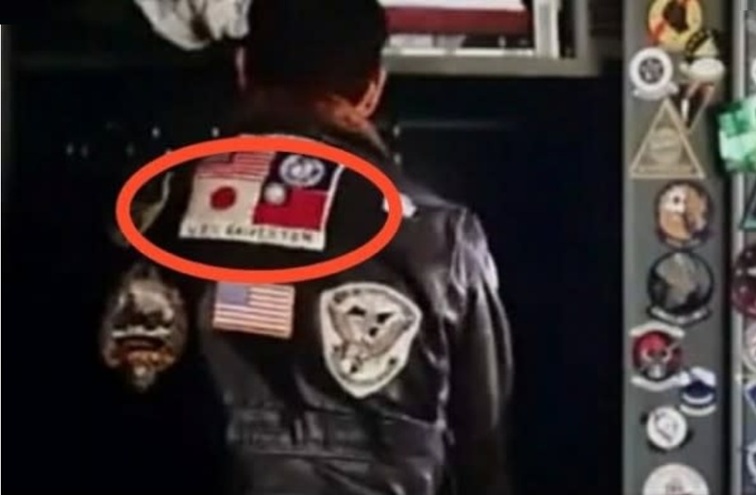
The 2022 blockbuster 'Top Gun: Maverick' produced by Hollywood stood firm against the CCP, retaining the flags of Japan and the Republic of China. (Video screenshot)
Breaking the Myth: Life is Better Without the Chinese Market
In 2022, the film "Top Gun: Maverick," featuring American actor Tom Cruise, grossed $248 million globally in its opening weekend. According to a report by NBC Business Channel on June 3, 2022, the film also performed well in Taiwan, as it did not comply with the Chinese Communist Party's (CCP) demands to remove the Republic of China flag.
The success of "Top Gun: Maverick" alongside several Marvel and DC blockbusters in recent years has significantly boosted the confidence of Hollywood executives.
These films chose to forgo the Chinese market during production and post-production, rejecting the CCP's requests for censorship and modifications. Consequently, they achieved substantial profits, relying on robust box office sales in North America and other free markets worldwide, including Europe, Japan, South Korea, and Taiwan, even setting historical records.
This development has dispelled the long-held belief in Hollywood over the past two decades that big-budget films would fail without access to the Chinese market. Hollywood has realised that as long as the story is compelling and the production quality is high, it can succeed without appeasing the CCP, thriving solely on the support of the global free world.
The transformation in Hollywood is quite apparent. Asian actors are re-emerging in villainous roles in major films, and sensitive topics such as the Taiwanese flag and Tibet are beginning to make a comeback on the big screen. In script meetings, it is likely that fewer people now consider, "Will this storyline upset Beijing?"
(First published by People News)
△




News magazine bootstrap themes!
I like this themes, fast loading and look profesional
Thank you Carlos!
You're welcome!
Please support me with give positive rating!
Yes Sure!