
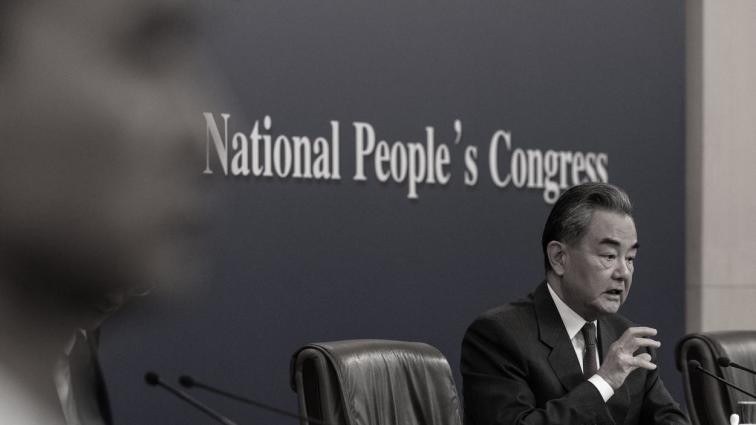
Image: Chinese Foreign Minister Wang Yi. (Photo by Kevin Frayer/Getty Images)
[People News] According to reports from state media in mainland China, on July 24, Kyrgyz President Sadyr Japarov met with Wang Yi, a member of the Political Bureau of the Central Committee of the Communist Party of China and Minister of Foreign Affairs, during his visit to Kyrgyzstan. In addition to asking Wang Yi to convey greetings to Xi Jinping, Japarov specifically noted that China's achievements are under the leadership of the Communist Party of China. Wang Yi also spoke extensively about the Communist Party during their conversation, stating that it 'is leading the entire nation... in advancing the construction of a strong country and the great cause of national rejuvenation.'
Isn't it strange? Why would a foreign president specifically mention the leadership of the Communist Party of China? Was this a request from the Chinese side? If so, what was the reason behind such a request? Furthermore, why did Wang Yi, who has consistently praised Xi in the past, focus more on the Communist Party than on Xi this time? When did this shift begin?
A comparison can be made with the report on Japarov's meeting with Wang Yi in Bishkek on November 19, 2025. During that meeting, Japarov not only expressed satisfaction with Kyrgyz-China relations but also 'highly praised and supported the four global initiatives proposed by Xi Jinping,' which were notably absent in this year's meeting.
Wang Yi stated that 'head of state diplomacy plays an irreplaceable leading role in the development of bilateral relations,' and that 'Mr. President's three meetings with Chairman Xi Jinping this year have provided top-level design and strategic guarantees for the development of bilateral relations,' adding that 'China is willing to work with Kyrgyzstan to adhere to the consensus of the two heads of state.'
During the discussions, while Wang Yi referenced the convening of the 20th Central Committee's Fourth Plenary Session of the Communist Party of China, he emphasized that 'under the leadership of Chairman Xi Jinping, China is confident in continuing to achieve the two great miracles of rapid economic development and long-term social stability.'
In contrast, Wang Yi has noticeably altered his tone, beginning to downplay the concept of 'leader diplomacy.' When did this shift occur?
It may be useful to review reports of Wang Yi's meetings with various national presidents and prime ministers, the most recent being over a year ago when Zaparov met with him.
On July 5, Finnish President Stubb met with Wang Yi in Turku. During their discussions, Wang Yi reiterated that the Communist Party of China 'has led the Chinese people to follow a successful development path that aligns with national conditions, creating the two great miracles of rapid economic development and long-term social stability,' without mentioning Xi's contribution.
On July 4, Swedish Prime Minister Kristersson met with Wang Yi in Stockholm. Wang Yi's statements continued to highlight that the Communist Party of China has led the Chinese people to 'completely eradicate poverty and embark on the path of modernization,' and he shamelessly claimed that the Communist Party 'has consistently received the heartfelt support of the Chinese people throughout its long governance, maintaining continuity and stability in both domestic and foreign policies, thereby injecting valuable certainty into the world,' again without mentioning Xi's role.
On May 29, Canadian Prime Minister Carney met with Wang Yi in Ottawa. Wang Yi stated that 'the leaders of the two countries have agreed to establish a new type of strategic partnership between China and Canada, providing strategic guidance for the development of bilateral relations,' without referencing the role of the Communist Party.
On March 16, General Secretary of the Communist Party of Vietnam, Su Lin, held a meeting in Hanoi with Wang Yi, Minister of Public Security Wang Xiaohong, and Minister of Defense Dong Jun. Wang Yi remarked that 'the highest leaders of the two parties maintain strategic communication, guiding China-Vietnam relations to advance steadily amid global changes,' and that 'China is willing to collaborate with Vietnam to adhere to the important consensus of the highest leaders of the two parties.' Notably, the role of the Chinese Communist Party was not mentioned.
On February 14, 2026, German Chancellor Merz met with Wang Yi in Munich. Wang Yi noted that Xi Jinping 'proposed the global governance initiative to revitalize the United Nations and establish a more just and reasonable global governance system.' There was no reference to the Chinese Communist Party, and the subsequent meeting followed a similar pattern.
On February 13, 2026, Serbian President Vucic met with Wang Yi in Munich. Wang Yi stated that 'under the leadership of President Xi Jinping and President Vucic, the construction of the China-Serbia community of shared future in the new era has begun positively. The two heads of state met twice last year, engaged in strategic communication, and reached a broad consensus, further clarifying the direction for the development of bilateral relations.'
On December 15, 2025, Jordanian King Abdullah II met with Wang Yi in Amman. Abdullah II expressed that he 'greatly values the deep friendship with President Xi Jinping,' while Wang Yi remarked that 'under the strategic guidance of the two heads of state, bilateral relations have maintained healthy and stable development.'
On November 22, 2025, Tajik President Rahmon met with Wang Yi in Dushanbe. Wang Yi stated that 'the two heads of state maintain close exchanges and strategic communication, establishing solid mutual trust and deep friendship, and both sides have reached an important consensus on the goal of building a China-Tajik community of shared future.'
On November 21, 2025, Uzbekistan's President Shavkat Mirziyoyev met with Wang Yi in Tashkent. Wang Yi remarked, 'Under the leadership of the heads of state of both countries, China-Uzbekistan relations are continuously reaching new heights.'
This suggests that Wang Yi's shift in position is likely connected to internal changes within the Chinese Communist Party (CCP) leadership. Following the mid-June CCP Party Building Symposium, which included 'the Party Central Committee's centralized and unified leadership' in Xi Jinping's Party Building Thought, there are increasing indications that a consensus has been reached in Zhongnanhai regarding this 'centralized and unified leadership,' thereby constraining Xi's power. Xi's comments during his July 1 speech, where he emphasized 'upholding the Party's overall leadership and the Party Central Committee's centralized and unified leadership,' along with the downgrading of official reports about him, further corroborate this point.
Thus, it is not surprising that Wang Yi, following the new directive of 'collective leadership,' has downplayed Xi's head-of-state diplomacy.
(First published by People News) △





News magazine bootstrap themes!
I like this themes, fast loading and look profesional
Thank you Carlos!
You're welcome!
Please support me with give positive rating!
Yes Sure!