
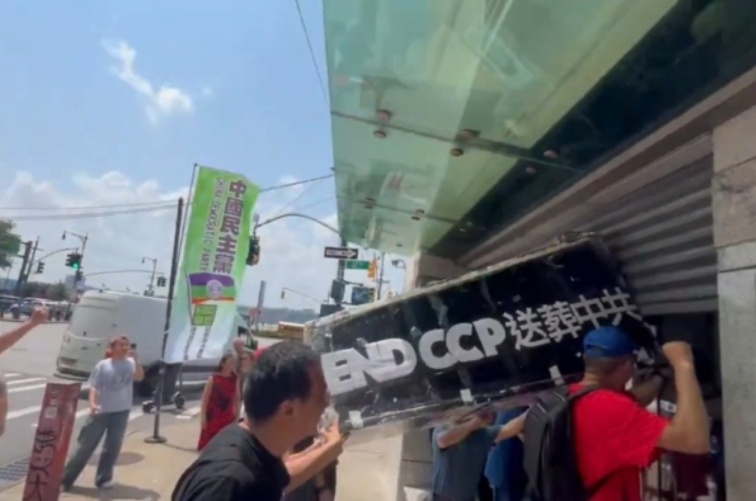
On July 1, 2026, various protest groups gathered in front of the Chinese consulate in New York to carry a coffin for the Communist Party, chanting' Down with the Communist Party' voicing their long-standing grievances and hopes for the Party's swift demise. (Provided by Jie Lijian)
[People News] The CCP's method of managing society is through control, encompassing everything from the broad scope of a planned economy to individual family planning. History over the decades since the CCP's establishment has shown that the more the party exerts control in certain areas, the worse those areas perform, often leading to stagnation. Following the CCP's rise to power in 1949, it began to tighten its grip on urban areas, and within just over six months, the Chinese economy faced stagnation, resulting in widespread social decline.
At that time, after the CCP took control of major cities nationwide, it attempted to win over workers by misleading them into believing they were the 'masters of the state' and were preparing to 'take charge.' However, as the CCP increased its control over various sectors in the cities, the overall decline of the social economy led to significant unemployment among workers.
Firstly, the CCP mandated that the Renminbi it issued was the only legal currency, while US dollars, silver dollars, and gold were banned from circulation just a few months later, causing many companies to experience disruptions in their capital chains.
Simultaneously, the CCP utilized its state-owned trading companies to exert comprehensive control over the supply of raw materials. The state-owned stores and cooperatives under these trading companies gradually monopolized all domestic commodity distribution channels under the guise of preventing private manipulation of prices.
The CCP also gradually centralized control over foreign trade, artificially setting a very high exchange rate for the Renminbi, which significantly diminished the competitiveness of Chinese goods in the international market, leaving many enterprises across various sectors facing severe capital shortages.
For instance, Shanghai, which once represented half of the national industrial output, is currently facing significant underperformance, with factories operating only three days a week. The raw materials required for cotton spinning mills, such as cotton, are only enough for six months of production; meanwhile, the total industrial output in Northeast China has plummeted to just 30% of what it was during Japan's Manchukuo period.
To rectify this situation, importing raw materials from abroad is essential. However, the Chinese Communist Party (CCP) staunchly opposes foreign imports. In an effort to tackle the financial struggles that most enterprises are facing, which are on the verge of shutting down, the CCP has resorted to borrowing heavily from the Soviet Union.
Amidst this backdrop, the CCP's earlier commitments to raise wages and enhance living conditions for workers have not materialized, leading to protests among the workforce. Ironically, the CCP, which had previously encouraged strikes and demonstrations during the Kuomintang era, has now introduced new laws declaring strikes illegal. Additionally, the unfulfilled promises have compelled business owners to increase wages, resulting in a swift rise in production costs, further complicating the challenges faced by enterprises and even forcing some to close their doors.
The CCP's grain requisitioning in rural areas was marked by extreme brutality, with food rations and seed grain being confiscated, and various forms of torture being employed. A similar situation was unfolding in urban areas as well. In dire need of cash, the CCP imposed a range of heavy taxes in cities.
For instance, in Beijing, tax revenue measured in millet was 31,400 tons in 1946, 21,000 tons in 1947, and only 10,000 tons in 1948. However, after the Communist Party of China (CPC) came to power in 1949, tax revenue skyrocketed to 53,000 tons. This additional collection of over 40,000 tons of millet undoubtedly pushed many people into hardship. Consequently, both bankrupt small shop owners and ordinary citizens struggling to support their families voiced their grievances against the CCP.
In Changsha, Hunan Province, during the Republic of China era, the annual tax burden per person was merely 80 kilograms of food, but by 1949, it had risen to 250 kilograms per person per year.
Simultaneously, the CCP imposed arbitrary taxes on private enterprises, with some tax categories even retroactively applied for several years. For example, the tax on the tobacco industry reached an astonishing 120%, effectively destroying the sector. Bo Yibo admitted that such circumstances had already "destroyed commerce."
Within just a few months, major cities like Shanghai, Tianjin, and Guangzhou displayed clear signs of collapse, with factories halting operations and trade coming to a standstill, resulting in numerous company bankruptcies.
In Shanghai alone, around 2,000 trading companies and 1,000 factories went bankrupt. Of the more than 500 banks in the city, only about 100 remained operational, and over 50 of them were seeking bankruptcy protection from the government. Many foreign-funded transportation and power companies, facing financial shortages, were forced to borrow heavily from the People's Bank, ultimately unable to avoid being effectively controlled by the government.
Hundreds of factories producing paper, matches, rubber, and cotton cloth have shut down; of the 136 cosmetics factories, only 30 remain operational, with most having shifted to toothpaste production.
According to the Chinese Communist Party's May 1950 "Internal Reference," Wuhan, once celebrated as the "Eastern Chicago," now has over 500 shops closed and hundreds of factories out of business; the once-bustling industrial center of Wuxi has fallen silent, with hundreds of shops also shuttered; in the textile stronghold of Songjiang, only one of the 18 textile factories is still managing to produce.
The unemployment rate among urban residents has surged dramatically. In December 1949, Beijing, with a population of 2 million, had 54,000 unemployed individuals; in the summer of 1950, Shanghai reported 150,000 unemployed; in Fuzhou, which has a population of less than 500,000, over 100,000 were jobless; in Guangzhou, one-third of the city's workers were unemployed.
In the context of high taxes and soaring unemployment, numerous suicide incidents have been reported across various regions, with some individuals starving to death and others being compelled to sell their own children.
The widespread discontent among urban citizens quickly escalated into collective actions. In Changsha, there were six incidents where unemployed workers surrounded unions and protested against the Communist Party, with some even inciting violence to overthrow the government; similar occurrences were reported in Guangzhou; in Zhengzhou, hundreds of porters protested against low wages, gathering to attack the city government, assaulting officials, and vandalizing doors, windows, and furniture; in Nanjing, workers complained that their conditions were worse than during the Kuomintang era, with "Anti-Communist" slogans scrawled across the walls of government offices and factories.
On May 10, 1950, Chen Yi, who was the Mayor of Shanghai at the time, sent a telegram to Mao Zedong reporting that there was widespread disappointment with the current situation. Many people were leaving the party in large numbers, while ordinary citizens were petitioning the government, and some even went so far as to tear up portraits of Mao Zedong.
(Originally published in the People News) △





News magazine bootstrap themes!
I like this themes, fast loading and look profesional
Thank you Carlos!
You're welcome!
Please support me with give positive rating!
Yes Sure!