
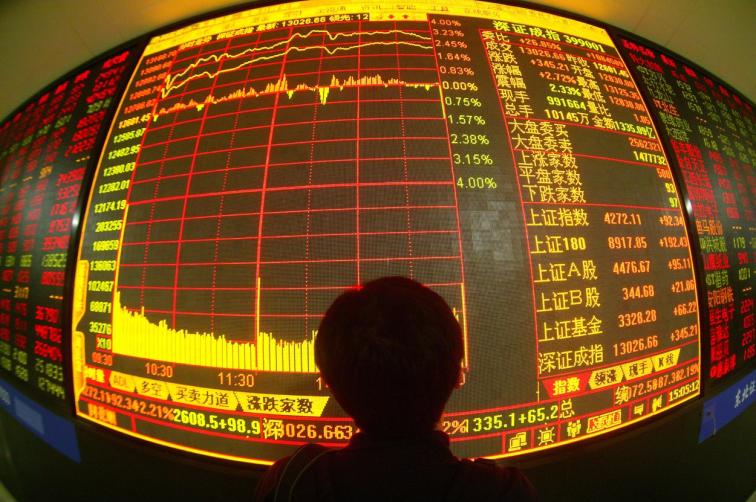
Photo caption: Recently released May financial data once again confirms the grim state of China's economy. (Photo by China Photos/Getty Images)
[People News] Based on data from Enterprise Early Warning, as of May 31, the Chinese banking sector—excluding branches and individuals—has faced 435 penalties this year, which is a 2.02% decrease compared to the same period last year. The total fines amounted to 445 million yuan, reflecting a 15.3% increase from 385 million yuan during the same period last year. Notably, rural commercial banks and rural cooperative banks accounted for approximately 219 million yuan in fines, making up about 49% of the total.
The report highlights that the top three violations among rural commercial banks and rural cooperative banks include non-compliance in credit operations, insufficient internal control systems, and violations in data reporting and governance. Hangzhou United Bank received a fine of 11.1 million yuan in February this year, the highest penalty among rural commercial banks so far. The main infractions included inadequate loan management and inaccurate data reporting.
Sun Simao, a financial regulatory insider, explained that while the total fines imposed on banks have risen this year, the number of penalties has decreased, indicating that the average penalty amount has increased. He noted: 'First, regulators are now conducting more thorough inspections, checking not only for loan violations but also for issues in data reporting, risk classification, and fund flows; second, local small and medium-sized banks have a history of accumulating various problems, and when these are uncovered, they often reveal a series of issues rather than isolated ones; third, regulators are now focused on raising the cost of violations to prevent banks from thinking they can simply pay a small fine to avoid consequences. Given the current economic challenges, issues related to loan quality and risk classification are more likely to come to light.'
Rural commercial banks have become a primary target for penalties.
According to the Daily Economic News, in May, the Jiangxi Duchang Rural Commercial Bank was fined 1.5 million yuan by the Jiujiang Financial Supervision Bureau due to several issues, including inadequate implementation of the "three checks" for loans, illegal issuance of personal loans, poor seal management, and inaccurate classification of loan risks. In March, the Hubei Xishui Rural Commercial Bank faced a fine of 850,000 yuan for inadequate credit management that led to incidents, insufficient post-loan management, and poor employee behaviour management. In April, the Jiangsu Hongze Rural Commercial Bank was fined approximately 1.8 million yuan by the Huai'an branch of the People's Bank of China for violating regulations related to cybersecurity, data security, and financial statistics.
Financial scholar Si Ling commented to our station that the recent fines imposed by financial regulatory authorities in Jiujiang and the Yangtze River Delta region on rural commercial banks may only be the beginning and could signal a nationwide effort to rectify grassroots financial institutions. He stated, "The series of fines issued to rural commercial banks is just the start, and it may also indicate a comprehensive crackdown on other rural grassroots financial institutions across the country. This suggests that financial regulatory authorities are aiming for strict control and risk mitigation, as well as a macro-control practice at the grassroots level, which aligns with the current economic downturn and fiscal constraints in China." He believes that the authorities may consider using fines as a means to increase fiscal revenue.
Si Ling further noted that rural commercial banks have traditionally been closely linked to farmers, large grain producers, and local small businesses within the grassroots financial system. As rural credit cooperatives transition into rural commercial banks, loan approval and financial authority may become more centralised, potentially affecting grassroots financing as well.
Payment institutions have also faced penalties.
In addition to banks, third-party payment institutions have also faced a series of fines. On June 4, the Guangdong branch of the People's Bank of China announced an administrative penalty decision, revealing that Yipiaolian Payment Co., Ltd. was fined for breaching regulations related to payment settlement, financial technology, and anti-money laundering. The company was ordered to forfeit illegal gains amounting to 10.0516 million yuan and was fined 3.82974 million yuan, bringing the total penalties to 48.349 million yuan. According to reports from mainland media, this represents the largest fine in the payment industry this year. Two individuals held responsible, Su Mou'an and Chen Mou, received fines of 375,000 yuan and 20,000 yuan, respectively.
On June 8, the Zhejiang branch of the People's Bank of China released an administrative penalty decision information disclosure form, indicating that NetEase Payment (Hangzhou) Co., Ltd. was warned and fined 2.204 million yuan for violating account management, clearing management, and data security regulations, as well as for failing to conduct customer due diligence as required. Yu Mou from the NetEase Payment Technology Centre and Zhu Mou from the Anti-Money Laundering Centre were fined 45,000 yuan and 24,000 yuan, respectively.
Mr Gong, a professional in the payment industry, stated to our station that the recent simultaneous penalties against banks and payment institutions signify a shift in regulatory focus from traditional credit operations to encompass accounts, payments, customer identification, and anti-money laundering efforts. Third-party payment institutions link merchants, platforms, and individual accounts, thus possessing a significant amount of transaction data. The regulation of payment institutions is also aimed at tracing the flow of funds behind these accounts.
According to a report by the Securities Times, four payment licenses have been revoked this year. The central bank's announcement regarding the renewal of payment licenses also indicates that the renewal applications from Shenzhen Kuaiyitong Payment Co., Ltd., Dongfang Electronic Payment Co., Ltd., and Shande Payment Network Service Development Co., Ltd. have been suspended for review.
Mr Gong believes that the decrease in payment licenses and the rise in fines are part of the regulatory authorities' initiative to clean up existing institutions. The fact that both banks and payment institutions are facing penalties suggests that the monitoring of fund flows, transaction data, and account management will continue to be key areas of focus in future financial regulation.
Source: (Radio Free Asia) △





News magazine bootstrap themes!
I like this themes, fast loading and look profesional
Thank you Carlos!
You're welcome!
Please support me with give positive rating!
Yes Sure!