
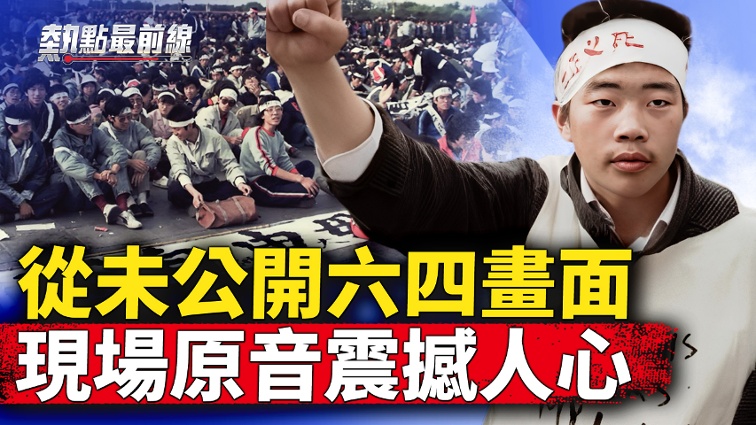
Unseen June Fourth Footage: Original Sound from the Scene is Heart-Wrenching! (Video)
[People News] Greetings to our viewers! Welcome to the June 3rd episode of 'Hotspot Frontline.' I am Xiaokun.
What you just witnessed at the start of the video is not a film nor AI-generated virtual effects; it is the original footage of the June Fourth incident recently released by the British ITN television station, which had been stored away for over thirty years. Although thirty-six years have passed, the marks on Chang'an Avenue have long been erased, but has Zhongnanhai's deep-seated fear of that historical period vanished?
The answer is: absolutely not. Not only has it not faded, but it has morphed into an inexplicable hysteria over time.
This year's June Fourth anniversary falls on a Thursday, and in a surprising move, Weibo has turned the most popular KFC promotion in China, 'Crazy Thursday,' into a banned term overnight. Additionally, in the game 'World of Tanks,' the term 'tank' has become a significant taboo, making it impossible to chat or type in the game these days.
Why did the June Fourth movement fail back then, and how can we prevent repeating the same mistakes? Overseas pro-democracy leader Wang Juntao has recently made a bold declaration regarding regime change in his latest speech.
Historical Impact—UK ITN Declassified Footage
Now, let’s rewind to that bloody night thirty-seven years ago. This footage, which has been publicly released for the first time by the British Independent Television News (ITN), is shocking because it brutally dismantles the Chinese Communist Party's lies that have endured for over thirty years, captured through the most unfiltered lens.
Everyone, take a close look at this footage. Before the bloody crackdown on June 4th, the students and citizens of Beijing gathered in the square, facing the impending suppression, displaying not riots, but rather extreme purity and despair.
Is this what the Chinese Communist Party refers to as 'counter-revolutionary rioters'? No, they are simply a group of unarmed individuals, filled with passionate hopes for the future of their country.
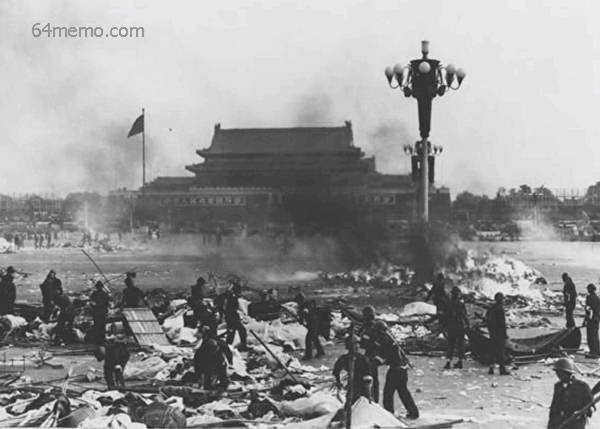
Then, the most brutal scene in history unfolded. As a large number of martial law troops were ordered to advance, the loudspeakers at the Great Hall of the People issued an ultimatum, warning the crowd to leave the square immediately. Soon after, dense gunfire erupted from the southern side of Tiananmen Square, causing the crowd to panic and flee in all directions.
The authorities later claimed that the military exercised maximum restraint during the clearing process, even asserting that no one died in Tiananmen Square. However, the records captured by ITN reporters on the scene, at the cost of their lives, tell a story filled with blood and tears.
In the footage, countless bodies and injured individuals, struck by bullets, were spontaneously transported to hospitals by citizens using tricycles and wooden carts, one after another, amidst the sounds of police sirens and cries of anguish. (Video 00:05:56)
This footage also includes a precious testimony. A Beijing resident named Bob Chen tearfully expressed in front of the camera: 'We do not want the army, we do not want to hear gunfire; the army actually opened fire on innocent people!'
When I see these precious historical images, I am filled with tears, mourning the lost lives and moved by their courage. Friends, what impact do these images have on you? Feel free to share your thoughts in the comments section.
On the eve of June 4th, 2026, the entire internet is blocked.
The original audio from the scene, long sealed for thirty-seven years, has transcended time and space, becoming the most undeniable testimony in court. This is exactly why, thirty-seven years later, Zhongnanhai exhibits an almost obsessive sensitivity to the term 'June Fourth'...
If you believe that avoiding political discussions, staying home to play games, and engaging in tank simulations will keep you safe, you are seriously underestimating the sensitivity of this regime. In recent days, several major online games in China, particularly military-themed titles like 'World of Tanks' and 'World of Warships', have unexpectedly and synchronously announced system maintenance.
Take note of the timing in these announcements: starting from the early morning of June 2nd and lasting until the early morning of June 6th. These four days perfectly encapsulate June 4th. During this period, all text chat, voice communication, and guild systems within the games will be disabled, and players will even be unable to change their names or switch their guild titles.
Why is this happening? Because the main character of this game is called 'Tank'. Players are incredibly creative.
They often use guild names, team formations, or personal profiles to alter strings into homophones or codes such as '8964', 'May 35th', or '8 Square'.
In 'World of Tanks' or similar tactical games, there have been instances where players lined up their tanks or deliberately positioned their characters to block tanks, capturing screenshots or recording videos to share on social media, which is viewed as a significant political incident by the censorship authorities.
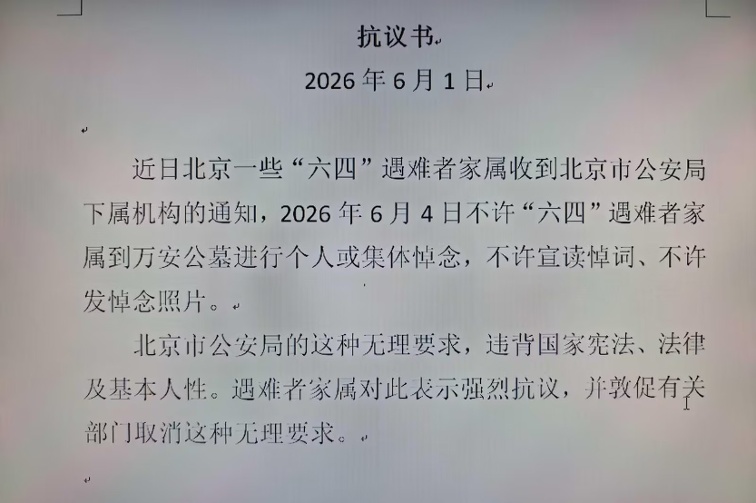
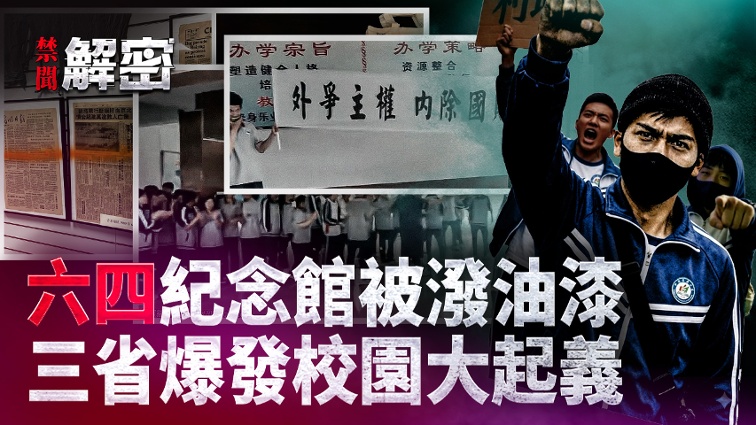
However, this year's censorship extends far beyond previous measures. Alongside online games, platforms such as WeChat, Weibo, Xiaohongshu, and Douyin have almost simultaneously implemented the highest level of stability maintenance—prohibiting users from changing their personal avatars and nicknames.
If you try to open WeChat now to send a 'candle' emoji in mourning, you’ll find that the symbol is simply blocked; if you attempt to send a 'tank' sticker, it won’t go through. Even terms like 'soldier' and 'sunglasses' can trigger censorship alerts on major forums, leading to automatic removal by the system.
The most surreal and absurd incident of internet management this year occurred on Weibo on June 3rd. Many users behind the Great Firewall were shocked to find that China's most popular meme—KFC's 'Crazy Thursday'—had suddenly been classified as a banned term overnight!
Netizens were left bewildered: I’m just a broke worker wanting to enjoy discounted fried chicken on Thursday; how did ordering KFC suddenly become counter-revolutionary and a threat to national security?
The reason is that June 4, 2026, coincidentally falls on a Thursday! The censorship apparatus in Zhongnanhai is concerned that the phrase 'Crazy Thursday' could be used by netizens to reference that truly chaotic Thursday from thirty-seven years ago. Thus, the innocent 'Thursday' has become a scapegoat.
This annual 'internet silence' has ironically led to a unique reverse popularisation effect among young internet users in China, as 'those who understand, understand.'
Every year in early June, many young players who were previously unaware of the events of 1989 notice that the mobile and PC games they play suddenly restrict name changes, disable typing, and even limit combo functions. This prompts them to take to the internet to ask, 'Why does maintenance occur every year during these days?' Ironically, this curiosity drives them to circumvent the Great Firewall in search of the truth. Internet users often humorously label this phenomenon as a 'national-level annual historical reminder.'
The Failure and Reflection of History
Let us now revisit the origins of this tragedy to address a profound question that has troubled countless intellectuals and democratic activists over the past thirty-seven years: Why did this monumental democratic movement, which garnered widespread societal support, ultimately end in failure?
In the last three decades, there have been numerous debates within the academic community, both in China and abroad, regarding this issue. Some critics argue that the students lacked unity and that their organisation was chaotic; others contend that the leadership became too radical in the later stages of the movement, missing the political opportunity to withdraw from the square when the situation was favourable.
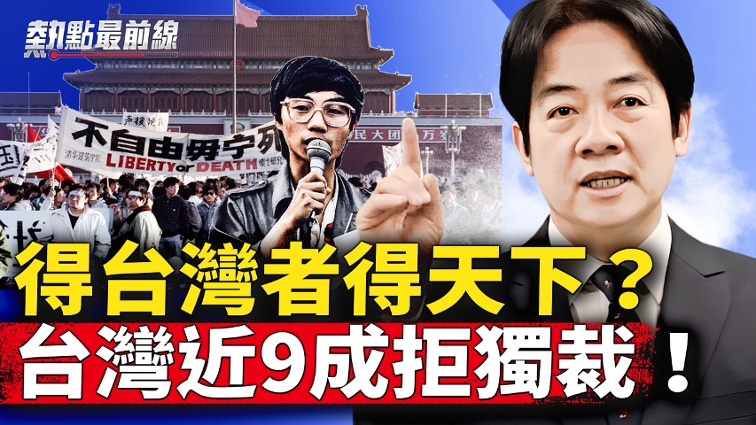
However, Wang Juntao, the current chairman of the National Committee of the China Democracy Party and a firsthand participant and organiser of that movement, offered a much harsher and more fundamental institutional reflection during the latest seminar commemorating the 37th anniversary of June Fourth on June 1.
Wang has previously pointed out with precision that both the students in the square and intellectuals like himself were fundamentally influenced by a traditional literati's reformist sentiment of 'petitioning the emperor for change.'
At that time, everyone was caught up in an incredibly pure yet equally deadly 'political rose dream.' The students believed that their intentions were patriotic and their methods peaceful and rational. They thought that by demonstrating immense moral fervour, even resorting to hunger strikes and risking their own lives to inspire the rulers, the system would inevitably engage in a respectful dialogue with the people, similar to what occurred in Eastern Europe during the same period, thereby facilitating a gradual transformation of the country from the top down.
However, the harsh reality of history is that this group of passionate youths severely underestimated the true nature of the Chinese Communist Party (CCP) system. Whenever the masses took to the streets and the absolute authority of the regime was challenged, it was labelled a 'counter-revolutionary riot' aimed at subverting the socialist system, directly threatening the Communist Party's survival.
In matters of regime survival, this totalitarian apparatus lacks any political conscience or moral boundaries. It will not hesitate to deploy 200,000 regular troops, along with armoured vehicles and tanks, to completely clear Chang'an Avenue.
Furthermore, in terms of the structure of social movements, although the movement at that time was large in scale, its core remained focused on young students and the intellectual elite. It never evolved into a labour and peasant alliance like Poland's 'Solidarity,' which could have initiated a nationwide general strike, effectively paralysing the rulers by disrupting the economic and social lifelines.
Having endured over thirty years of suffering and sacrifice, Wang Juntao, in his 2026 speech, unequivocally renounced the past illusions of 'kneeling for the system's redress and hoping for reconciliation between the parties.' He emphasised that there is no middle ground in China's democratic transition; the only viable path for overseas democracy movements and grassroots resistance is a complete revolution and a change of regime, with the overthrow of the Chinese Communist Party (CCP) being the sole prerequisite for establishing a free society.
Thus, the shift from 'kneeling for dialogue' in 1989 to 'must overthrow' in 2026 reflects a radicalisation not of the protesters, but of the harsh reality imposed by the Central Committee of the Communist Party of China, which has been tightening its grip and reversing progress, forcing this change.
May the day without the Communist Party arrive swiftly.
Thank you all for your attention. This struggle, which has lasted thirty-seven years, has fundamentally never been a battle of weapons, but rather an 'ultimate struggle between memory and forgetting.' The most formidable weapon of a totalitarian regime is its ability to enforce collective amnesia, while our only weapon is our refusal to forget. As long as the true voice of history continues to be heard, and as long as the voices of resistance resonate both inside and outside the high walls, the historical fabrications that Zhongnanhai seeks to construct will inevitably be exposed one day.
What spirited young people they were! The intellectual youth of that era were imbued with a profound sense of responsibility towards their country and society. History continues to observe; justice may be delayed, but the truth will never be concealed. May all the victims of the June Fourth incident rest in peace. May the day without the Communist Party come soon.
Thank you for tuning in to today's episode of "Hotspot Frontline." If you share our commitment to preserving this unforgettable history, please like, subscribe, and share this video with others who are eager to uncover the truth. I am Xiaokun, and I look forward to seeing you in the next episode.
△


News magazine bootstrap themes!
I like this themes, fast loading and look profesional
Thank you Carlos!
You're welcome!
Please support me with give positive rating!
Yes Sure!