
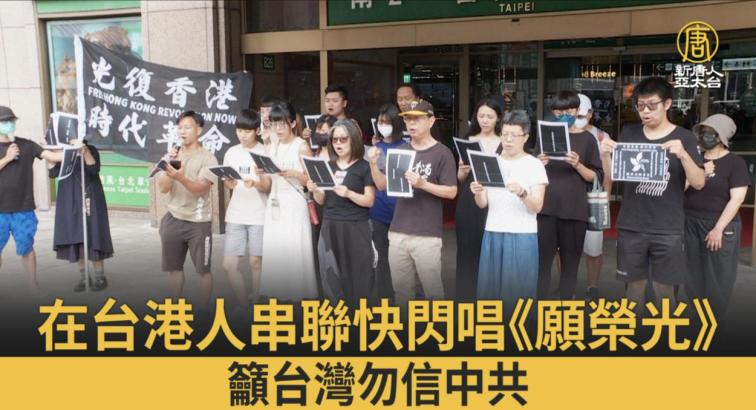
In June 2023, several Hong Kong exiles in Taiwan sang Glory to Hong Kong outside Taipei Main Station. (Screenshot/New Tang Dynasty Television)
[People News] As the 37th anniversary of the June Fourth incident approaches, Hong Kong society has once again fallen into silence. For more than 30 years, Victoria Park has served as a key venue for the global Chinese community to commemorate June Fourth. However, following the implementation of the Hong Kong version of the National Security Law, the candlelight vigil in Victoria Park has vanished, the Alliance in Support of Patriotic Democratic Movements of China has been disbanded, organisers have faced charges, and media coverage of the June Fourth commemoration in Hong Kong has nearly disappeared. The space for public mourning has shrunk, media reports have become increasingly cautious, and June Fourth has transformed from a public commemorative event into a high-risk political issue in Hong Kong.
According to Radio Free Asia, Mr Chen, a senior media figure focused on press freedom in Hong Kong, recently stated: "Hong Kong media is not ignorant of June Fourth, nor do they lack information, but they are now afraid to address it. In the past, around the time of June Fourth, newspapers and television stations would report on the candlelight vigil in Victoria Park, and some media would publish retrospectives on June Fourth, with reporters interviewing citizens attending the vigil. Now, with the National Security Law in place, such activities are classified as illegal, and the media cannot report on them."
The Hong Kong Alliance in Support of Patriotic Democratic Movements of China was founded in 1989 and has held the June Fourth candlelight vigil annually since 1990, advocating for demands such as "vindication of June Fourth," with participation numbers ranging from tens of thousands to over a hundred thousand. Mr Chen remarked that the disappearance of the candlelight vigil in Victoria Park marks a significant change in Hong Kong's public space.
The Alliance case and changes in Victoria Park
In 2021, the Hong Kong Alliance in Support of Patriotic Democratic Movements of China was disbanded due to the pressures of the Hong Kong version of the National Security Law, leading to the arrest or prosecution of several core members. On January 21, Reuters reported that former chairman Lee Cheuk-yan, Ho Jun-yan, and former vice-chairman Chow Hang-tung were facing trial in the Hong Kong High Court for 'inciting subversion of state power.' The Hong Kong Department of Justice included the political demands that the Alliance had long advocated in the charges, and this case is regarded by many as significant in Hong Kong's approach to the memory of the June 4th incident.
According to a report by the Central News Agency on May 27, Victoria Park in Hong Kong will once again host a 'Hometown Market Carnival' organised by pro-China hometown associations this year, with the event taking place over June 4th. In previous years, Victoria Park had seen tens of thousands of citizens gather on the evening of June 4th to commemorate the victims of the 1989 Tiananmen Square crackdown. The year 2019 marked the last time the Hong Kong Alliance was permitted to hold a large-scale candlelight vigil in Victoria Park. Following that, the Hong Kong government initially banned gatherings citing the pandemic, and after the implementation of the Hong Kong version of the National Security Law, related commemorative activities were classified as political risks.
Hong Kong resident Ms Li stated, 'In the past, I would take my children to Victoria Park every year for June 4th. In recent years, we have not been allowed to hold candlelight vigils, which are deemed illegal activities, so I stopped attending. I have heard that some Hong Kong people overseas are organising small-scale commemorative events.'
Overseas Commemoration Continues
The International Amnesty Organisation recently released a statement indicating that the June Fourth vigil in Hong Kong was banned in 2020 and 2021 under the guise of the pandemic. Since then, the National Security Law has effectively criminalised peaceful protest activities in Hong Kong, including the commemoration of June Fourth, creating a risk of criminalisation. The organisation highlighted that the trial of members of the Alliance in Support of Patriotic Democratic Movements of China is part of the Hong Kong authorities' efforts to suppress peaceful expression and the freedom of assembly. Over the past few years, expressions related to June Fourth in both the streets and online spaces of Hong Kong have significantly decreased, with public mourners facing police interception, detention, or prosecution.
As the 37th anniversary of June Fourth approaches, overseas Hong Kong residents and Taiwanese civil groups continue to hold commemorative events. Taiwanese civil groups will host a June Fourth memorial vigil at Taipei Freedom Square under the theme "Memory knows no borders, resistance knows no boundaries." June Fourth survivor Wu Renhua remarked that following the 2019 anti-extradition movement and the implementation of the Hong Kong version of the National Security Law, it has become impossible to commemorate June Fourth in Victoria Park. Meanwhile, Hong Kong communities in Taiwan, the UK, Canada, Australia, and elsewhere continue to mourn in solidarity.
Our station was the first to report that members of the "Tiananmen Mothers" group received a notification from the Beijing Municipal Public Security Bureau on June 1, stating that they are prohibited from visiting the Wan'an Cemetery in Beijing to pay tribute to their relatives on June 4 this year, and they are also barred from holding the usual commemorative ceremonies. The families of the victims assert that the authorities are violating the constitution, laws, and fundamental human rights, and they demand the removal of these restrictions. This marks the first time in over 30 years that families of June Fourth victims have been forbidden from visiting the cemetery to honour their loved ones.
Taipei continues the candlelight vigil from Victoria Park.
Zeng Jianyuan, the Executive Director of the Taiwan Chinese Democratic Academy Association, stated in an interview with this station that following the last June Fourth vigil at Victoria Park in Hong Kong in 2019, the implementation of the Hong Kong version of the National Security Law has weakened civil society and the rule of law in Hong Kong, leading to the forced cessation of June Fourth commemorative activities. With the candlelight in Victoria Park extinguished, the Taipei June Fourth vigil has emerged as a significant site for commemorating June Fourth in the Chinese-speaking world and has also become a source of spiritual support for some exiled Hong Kong residents. He remarked, 'As the candlelight in Victoria Park gradually fades, this light will be rekindled in Taipei, and it will be lit by the people of Hong Kong.'
Zeng Jianyuan noted that in recent years, there has been a noticeable increase in the number of Hong Kong participants at the Taipei June Fourth vigil, with more Cantonese being heard at the event. The organisers have also arranged for Cantonese-speaking hosts and short talks focused on Hong Kong themes. He stated, 'This symbolises the continuation of the spirit of Victoria Park in Hong Kong here in Taiwan.'
Zeng Jianyuan emphasised that while the June Fourth incident took place in Beijing, it has become a collective historical memory for the people of Hong Kong over the past 30 years. He believes that the experiences of Hong Kong serve as a reminder to Taiwanese society that issues of human rights and democracy in China are indeed relevant to Taiwan. He said, 'This country is constantly seeking to eliminate Taiwan's sovereignty and undermine democracy, so any violations of human rights, destruction of democracy, and suppression of democratic practices that occur in this country are directly related to Taiwan and are closely linked to Taiwan's national security.'
June Fourth has become a political taboo.
On the night of June 3 to the early morning of June 4, 1989, the Chinese Communist Party's military opened fire on students and citizens in Beijing, leading to a significant number of casualties. Since that time, the events of June Fourth have become a political taboo in mainland China. The Hong Kong Alliance in Support of Patriotic Democratic Movements of China has organised a candlelight vigil in Victoria Park since 1990, with 2019 marking the last large-scale event that was allowed to take place. Following the implementation of the Hong Kong version of the National Security Law in 2020, the opportunities for publicly commemorating June Fourth in Hong Kong have significantly decreased, and the candlelight vigil in Victoria Park has not yet been reinstated. △






News magazine bootstrap themes!
I like this themes, fast loading and look profesional
Thank you Carlos!
You're welcome!
Please support me with give positive rating!
Yes Sure!