
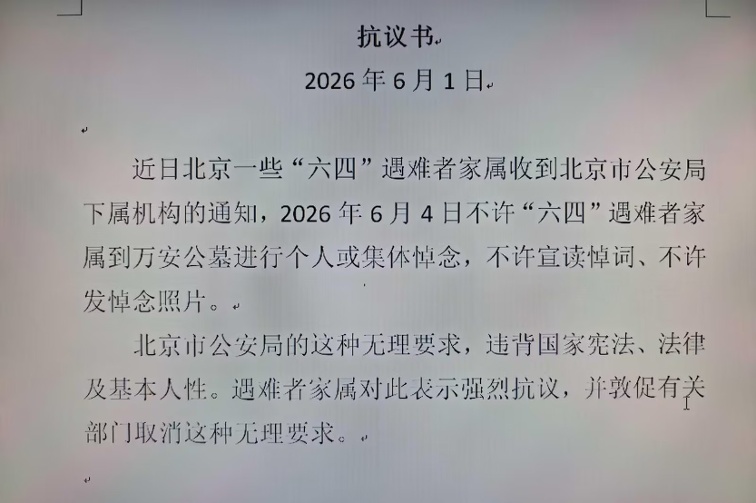
The Tiananmen Mothers group has voiced their opposition to the Beijing police's ban on collective memorials for the June Fourth incident, urging the relevant authorities to rescind these unreasonable demands. (Provided by volunteers)
[People News] On the eve of the 37th anniversary of the June Fourth incident, members of the Beijing 'Tiananmen Mothers' group received a notification from the Beijing Municipal Public Security Bureau stating that they would not be allowed to visit the Wan'an Cemetery in Beijing on June 4 this year to commemorate their loved ones, nor could they hold the customary memorial ceremonies. On June 1, the families of the victims issued a protest letter, asserting that the authorities' demands contravene the constitution, laws, and fundamental human rights, and called for the removal of these restrictions. This marks the first time in over 30 years that families of June Fourth victims have been barred from visiting the cemetery to honour their loved ones.
A protest letter obtained by Radio Free Asia indicates that recently, some families of 'June Fourth' victims in Beijing received notifications from agencies under the Beijing Municipal Public Security Bureau, stating that on June 4, 2026, the families of 'June Fourth' victims would not be permitted to visit Wan'an Cemetery for personal or collective mourning, nor would they be allowed to read eulogies or share memorial photos. The protest letter asserts that these unreasonable demands from the Beijing Municipal Public Security Bureau violate the national constitution, laws, and basic human rights, prompting the families of the victims to express their strong opposition and urge the relevant authorities to withdraw such unreasonable demands.
On Tuesday (June 2), Zhang Xianling, a member of the Tiananmen Mothers, informed our station that the Beijing Municipal Public Security Bureau has prohibited them from visiting Wan'an Cemetery to commemorate the victims of June 4 this year, as well as from holding their usual memorial ceremonies. She stated, 'They are not allowing us to go to Wan'an Cemetery anymore, nor to recite memorial texts or eulogies; these routine actions are no longer permitted. We are not even allowed to go, which has never happened before.'
For the first time in over thirty years, the Tiananmen Mothers are banned from commemorating the June 4 victims at the cemetery.
For decades, the Tiananmen Mothers group has visited Wan'an Cemetery every June 4, accompanied by police, to pay their respects and read memorial texts and eulogies in memory of their loved ones.
Since April 28, the Tiananmen Mothers group has been under surveillance by public security and community personnel. Zhang Xianling remarked, 'In my area, they started monitoring us on the 28th, with two security guards at the community entrance, two police officers downstairs, and two vehicles—one police car and one civilian police car—making for very strict precautions. And don’t even mention receiving calls from foreign media reporters.'
Zhang Xianling is the mother of June 4 victim Wang Nan. For many years, the Tiananmen Mothers group has persistently demanded the truth about June 4, accountability, and compensation for the families of the victims. Each year on the eve of June 4, members of the Tiananmen Mothers face varying degrees of surveillance, and their contact with the outside world and daily activities are restricted.
Many individuals in Beijing have been placed under surveillance or restricted from travelling.
Beijing dissident Mr Wu expressed to our station that the authorities' ban on the Tiananmen Mothers commemorating their loved ones this year is excessively cruel: 'Relatives were shot dead for no reason, and in the past we could still commemorate them. After more than thirty years, now even the right to visit the cemetery has been taken away. Sigh, the news is too sudden.'
Mr. Wu also mentioned that many individuals have faced restrictions on their freedom this time: "Gao Yu was taken away on the 25th, Jifeng traveled to Guilin, and there are also lawyers Mo Shaoping, Pu Zhiqiang, Wu Qiang, He Depu, Cha Jianguo, Lao Gui, Zhang Lina, Ma Licheng, Hu Jia, Liu Di, Li Wei, and others who have been put under surveillance."
Numerous rights activists in Zhuzhou, Hunan, have reported that they have recently encountered increasing difficulties in bypassing the Great Firewall using VPN software. Qiu Zhi shared with reporters: "The issue of bypassing the firewall has become increasingly severe lately. Several friends who specialise in firewall bypassing software mentioned that over the past ten days, it has been somewhat challenging to bypass the firewall. Some users of foreign VPNs have also experienced intermittent connectivity issues, often unable to access the internet, with conditions improving slightly later at night. The most difficult times to bypass the firewall are from 9 AM to midnight."
Internet users across various regions are facing challenges in circumventing the firewall.
Qiu Zhi noted that while this phenomenon has occurred during the June Fourth period in previous years, it has not been as severe as it is now. Mr He, a member of the Guizhou Human Rights Seminar, informed reporters: "It is also quite difficult to bypass the firewall here. The police have stationed individuals to guard downstairs, and they frequently call me, advising me not to attempt to bypass the firewall, claiming they can detect our attempts."
Mr He stated that since last week, members of the Guizhou Human Rights Seminar have been gradually subjected to control by public security: "Liao Shuangyuan, Shen Youlian, Zeng Ning, and Huang Yanming have been affected; some have been taken to the suburbs for forced tourism, while others have been placed under surveillance. After their release from prison, Chen Xi and Yang Shaozheng (a university professor) have been closely monitored, particularly Chen Xi, who is followed by the police wherever he goes."
Over the past 30 years, more than a dozen members of the Guizhou Human Rights Seminar have been under continuous surveillance by local public security authorities. During the National Two Sessions and around the anniversary of the June Fourth incident, individuals such as Liao Shuangyuan and Chen Xi are frequently designated as "key figures" by the authorities, with their guards rarely leaving their side.
In Hangzhou, Zhejiang, members of the China Democracy Party's Zhejiang Committee also face varying levels of control. Notably, Chen Shuqing, who was released from prison in 2004, and Xu Guang, who was recently released, have received warnings from the National Security police prohibiting them from breaching the Great Firewall during the June Fourth period, as well as from expressing opinions or accepting interviews from foreign journalists. A friend of Xu Guang shared with reporters: "Xu Guang has just been released from prison; he had been on a long-term hunger strike while incarcerated, and his health is quite poor. He is someone who insists on fasting every year during the June Fourth period, and we are very concerned about his health."
The memory of June Fourth continues to be tightly controlled.
From June 3 to 4, 1989, the People's Liberation Army's martial law troops opened fire on students advocating for freedom and democracy, leading to significant casualties, with the exact number of deaths still unknown to the outside world. For the past 30 years, the Tiananmen Mothers group has been demanding that the Chinese Communist Party reveal the truth, hold those responsible accountable, and provide compensation to the families affected. Each year, on the eve of the anniversary, June Fourth victims, dissidents, rights activists, and some former political prisoners are subjected to varying degrees of surveillance, questioning, being put on duty, or forced travel.
(Adapted from Radio Free Asia) △







News magazine bootstrap themes!
I like this themes, fast loading and look profesional
Thank you Carlos!
You're welcome!
Please support me with give positive rating!
Yes Sure!