
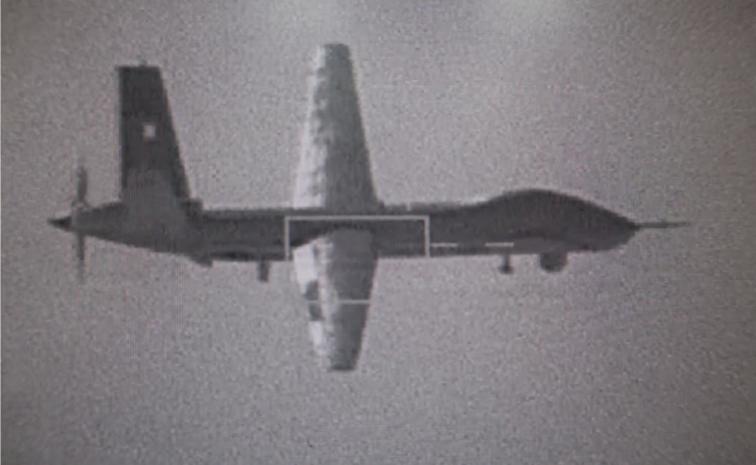
Taiwanese F-16V fighter jet monitors a Chinese CH-4 reconnaissance drone. (Photo provided by Taiwan’s Ministry of National Defence / Dajiyuan)
[People News] Trump is scheduled to visit Beijing at the end of March, and there is growing speculation about whether Taiwan will become a bargaining chip in the "big deal" between Trump and Xi Jinping. Amid the ongoing military operations by the US-Israel coalition against Iran, an unusual situation has arisen: the PLA aircraft, which used to make daily appearances, has been silent in the Taiwan Strait for three consecutive days. Why is that? Some have jokingly suggested that they might be "out of fuel"?
As reported by Liberty Times, the Ministry of National Defence of the Republic of China revealed in its reconnaissance report from February 28 to March 2 that the PLA dispatched only one balloon and a total of 14 warships on February 28 and March 1; on March 2, five warships were detected. No military aircraft were observed. However, on February 27, eight PLA aircraft were detected.
DPP Taoyuan City Councillor Yu Xinxian commented on Threads, noting, "Iran has just been hit hard by the US," so why is the CCP, which used to frequently harass Taiwan, suddenly so quiet? Are they genuinely so frightened that they don’t dare to come out?
Netizens have remarked, "The PLA has run out of cheap fuel," and "They are worried that Xi Baozi will become the next target, so they have moved all their aircraft back to Beijing to protect Baozi."
In reality, the actions of the US-Israel coalition not only serve as military deterrence but also effectively sever Beijing's economic lifeline. Many may not realise that approximately 90% of Iran's crude oil is exported to China. Additionally, with Trump having recently conducted a "cleanup" in Venezuela, these two oil-producing nations, which are aligned with Beijing, together account for 15% of China's oil imports.
In simple terms, Beijing has managed to keep its economy running in recent years largely thanks to these 'cheap oils.' Now that this 'dark supply chain' has been disrupted, it is only a matter of time before oil prices rise, and more critically, the stability of supply is in jeopardy. Some netizens have humorously remarked that the Chinese military aircraft are not circling Taiwan, perhaps indicating that they really need to 'conserve their resources.'
The most unexpected consequence for the international community is the shift in the situation across the Taiwan Strait. There were earlier concerns that Trump might use Taiwan as a bargaining chip in a 'big deal' with Beijing. Zhang Wuyue, director of the Cross-Strait Relations Research Centre at Tamkang University, informed the Central News Agency that with the recent actions of the U.S. military in Venezuela and the Middle East, this possibility is significantly diminishing. This serves as a demonstration to Xi Jinping ahead of the Xi-Trump meeting: the U.S. has the capability to remove Beijing's overseas assets at any moment.
He analysed that as the meeting between the U.S. and Chinese leaders draws near, both sides have internal issues to manage, making it unlikely to reach substantial agreements on economic, trade, and Taiwan issues all at once. Taiwan's sovereignty and status will not be altered as a result.
As 'decapitation' emerges as a new mode of warfare, and as cheap energy becomes a relic of the past, the unsettling feeling of 'chills down the spine' will likely linger with Beijing for a considerable time ahead.
△






News magazine bootstrap themes!
I like this themes, fast loading and look profesional
Thank you Carlos!
You're welcome!
Please support me with give positive rating!
Yes Sure!