
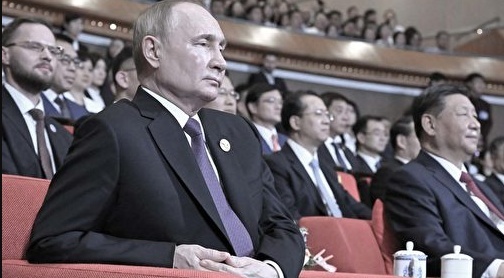
On the afternoon of May 16, 2024, Putin (front left) attended a concert in Beijing commemorating the 75th anniversary of China-Russia (Soviet) diplomatic relations. His gaze was unfocused on the performance, appearing deep in thought. Putin's body also leaned slightly away from Xi Jinping (front right, second from the right).
[People News] In public, Chinese Communist Party leader Xi Jinping and Russian President Vladimir Putin frequently refer to each other as 'old friends' and sometimes intentionally cultivate a political image of 'brotherly friendship.' However, in the realm of international politics, the relationships between countries are often driven more by interests than by emotions.
Recently, during Putin's visit to Beijing, a key issue that garnered significant attention was the final agreement on the 'Power of Siberia 2' natural gas pipeline, which is highly valued by Russia. This pipeline, which is planned to transport gas from the Yamal gas field in Russia through Mongolia to China, has an annual capacity of 50 billion cubic meters and is strategically important for Russia. Particularly after the onset of the Russia-Ukraine war, the demand for Russian natural gas in Europe has sharply declined, creating an urgent need for Moscow to secure new long-term export markets.
However, even with Putin's personal visit to China, Beijing did not grant Russia the final contract it sought. Many analysts believe that Beijing is currently employing a strategy of 'intentionally supporting, but not allowing it to become too comfortable' with Russia. This means that while Beijing does not want Russia to collapse—since that would mean losing a crucial strategic partner to counter the United States—it also does not wish for Russia to become overly powerful, instead aiming to maximise its own benefits when Russia is in critical need of assistance.
The Russia-Ukraine war has placed a significant strain on the Russian economy, and with the continuation of Western sanctions, Russia's reliance on the Chinese market, capital, and technology is growing. In this context, Beijing naturally possesses greater negotiating power.
One of the main hurdles preventing an agreement between the two sides is the negotiation over natural gas prices. It is widely believed that China aims to purchase natural gas at preferential rates significantly lower than international market prices, potentially even close to domestic prices in Russia. Moscow, while dissatisfied, finds itself lacking sufficient room for negotiation.
Despite both sides publicly declaring that they are 'old friends' and showcasing close interactions, the core of their international relations remains centred on interests. For instance, Russia continues to maintain strategic caution towards China, with a substantial number of missiles aimed at Chinese territory; additionally, Beijing has not fully met Russia's expectations regarding the 'Power of Siberia 2' project. There is also competition between the two in Central Asia, energy pricing, and military influence...
As a result, many scholars characterise the relationship between China and Russia as 'superficially cordial, but internally calculating,' or alternatively, as 'strategic partners, but not true allies.' This indicates that the term 'old friends' serves more as a diplomatic expression and political signal, rather than a complete absence of interest calculations.
In relation to China-Russia ties and Putin's visit to China in May, the German newspaper Die Tageszeitung published a commentary titled 'The Journey of a Beggar.' The article notes that Putin's initiation of the war in Ukraine and the subsequent economic sanctions have not increased Europe's dependence on Russian energy; instead, they have gradually pushed Russia into a deeper reliance on China.
The article highlights that to encourage China to make substantial purchases of Russian natural gas, Moscow has had to offer significant discounts. In turn, Beijing has taken full advantage of Russia's predicament during negotiations, consistently seeking more favourable terms. The article even likens Xi Jinping to someone 'squeezing a lemon' for maximum benefits from Russia, which, under mounting financial pressure, finds it hard to refuse.
The commentary notes that while Xi Jinping asserts that the China-Russia friendship is unbreakable, in reality, Putin has become ensnared by Xi Jinping's influence. Chinese cars, trucks, and buses have come to dominate the new car market in Russia, severely impacting the domestic automotive industry. The so-called 'deepening economic cooperation' touted by both nations is, in essence, superficial.
Beyond the energy sector, Russia is also looking for Chinese financial backing for infrastructure projects. Additionally, Russia's reliance on Chinese manufacturing for technology equipment, electronic components, and drones is on the rise. Reports indicate that 36% of Russia's imports now come from China, with Chinese automotive firms rapidly filling the void left by the exit of Western brands.
The commentary further emphasises that despite the ongoing declarations of 'unbreakable friendship' from both sides, the relationship is increasingly characterised by inequality: Russia is becoming more dependent on China, while China is securing a more advantageous position in energy, raw materials, and market access.
The article warns that if Beijing ceases to provide crucial support, Russia's capacity to continue the war will face significant challenges. Consequently, given Moscow's heavy dependence on China, Beijing will naturally seek corresponding returns, such as more favourable energy supply prices and increased economic benefits.
Additionally, the article notes that a growing number of Chinese individuals are moving into the sparsely populated Far East region of Russia. Chinese companies are recklessly logging the pristine forests of Siberia, ignoring the environmental consequences. Putin's expansionist ambitions are transforming the vast Russian Empire into a 'province of China,' compelling him to approach Beijing as a 'beggar.' His desire for hegemony ultimately leaves him in a position of weakness and powerlessness.
The commentary concludes that the Russia-Ukraine war has not only altered the relationship between Russia and Europe but has also reshaped the power dynamics between China and Russia. Once a competitor for influence with the Chinese Communist Party during the Cold War, Russia is now gradually tilting towards China, while Beijing is further enhancing its influence in global energy and raw material supply chains.
It is clear that although Xi Jinping and Putin often refer to each other as 'old friends,' when faced with real interests, this so-called friendship ultimately must yield to national interests and power calculations.
(Original publication by People News)△





News magazine bootstrap themes!
I like this themes, fast loading and look profesional
Thank you Carlos!
You're welcome!
Please support me with give positive rating!
Yes Sure!