
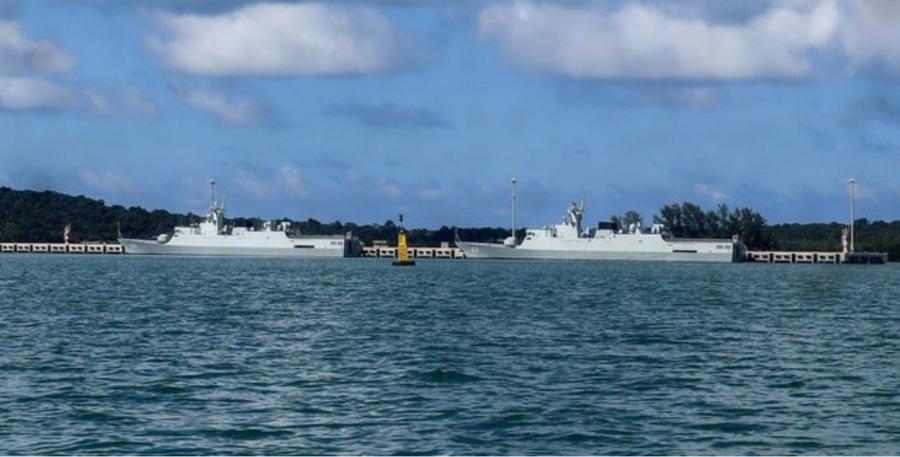
The image shows two Chinese Navy Type 056A missile frigates docked at Cambodia&9;s Ream Naval Base in August 2024. They are the Aba (hull number 630) and the Tianmen (hull number 631). (Radio Free Asia)
[People News] U.S. defense and intelligence officials warned at a congressional hearing on Monday (March 2) that the Chinese Communist Party (CCP) is rapidly expanding its undersea military power and seabed activities, aiming to erode America’s long-held advantages and threaten the global economic lifelines in which Taiwan plays a critical role.
According to Voice of America (VOA), the hearing, held by the U.S.–China Economic and Security Review Commission (USCC), was titled “Part of Your World: U.S.-China Competition Under the Sea.” It focused on submarine forces, seabed sensors, undersea fiber-optic cables, and critical minerals.
Commission Chairman Randall Schriver warned in his opening statement that since World War II, the U.S. Navy has safeguarded global commerce, deterred conflict, and protected maritime commons—but this system is now being challenged by the CCP.
He pointed to China’s administrative expansion in the South China Sea, militarization of artificial islands, and accelerated deployment of submarines, seabed sensors, unmanned underwater vehicles (UUVs), and ocean-mapping technologies.
“The United States still holds significant advantages in the undersea domain, but without sustained investment, those advantages will erode,” Schriver said.
Kuiken: Taiwan Has Become the “Island at the Center of the World”
USCC Vice Chairman Michael Kuiken emphasized that Taiwan lies at the heart of undersea competition because it controls the world’s most critical semiconductor industry.
Using the hearing’s lighting, microphones, and cameras as examples, Kuiken illustrated Taiwan’s semiconductor importance. “They all rely on foundational semiconductor chips, which are almost certainly produced in Taiwan. Whether basic or advanced, these chips are the lifeblood of nearly everything around us.”
He noted that CCP leader Xi Jinping has ordered the Chinese military to be capable of taking Taiwan by 2027. “Look at the calendar—there are only nine months left,” Kuiken said.
He warned that if Beijing takes action, early warning signs could emerge from space, cyberspace, and undersea domains—including threats to Taiwan’s and regional undersea cables.
There are nearly 600 undersea cables worldwide, carrying 99% of intercontinental data traffic and facilitating over $10 trillion in financial transactions daily.
“Any disruption to these cables is not just a communications outage—it is a direct threat to the global economic circulatory system,” Kuiken said.
He also warned that the CCP is accelerating deep-sea mining efforts to control critical mineral supply chains—an emerging battleground in future economic and strategic competition.
Submarine Commander: China Building an “Underwater Great Wall”
Vice Admiral Richard Seif, commander of U.S. submarine forces, said that while the U.S. has maintained significant undersea superiority for decades, the CCP is now trying to close the gap at unprecedented speed and scale.
He warned that China is not only rapidly building ships but also developing a comprehensive anti-submarine warfare (ASW) system, including:
-
New-generation nuclear and conventional submarines
-
Maritime patrol aircraft, helicopters, and towed sonar systems
-
Fixed and mobile seabed sensor networks
-
Swarms of unmanned underwater vehicles
These systems are often referred to in open sources as China’s “Underwater Great Wall.” Seif said the likely result “will not make the ocean transparent, but it will compress the maneuver space of U.S. submarines—especially near strategic chokepoints and vital sea lanes during crises and conflicts.”
He noted that China’s next-generation Shang III-class and Type 095 nuclear-powered guided-missile submarines (SSGNs) feature improved stealth and the ability to launch large-scale land attacks from concealed underwater positions, significantly increasing operational risks for U.S. forces.
Seif urged urgent U.S. action: enhance submarine readiness and industrial supply chains; deploy resilient undersea detection and counter-detection systems; expand large-scale deployment of UUVs; increase stockpiles of critical undersea weapons and payloads; and deepen intelligence-sharing and training cooperation with allies.
As U.S.–China competition intensifies, he stressed, America must preserve its ability to operate freely undersea in the Indo-Pacific.
Naval Intelligence Director: CCP Building a Systematic “Undersea Combat Network”
Rear Admiral Mike Brookes, Director of Naval Intelligence and head of the National Maritime Intelligence Integration Office, provided a broader intelligence assessment.
“China views undersea warfare as a critical enabler across the full spectrum of naval operations,” Brookes said. He explained that Beijing is moving beyond traditional “platform-versus-platform” combat and instead prioritizing networked, multi-domain anti-submarine systems.
He testified that the People’s Liberation Army (PLA) is integrating airborne, surface, seabed, and underwater sensors into a multi-domain ASW network designed to control key maritime zones and force adversary submarines to withdraw.
Brookes noted:
-
China operates more than 60 submarines, including nuclear attack submarines, nuclear cruise missile submarines, ballistic missile submarines, and over 50 diesel-electric submarines
-
Since 2010, China has significantly expanded three major shipyards, doubling submarine production capacity
-
It is transitioning toward an all-nuclear submarine fleet, including smaller, low-power, regional patrol nuclear subs
-
It plans to expand its submarine fleet to about 70 by 2027 and 80 by 2035
-
Future deployments may extend to the Indian Ocean, Arctic, and potentially the Atlantic
On unmanned systems, Brookes said China has developed multiple types of UUVs, including:
-
Deep-sea gliders for hydrographic and acoustic intelligence
-
Ultra-large unmanned underwater vehicles (ULUVs)
-
Modular UUV systems capable of carrying mines, torpedoes, or missiles and operating in coordinated swarms
Regarding seabed surveillance, he cited China’s “Blue Ocean Information Network,” a multi-layered system integrating fixed sensors, buoys, satellite links, and UUVs to monitor critical waters such as the South China Sea.
Deep-Sea Mining: Merging Economic Strategy and Military Intelligence
Brookes emphasized that China has elevated deep-sea mining to a national strategy and holds the largest number of exploration licenses from the International Seabed Authority (ISA).
Deep-sea deposits contain nickel, cobalt, copper, and rare earth elements—critical for electric vehicle batteries, semiconductors, and defense systems.
“China already dominates terrestrial critical mineral supply chains through mining, processing, and downstream manufacturing,” Brookes said. “Extending that dominance to seabed resources would further consolidate strategic leverage and create dependency risks for countries pursuing energy transitions and defense production.”
He also pointed out that China has secured bilateral agreements with Pacific island nations such as the Cook Islands and Kiribati to conduct mining trials within their 200-nautical-mile exclusive economic zones—potentially bypassing international oversight while expanding Beijing’s influence.
Brookes warned that seabed mapping, terrain analysis, and acoustic surveys conducted under the guise of mining could provide crucial data for submarine warfare and undersea military deployments.
U.S. Military: Superiority Must Be Sustained Through Investment and Innovation
Both Seif and Brookes emphasized that the CCP’s undersea ambitions represent a systematic, well-funded strategic project posing military, economic, and technological challenges to the United States.
They jointly urged:
-
Expanding submarine readiness and fleet size
-
Building more resilient undersea detection systems
-
Deploying large-scale unmanned undersea combat systems
-
Ensuring sufficient stockpiles of undersea munitions and payloads
-
Strengthening intelligence-sharing and joint operations with Indo-Pacific allies
-
Maintaining forward presence without escalating tensions
Seif concluded: “America’s undersea advantage has never been guaranteed—it has always been earned.”
He added that with sustained investment and innovation, the United States can ensure the Indo-Pacific remains free and open for generations to come. △






News magazine bootstrap themes!
I like this themes, fast loading and look profesional
Thank you Carlos!
You're welcome!
Please support me with give positive rating!
Yes Sure!