
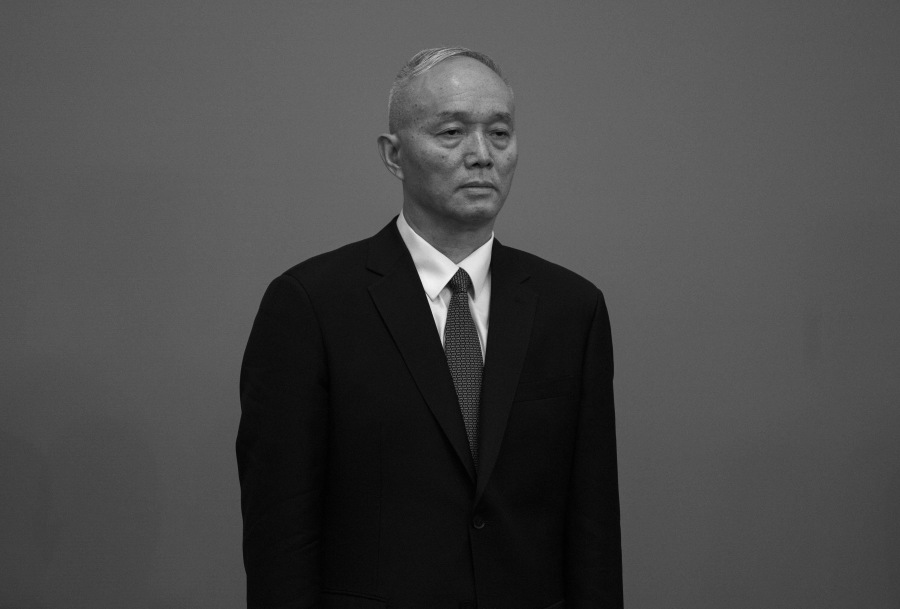
On October 23, 2022, Politburo Standing Committee member Cai Qi attends a press conference at the Great Hall of the People with other newly appointed Standing Committee members and both domestic and international journalists. (Photo by Kevin Frayer/Getty Images)
[People News] The CCP’s Central Leading Group for Party Building recently convened a meeting to deploy what it calls a Party-wide campaign on “establishing and practicing a correct view of political achievements.” The meeting was chaired by Cai Qi, with Li Xi in attendance. According to insiders, the deliberate arrangement of this meeting itself constituted a concentrated political warning to officialdom—demanding that cadres clearly take sides.
According to a February 24 report by state media outlet Xinhua, the Party Building Leading Group meeting held in Beijing that day centered on the issue of “political achievements.” In substance, however, it directly targeted political stance. The communiqué proposed “integrating study, investigation, and rectification,” requiring the establishment of mechanisms to correct deviations in political performance, and explicitly embedding these requirements into the entire process of leadership reshuffles at the provincial, municipal, county, and township levels. This signals that cadre promotion is now directly tied to political attitude, with evaluation standards tilting toward political loyalty.
An insider identified as Tian Guangyao (pseudonym) told The Dajiyuan that although the meeting outwardly focused on “political achievements,” it was in fact demanding that senior officials clarify their political positions and publicly align themselves.
“Strictly speaking, this was Cai Qi issuing a political warning to the Party’s upper ranks and conducting a ‘political lineup,’” Tian said. “The so-called ‘integrated study, investigation, and rectification’ means: ‘study’ equals strengthening political identification and obeying Xi Jinping’s command; ‘investigation’ means digging deeply into violations of the ‘Eight-Point Regulations’; and ‘rectification’ targets so-called ‘prominent problems,’ namely anti–high-level rhetoric, which will be subject to pinpoint crackdowns.”
“Political Achievements” as a Signal to Take Sides
Tian Guangyao said that this round of “political achievements” education essentially continues the logic of internal Party rectification launched before the 20th Party Congress, clearing obstacles ahead of next year’s 21st Party Congress.
“In the final analysis, raising the issue of political achievements is about taking sides,” he said. “We’ve noticed that the Party Building Leading Group personally deployed this effort, which is equivalent to redrawing internal lines within the cadre system—who is on the core track and who is at the margins.”
The Xinhua communiqué repeatedly emphasized slogans such as “building the Party for the public,” “benefiting the people,” “scientific decision-making,” and “practical implementation.” It called for overall coordination by the Party Building Leading Group, tightening Party committee responsibilities, and strengthening supervision and propaganda. The language was highly politicized, with the core focus not on governance performance but on ideological unity.
A Europe-based scholar identified as Mr. Chen said that when the CCP places political evaluation above economic assessment, correcting so-called “deviations in political achievements” essentially becomes a process of screening and reorganizing officials through the Party apparatus, further binding their career paths to the power center.
“In a system where power is highly concentrated in Xi Jinping alone, this kind of rectification actually reveals unease,” Chen said. “If there were full confidence in his reappointment and authority, there would be no need for such intensive recalibration of the cadre ranks. This shows that his authority is being repeatedly reaffirmed, rather than taken for granted.”
Frequent Rectification Reflects Anxiety Over Power Security
The high-level nature of this meeting is relatively rare among this year’s top-level gatherings. According to state media, those in attendance included two members of the Politburo Standing Committee and three vice–state-level officials.
Shi Taifeng and Li Shulei are Politburo members and Secretariat members, positioned within the Party’s power core. Mu Hong serves as Vice Chairman of the 14th National Committee of the Chinese People’s Political Consultative Conference. Under the current Party-state hierarchy, vice–state-level officials rank among national leaders, just below Standing Committee members and top state leaders. Such a high-level lineup suggests the meeting was not routine administrative work but a deliberate political signal to the senior officialdom under the banner of Party building.
Chen noted that Cai Qi has long overseen Party building and ideological affairs. His chairing of the meeting is widely viewed as the core of Xi’s power structure further tightening control over officialdom through Party channels. Li Xi’s presence in his capacity as head of the Central Commission for Discipline Inspection is interpreted as a signal that the disciplinary system stands ready to intervene.
“Li Xi’s presence alone is a warning,” Chen said. “‘Wrong direction’ can at any time be defined as a disciplinary violation. Issues of competence can be elevated into political problems. Cai Qi handles Party building; Li Xi handles discipline and casework. Their joint appearance carries far more deterrent meaning than procedural significance.”
In recent years, local government finances have deteriorated, hidden debt risks have expanded, and grassroots fiscal systems are nearing imbalance. Meanwhile, companies such as Apple have accelerated the relocation of key production capacity to India. Against a backdrop of economic slowdown and industrial chain shifts, the top leadership has chosen to intensify internal Party rectification under the banner of “political achievements,” rather than directly address economic challenges.
Interviewees said this shows that the current priority is not governance capacity, but power security.
“In a system of highly centralized authority under Xi, frequent rectification of officials through Party-building channels reflects anxiety, not stability,” Chen said. “If authority were unshakeable, there would be no need to repeatedly use rectification to confirm loyalty. The constant emphasis on ‘direction’ and ‘taking sides’ suggests a lack of security about internal unity.”
He added that such political recalibration typically occurs during periods when the power structure shows signs of loosening, rather than during phases of strong consolidation.
(Reprinted from The Dajiyuan, original title: “Inside Story: CCP Uses Party Building to Rectify Officialdom, Demands Officials Take Sides.”)






News magazine bootstrap themes!
I like this themes, fast loading and look profesional
Thank you Carlos!
You're welcome!
Please support me with give positive rating!
Yes Sure!