

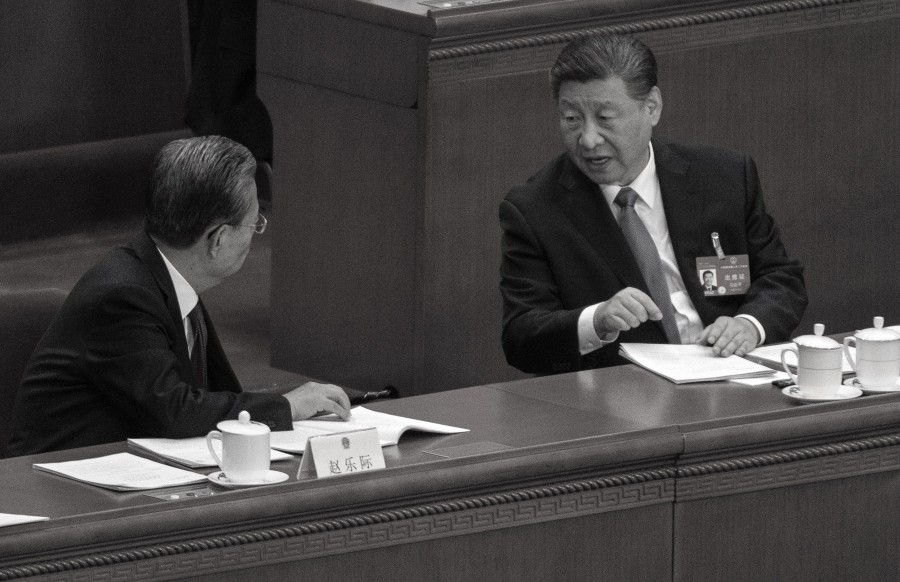
Cai Qi, a member of the Politburo Standing Committee of the Chinese Communist Party, attending the National People's Congress on March 12, 2023. (Screenshot from the web)
[People News] After the official announcement that Zhang Youxia and Liu Zhenli were under investigation, Beijing has fallen into an unprecedented political melee. A series of public appearances by the CCP leader and senior officials before the Lunar New Year, though seemingly routine, have failed to dispel the severe internal divisions. Xi Jinping could only extend New Year greetings to the military via video link, underscoring his continued unease. As for how Zhongnanhai will clean up the mess, there may well be no solution.
Xi’s Video Visit to the Military Resembles Pandemic-Era Precautions
On February 14, members of the Politburo Standing Committee attended the customary pre–New Year gathering. CCTV footage showed them forcing smiles upon entering, but once seated, their expressions turned solemn. Other officials present exchanged uneasy glances; there was no festive atmosphere.
Xi Jinping attempted to summarize the past year’s achievements, but merely repeated stock phrases without any highlights. When looking ahead to 2026, he read from a script about “galloping forward,” yet appeared lifeless.
On February 13, Xinhua reported that Xi and others visited or entrusted representatives to visit retired senior CCP officials, listing a long roster and claiming they all supported the so-called “core of Xi.” In reality, Xi likely did not dare meet party elders directly at this time.
According to Xinhua, on February 10 Xi held video calls with nine military units from the Bayi Building.
The last time Xi used video to greet the military before the Lunar New Year was January 18, 2023. At that time, COVID infections were peaking, crematoriums were overwhelmed, and top CCP leaders were still isolating themselves. Xi avoided direct visits and instead relied on video appearances.
In early 2024, Xi visited Tianjin and met with troops, accompanied by He Weidong. The report was delayed by two days. Thereafter, media routinely delayed reporting Xi’s military inspections, suggesting heightened concern over revealing his whereabouts. Xi has also insisted on traveling by special train rather than plane, reportedly out of fear of military air defense threats.
In early 2025, Xi inspected the Northern Theater Command and spoke with grassroots officers by video, accompanied by Zhang Youxia. Soon after, Zhang conducted his own inspections.
Following the apparent purge of Xi’s military allies, Xi suddenly moved against Zhang Youxia and Liu Zhenli at the start of 2026—seemingly an attempt to regain control. Yet for the February 10 holiday greeting, Xi again relied solely on video, reverting to the pandemic model. On February 11, Zhang Shengmin alone visited Beijing-based troops.
After taking action against Zhang and Liu, Xi may now fear backlash within the military and thus avoid in-person inspections. This suggests that while he seeks to reclaim military authority, he lacks confidence—and may be even more anxious than before.
Although Xi said he was greeting troops “on behalf of the Party Central Committee and the Central Military Commission,” he notably avoided mentioning the “Chairman responsibility system,” nor did he explicitly demand obedience to the Party Central Committee or CMC.
Unable to Leave Beijing — Or Afraid To?
From February 9 to 10, Xi conducted inspections within Beijing. Observers speculate that amid sensitive political tensions, he dares not leave the capital—fearing either a coup in his absence or threats to his personal safety.
His sudden move against Zhang and Liu broke longstanding internal norms and intensified divisions. He likely fears retaliation. If internal factions remain locked in confrontation, Xi would naturally hesitate to travel.
Alternatively, if his movements are being restricted rather than voluntarily limited, it may suggest that his gamble failed. Instead of consolidating power, his action may have provoked widespread criticism and left him isolated—perhaps forcing him to retreat.
While Xi was accompanied by Cai Qi and He Lifeng, and Beijing Party Secretary Yin Li gave a concluding report, Xi’s remarks lacked the confidence of someone firmly in control. Xinhua’s account omitted emphatic references to the “Party Central Committee.”
If Xi had regained the upper hand, he would likely have stressed centralized authority and demanded loyalty pledges. The absence of such rhetoric suggests otherwise.
Notably, while Xi remained in Beijing, Premier Li Qiang traveled to Jiangxi for inspections, highlighting a striking contrast. There is little sign that Xi will truly “gallop forward” in 2026.
Cai Qi’s Frequent Appearances — Damage Control?
After the Zhang and Liu affair, rumors pointed to Cai Qi as the key orchestrator. Some claimed Zhang leaked nuclear secrets to the U.S.—a charge widely seen as implausible and perhaps manufactured as justification.
As vice chairman of the National Security Commission, Cai could theoretically frame the arrests as national security measures. Yet insiders reportedly say party elders and “princelings” are unconvinced and have demanded explanations—possibly even calling for Cai to take responsibility.
Cai has appeared publicly numerous times since late January, repeatedly emphasizing loyalty to Xi and the “Two Upholds.” His increased exposure may be an attempt to dispel rumors or project stability.
However, such visibility may also betray insecurity.
Military Media in Disarray
After Zhang and Liu’s removal, PLA Daily coverage has seemed inconsistent—sometimes emphasizing anti-corruption, other times softening political characterizations. The initial harsh editorial language describing “severe political violations” has largely disappeared from subsequent articles.
On February 9, PLA Daily ran an article stressing that “to govern those below, one must first govern those above,” insisting discipline must be stricter “the higher up one goes.”
Given that the CMC now effectively consists of Xi and Zhang Shengmin, the repeated emphasis on “governing the top” carries implicit meaning.
What Is the State of the Military?
In early February, several former defense industry officials were stripped of positions. Yet the handling of Zhang and Liu remains unresolved.
At a February 6 military gala performance, Xi appeared smiling conspicuously, perhaps overly so. Observers noted the atmosphere felt tense and awkward rather than celebratory.
Recent revisions to internal military disciplinary regulations suggest ongoing turbulence.
After Xi’s move against Zhang and Liu, he has not convincingly demonstrated restored authority. Instead, his reliance on video appearances and careful staging suggests caution—or retreat.
The PLA appears unconvinced by the sweeping political accusations, and overt displays of loyalty are limited. Xi and Cai’s repeated appearances resemble efforts at self-encouragement more than confident leadership.
Beijing’s political infighting likely continues behind closed doors. Senior officials appear anxious, with little festive spirit. The Year of the Horse may bring intensified internal strife for the CCP.
— The Dajiyuan △





News magazine bootstrap themes!
I like this themes, fast loading and look profesional
Thank you Carlos!
You're welcome!
Please support me with give positive rating!
Yes Sure!