

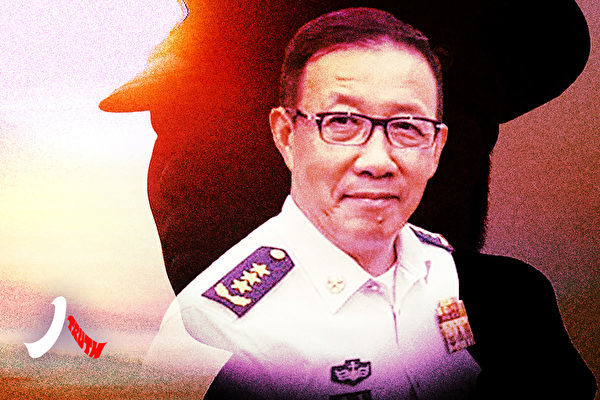
Zhang Youxia, Vice Chairman of the Central Military Commission of the Communist Party of China, remarked that Xi&9;s faction has been entirely apprehended. (Video screenshot)
[People News] The arrests of Zhang Youxia and Liu Zhenli were sudden and swift, deviating from the typical practices of the Chinese Communist Party (CCP) when targeting high-profile figures, which usually involves first cutting off their support. Prior to their arrests, there were no visible signs, such as the continuous detention of their trusted secretaries, former subordinates, or associates. Just before Zhang and Liu were taken down, the CCP had apprehended He Weidong, Miao Hua, and several generals, leading many to believe that the high-ranking military officials would remain stable for some time. However, unexpectedly, Zhang Youxia and Liu Zhenli were announced to be under investigation.
Rumours suggest that the CCP has been secretly plotting to take down Zhang and Liu for three years, with everything being arranged behind the scenes. Typically, when high-ranking CCP officials are removed, it can take up to a year for the news to be officially announced. Yet, within a week of Zhang and Liu's downfall, the CCP was eager to make an official announcement. The language used in the accusations was quite severe, indicating that it was a decision made by the Central Committee rather than a law enforcement agency. These previously undisclosed allegations resembled the circulating rumours about party division and coup attempts, implying they could face severe penalties.
These unusual aspects break the CCP's norms. Even more striking is that it has been five days since the official announcement of their downfall, yet state media remains silent, and high-ranking officials are still quiet. The Ministry of Defence's website, which announced that 'Zhang Youxia and Liu Zhenli are under investigation,' has only reprinted an editorial from the military newspaper and has not provided any further updates to date.
Military media have only published two articles concerning the arrests of Zhang and Liu. The first is an editorial in the 'People's Liberation Army Daily' dated the 24th, which claims that Zhang and Liu are implicated in 'five serious matters,' with the most critical being the 'serious violation of the responsibility system of the Chairman of the Military Commission.' The following day, a lengthy article titled 'Forever Sounding the Charge' was released, recounting how Mao Zedong ordered the execution of high-ranking officials accused of corruption, referred to as 'Red Little Devils,' at the onset of the Communist Party's rule. This story was intended to intimidate Zhang Youxia and all discontented high-ranking officials within the party and state, emphasising that 'status does not grant immunity, and merit is not a get-out-of-jail-free card.' Subsequently, both parties and military media ceased to comment further. A comprehensive review of the first to twelfth pages of the military newspaper reveals only routine reports, with no articles specifically addressing or hinting at how Zhang and Liu have severely undermined the political environment of the entire military.
On January 27, the headline on the Ministry of National Defence's website featured an unexpected letter from Xi Jinping to an old soldier from Zimbabwe, which seemed quite out of place as it expressed concern for foreign veterans. The rest of the news consisted of trivial diplomatic activities, such as phone calls and book publishing seminars, creating a somewhat cheerful atmosphere that obscured any signs of tension or shocking events within the People's Liberation Army. Such information is even harder to find in party media. It seems that the Communist Party is intentionally trying to downplay the internal strife related to the arrests of Zhang and Liu.
Historically, when prominent figures such as Zhou Yongkang, Bo Xilai, Su Rong, Ling Jihua, Guo Boxiong, Xu Caihou, Sun Zhengcai, He Weidong, and Miao Hua were ousted, the Communist Party of China (CPC) would rally various factions to publicly express their support and align with the Party Central Committee. In contrast, the recent cases of Zhang Youxia and Liu Zhenli have not seen a similar surge of 'support.' This raises the question: Is the Party Central Committee, under Xi Jinping's leadership, reluctant to escalate the situation? Are they trying to minimise external scrutiny, hoping that time will allow people to forget? Or is it that the severity of the situation means Zhang and Liu still possess the power to retaliate, with the conflict between Xi and Zhang continuing behind the scenes, leaving the outcome unresolved? Or could there be other factors at play? What were the actual reasons behind Zhang and Liu's downfall? Disloyalty, a lack of alignment with Xi's CPC, and corruption are certainly involved. The Wall Street Journal, citing informed sources, reported that Zhang Youxia allegedly leaked nuclear secrets to the United States. However, many analysts suspect this could be a manoeuvre orchestrated by the CPC.
Niu Ben, a researcher on Chinese politics at the Asia Society, raised questions on the X platform, asking, 'How could Zhang Youxia accomplish this? He would need to obtain secrets from the nuclear industry group and then relay them to agents. However, his communications are under surveillance, and he rarely meets anyone alone.' Officials among the current senior U.S. politicians who have visited Beijing and met with Zhang Youxia also noted that several CPC military personnel were present during the meeting, and Zhang Youxia did not mention nuclear weapons at all.
Another analysis indicates that there are disagreements between Zhang Liu and Xi Jinping regarding military aggression towards Taiwan, which has caused Xi to become angry. Some believe that Zhang and Liu do not support Xi's re-election at the 21st National Congress, and the forthright military figures Zhang and Liu have always held a degree of disrespect for Xi, who has never engaged in actual combat. Following He Weidong's downfall, Zhang's power has further consolidated and expanded, leading to Xi's dissatisfaction as he seeks to remove obstacles to his re-election. It now seems that the reasons behind Zhang and Liu's downfall are of secondary importance; rather, the subsequent reactions from various factions and the trajectory of the Chinese Communist Party (CCP) are what warrant attention. Numerous strange and abnormal occurrences continue to surface, suggesting that Xi's CCP has not yet managed to stabilise the repercussions of the incident, and various forces remain unsettled. Many officials from different countries are still in shock and panic, and the backlash from Zhang and Liu is still unfolding, indicating that the conflict between Xi and Zhang is far from over. In this context, excessively dramatising this event could have repercussions for Xi's governance of the CCP. Conversely, if one day the CCP openly criticises Zhang and Liu and calls for all parties to eliminate the residual effects, it would signify that Xi's CCP has achieved a decisive victory.
(People News first published)
△






News magazine bootstrap themes!
I like this themes, fast loading and look profesional
Thank you Carlos!
You're welcome!
Please support me with give positive rating!
Yes Sure!