

Zhang Youxia Arrested — Chaos in the PLA Is the Result of Jiang Zemin’s Corrupt Way of Running the Military
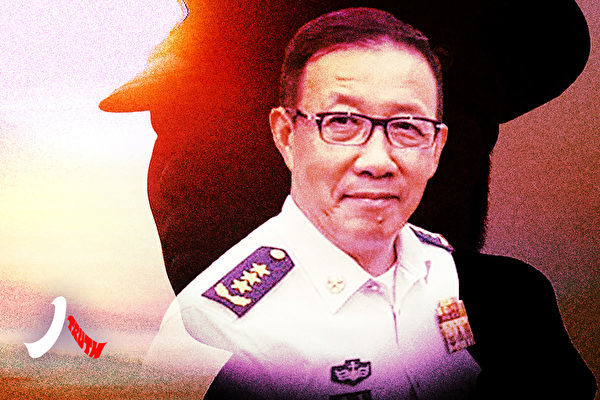
[People News] Since taking office, current Party leader Xi Jinping has brought down four vice chairmen of the Central Military Commission. Among them, Guo Boxiong and Xu Caihou were protégés of Jiang Zemin, while He Weidong and Zhang Youxia were his own confidants. In order to weaken the authority of then–General Secretary and CMC Chairman Hu Jintao, Jiang Zemin planted Guo Boxiong and Xu Caihou beside Hu to eavesdrop and monitor him, serving as Jiang’s eyes and ears while he ruled from behind the scenes. Because of this, a vicious culture of mutual distrust, mutual wariness, scheming against one another, and undermining each other took root inside the PLA.
It is circulating online that the downfall of He Weidong and Miao Hua occurred because Zhang Youxia monitored their private expressions of dissatisfaction toward Xi, and combined with economic issues, pressured Xi to remove them. Although Xi removed them, he was displeased that Zhang struck at his own confidants, cutting off the “skirt hem.” Figures from the Jiang faction then took advantage of the situation to whisper in Xi’s ear, sowing discord among Xi’s trusted circle, causing the PLA to lose face by repeatedly removing Xi’s own people.
The economic issues involved here are also lingering consequences of Jiang Zemin’s method of using corruption to run the military.
Corruption in the PLA is world-famous. The “military tigers” brought down involve sums in the billions. Even arms funds and military-industrial projects could be pocketed privately. As a result, anyone wanting to attack a political rival only needed to convince “Xi the supreme one,” and it would hit the mark every time. Why has PLA corruption been so unrestrained that after a wave of generals fell, Zhang Youxia and Liu Zhenli were arrested in such a short time, shocking the world into realizing that the seemingly powerful PLA is actually a chaotic rabble?
Jiang Zemin and his cronies were skilled in “thick black studies” (the art of manipulation), famous for “governing the country, the military, and the Party through corruption.” He understood deeply that morally fallen people are easier to control. Therefore, he encouraged capitalists to join the Party and to “get rich quietly,” with the starting price for buying an official position set at 30 million yuan. His protégés Guo Boxiong and Xu Caihou openly priced military promotions — “a million for a division commander,” “ten million for an army commander,” and so on. When those at the top are crooked, those below follow suit. Lower officials learned Jiang Zemin’s corruption and debauchery.
After Chongqing figures Bo Xilai, Gu Kailai, and Wang Lijun were arrested, Xia Deliang, Party secretary of Chongqing’s Nan’an District, confessed after his own arrest that in order to be promoted to vice mayor, he gave Gu Kailai 30 million yuan. Preliminary investigations showed that in the two years before Bo Xilai’s arrest, Bo, through his wife Gu Kailai, collected 1 billion yuan in bribes from official promotions in Chongqing. Japanese media outlet Asahi Shimbun once reported that CCP investigations confirmed Bo and his wife had transferred 6 billion U.S. dollars in illicit income overseas.
Jiang Zemin once told an American journalist in an interview: “When I was young, I believed communism would arrive soon. Now I don’t believe it anymore.” The communism Jiang spoke of was the deceptive “distribution according to need” earthly paradise. He did not believe in communism, but that does not mean he rejected it. On the contrary, every cell of his body was filled with communist evil, longing for the wanton life of communal ownership of everything, including women.
Where there is corruption, there is inevitably debauchery. Under the atheist, dictatorial CCP system, groups lacking traditional values cannot restrain themselves with morality and culture. Once they gain power, fame, money, and status, they inevitably indulge in lust. Debauchery in turn drives more corruption, risking everything for power, money, and status, creating a vicious cycle without regard for morality, shame, or law. Jiang Zemin publicly flaunted his four “iron mistresses” (Huang, Chen, Li, Song) without shame, and consorted with young singers of his grandchildren’s generation without embarrassment.
Under Jiang Zemin’s leadership, the military experienced unprecedented corruption. Some soldiers participated in prostitution, gambling, and drugs. Units profited from the “sex industry.” Within the General Staff, General Logistics, and General Political Departments, sexual indulgence was rampant. As early as 1995, one subordinate unit of the Third Department of the General Staff had 15 entertainment venues and hired 476 “six-companion” women outside official staffing quotas. The military maintained clubs, guesthouses, sanatoriums, and resorts of various levels, all racing to provide high officials with places for indulgence and pleasure.
On November 1, 2001, the State Council and the Central Military Commission suddenly issued a notice to “immediately seal and shut down military and police clubs,” forming a leading group to oversee it. Former Premier Zhu Rongji served as head, with Chi Haotian, Fu Quanyou, Zhou Ziyu, and Yu Yongbo as deputies. On November 2, the Ministry of National Defense and General Staff also issued a notice to strictly implement the central directive and rectify clubs, guesthouses, and resorts. Most of the venues ordered closed had been built after Jiang Zemin became CMC Chairman in the early 1990s, peaking around 1997. These pleasure venues were divided into three tiers: special-grade, high-grade, and sub-high-grade. There were about eight special-grade ones nationwide, offering service 24 hours a day year-round; over 30 high-grade ones were “fully booked” every day of the year.
Access to these venues and the level of treatment depended on the type of credential held. Holders of permanent membership cards could eat, drink, and play by signature only, without paying. Special- and high-grade venues were equipped with medical clinics staffed by experienced military doctors, emergency equipment, and ambulances. Special-grade clubs even had “Zhi-9” helicopters for emergency rescue.
As those above set the example, those below followed. Many local military units and bases also set up clubs so that officials could indulge during holidays. The facilities were luxurious. Staff such as “service attendants,” “assistants,” and “care workers” were all unmarried young women, selected after “political vetting” from military cultural troupes, medical schools, and local Party and government offices, then trained in culture, arts, etiquette, and social skills.
These places frequently saw young women commit suicide after being raped.
For the sake of debauchery and money, to maintain power and win support from subordinates, and to consolidate his position in the military, Jiang Zemin promoted wave after wave of generals who pledged loyalty to him, reshuffling the armed forces.
It was also heaven’s opportunity for Xi Jinping that just as he was about to take power, the Chongqing incident occurred. He seized the moment to arrest Bo and bring down Zhou Yongkang to establish authority. The corruption Jiang Zemin built provided him with the pretext to seize power. Therefore, later military “tigers” such as Fang Fenghui and Zhang Yang fell smoothly.
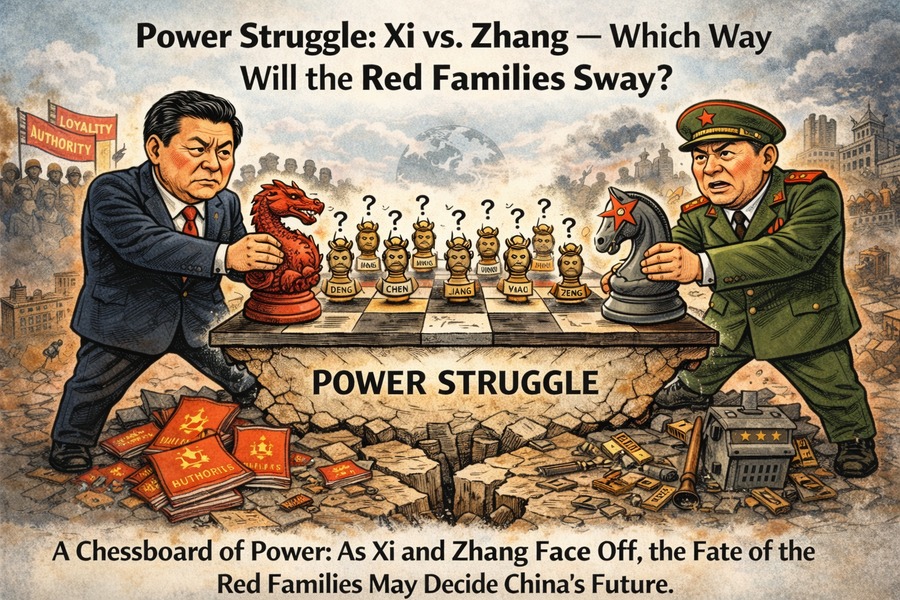
Of course, Jiang faction figures like Zeng Qinghong, Luo Gan, Zhang Dejiang, and Zhang Gaoli were unwilling to accept this. So they traded their support for Xi’s centralization of power and reappointment in exchange for their own safety. This was merely a conspiracy. In the process, they understood that the more chaotic the CCP became under Xi, the safer they would be, the easier it would be to place their own people, and perhaps one day they could even send Xi to Qincheng Prison. Thus, claims that Rocket Force weapons had problems, that the Equipment Department was corrupt, or that certain commanders leaked military intelligence are all true — they are corruption habits and culture left from the Jiang era, impossible to eradicate. Xi has had no choice but to keep arresting his own confidants, continuing to this day — first Miao Hua and He Weidong, then Zhang Youxia and Liu Zhenli.
The gun, strong in limbs, ultimately cannot outfight the pen, strong in mind. However, Xi Jinping believes that anti-corruption, tiger-hunting, and internal struggles are purely Party matters, fully controllable, and not harmful to the Party’s rule. It can be said that the collapse of the CCP is the inevitable result of Jiang Zemin’s corruption and evil, which stand opposed to human justice, selflessness, and kindness.
(People News original release) △






News magazine bootstrap themes!
I like this themes, fast loading and look profesional
Thank you Carlos!
You're welcome!
Please support me with give positive rating!
Yes Sure!